- 20
- Mar
- 2026

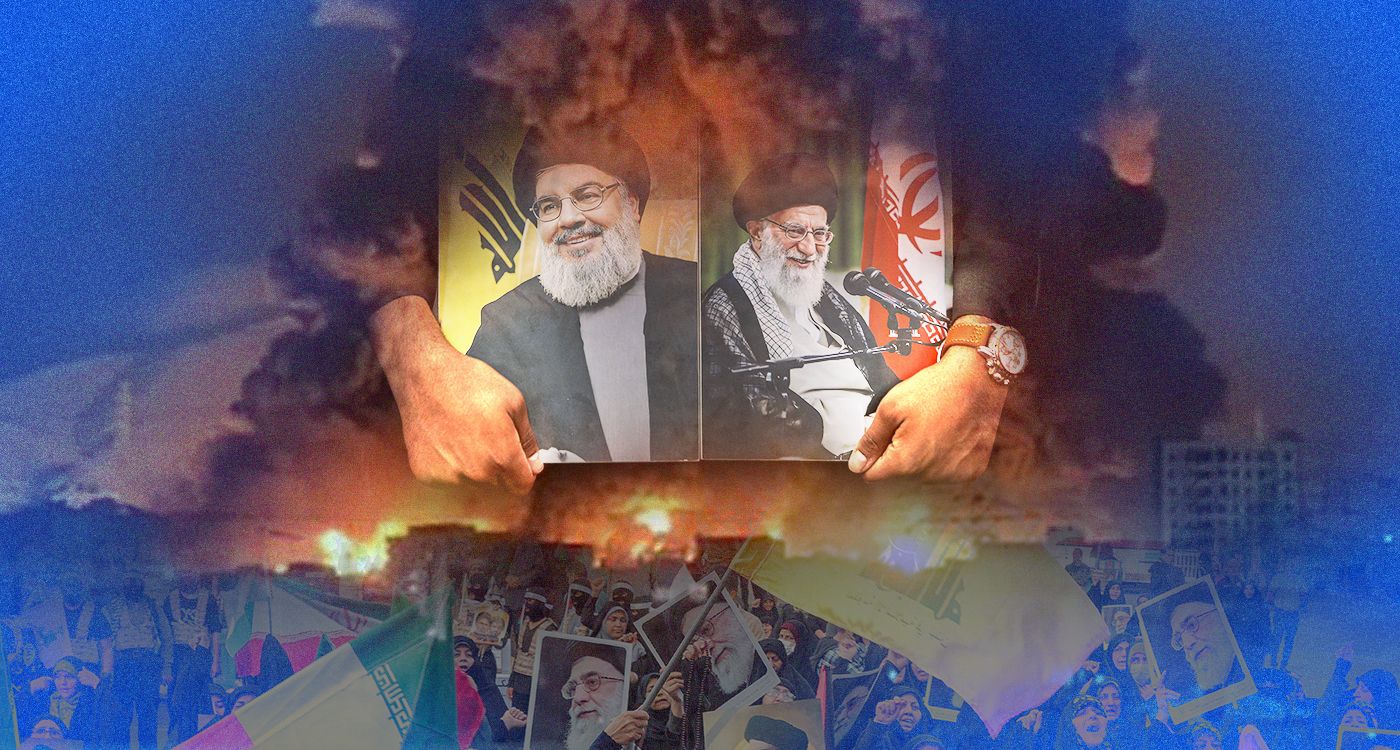
Unlike the June 2025 conflict, the current U.S.-Israeli military campaign against the Iranian regime is poised to reshape the region, with significant consequences for Tehran’s proxies, foremost among them Hezbollah. The fates of Iran and Hezbollah have become defining questions of the regional war.
Hezbollah did not hesitate to open a front from Lebanon in retaliation for the assassination of Iranian Supreme Leader Ayatollah Ali Khamenei. Hezbollah’s move reflected its strategic commitment to the Iranian regime, while reaffirming the group’s deeply rooted ties to Tehran and their shared trajectory.
For its part, Israel is as concerned with Hezbollah’s fate as it is with the future of the regime in Iran. It recognizes that curbing Tehran’s regional influence cannot be achieved without weakening one of its most prominent military arms, Hezbollah, as previous conflicts have shown.
Yet at the same time, Israel understands that eliminating Hezbollah, or even dismantling its military and financial infrastructure as well as its influence within Lebanon, is unlikely as long as the clerical regime in Iran remains in power. Israel also appears to have secured a U.S. greenlight to tackle Hezbollah independently of the broader course of the military campaign against Iran, whose trajectory hinges on decisions by Donald Trump.
The future of Iran’s political system after the war cannot be treated as a purely domestic matter. Its repercussions will extend across the region, particularly to Lebanon, most acutely to Lebanon, particularly regarding Hezbollah's role and influence. Accordingly, plans for the outcome of the war against Iran must take into account the future nature of Tehran’s relationship with Hezbollah.
In this regard, the next phase should aim for a fundamental redefinition of this relationship. The Iranian regime—whatever form it may take, whether it retains its religious character while modifying its geopolitical behavior, or evolves into an ideologically distinct system—should move toward a complete disengagement from Lebanon’s Shia community.
Any outcome that preserves political or ideological linkage between Lebanon’s Shia community and the new order in Tehran would guarantee Hezbollah’s continued influence, regardless of the scale of Israel’s military campaign against the organization. Such a connection would provide Hezbollah with the means to gradually reconstitute its power.
If this were to happen, Lebanon would remain an open arena for regional confrontation, vulnerable to any renewed instability. Any semblance of stability in Lebanon would be fragile and fleeting. Meanwhile, Israel’s military campaign against Hezbollah would conclude with a framework oriented to containing Hezbollah’s arms, similar to after the 2024 war, rather than achieving a historic transformation that would resolve the conflict along its northern border.
While severing the link between Tehran and Lebanon’s Shia is a key element to resolving the problem of Hezbollah, it is not sufficient on its own. Rather, this step would be a gateway to a broader process that requires dismantling the complex structure the party has built over the decades, military, financial, and social alike.
Unless these ties are broken, domestic efforts in Lebanon to confront Hezbollah will remain constrained, with the group retaining its influence and ability to rebuild, perpetuating the crisis rather than bringing it to an end.

Comments