- 16
- Apr.
- 2026

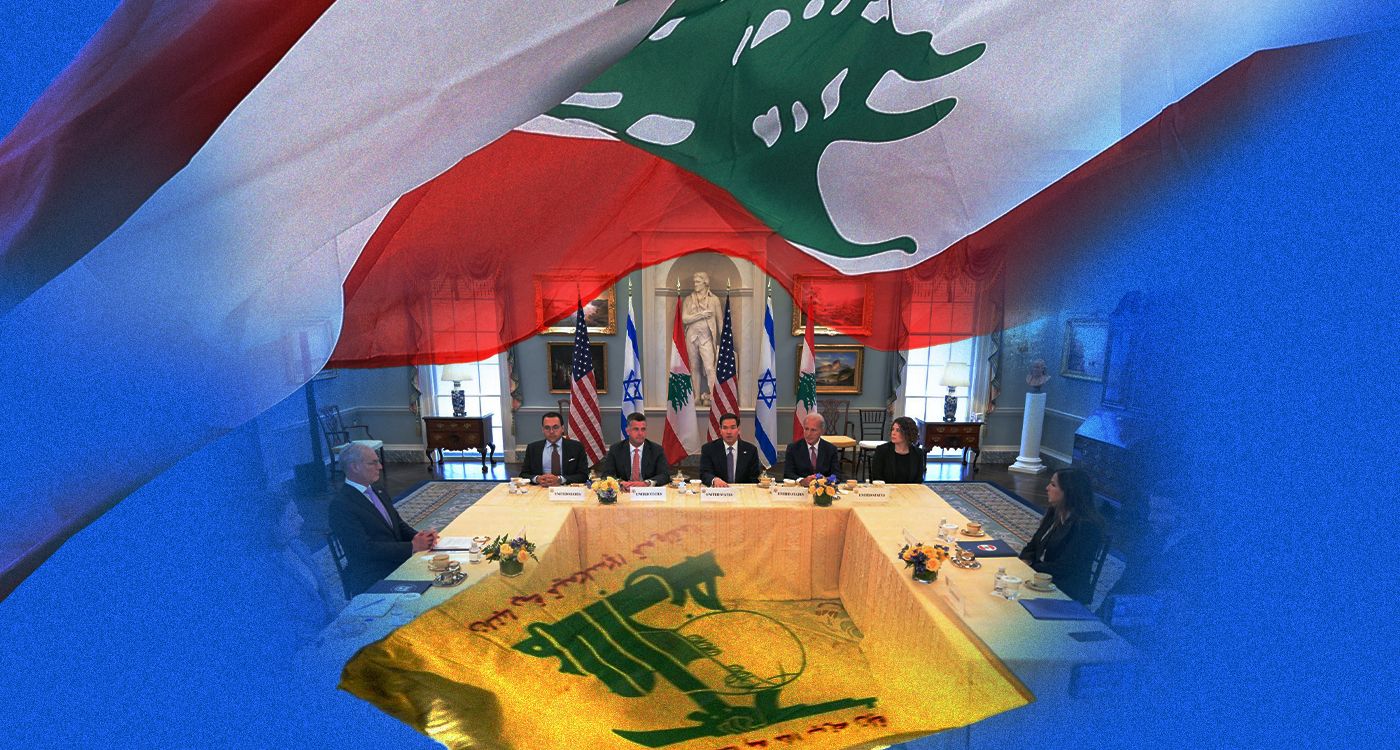
The April 14 diplomatic meeting between Lebanon and Israel in Washington signals, however partially, a reassertion of Lebanese state authority over its own decision-making, while challenging Iranian influence in the country. Most significant is the fact that the meeting took place at all, a historic step given the ongoing war between Hezbollah and Israel and wider regional upheaval.
The direct diplomacy broke long-standing political taboos that for decades have fueled recurring conflict and reduced Lebanon to a battleground for others. Throughout its modern history, Lebanon has been exploited as a front for Palestinian factions’ conflict with Israel, an arena for Syrian dictator Hafez al-Assad, and later an extension of Iran’s regional project. In this sense, direct engagement between Lebanon and Israel raises the prospect of dialogue driven by the interests of both countries rather than those of external powers, potentially ushering in a new era.
The Washington meeting also sent an important political signal. For the first time in decades, the Lebanese state appears to be reclaiming its diplomatic agency, long constrained first by the Assad regime and later effectively commandeered by Hezbollah and, by extension, Iran. This shift represents a meaningful starting point for restoring the state’s role and its capacity for independent decision-making.
Reclaiming diplomatic sovereignty is, in itself, a notable achievement for Lebanon. However, this step remains incomplete without the restoration of security and military sovereignty, which form the essential foundation of any independent national policy. Some may argue that the meeting was largely symbolic rather than a sign of substantive change, particularly absent tangible progress on issues such as Hezbollah’s arms or a cessation of hostilities.
While this assessment may hold at a superficial level, a closer examination reveals the deeper strategic significance of restored diplomatic agency. It carries important strategic implications for Lebanon, both in restoring state authority and in shielding the country and its citizens from destructive policy choices. In turn, it directly challenges Iran’s influence.
In practical terms, Iran and Hezbollah appear to have lost one of their most valuable levers: control over Lebanon’s diplomatic decision-making and its use as a political bargaining chip. For years, this enabled them to convert military activity into political capital, often through tacit understandings with Israel based on a formula of “security in exchange for influence.”
Today, however, as the Lebanese state reclaims a significant measure of its diplomatic sovereignty, that equation has been fundamentally altered. Hezbollah’s military actions risk becoming strategically unmoored, with no political horizon to anchor them. They increasingly resemble isolated, self-contained acts that are difficult to convert into political gains for Iranian influence in Lebanon. This shift is likely to force Tehran to reassess its investment in Hezbollah’s military apparatus, particularly as its political utility appears to be diminishing.
The recent escalation in rhetoric by Iranian and Hezbollah figures, including Ali Akbar Velayati in Tehran to Naim Qassem in Beirut, is best understood against this backdrop. Their fiery words are less an objection to negotiation with Israel per se than a reaction to the erosion of their core pillars of influence.
These momentous developments could reshape the rules of political engagement, limiting Lebanon’s use as an operational arena for Iran’s Islamic Revolutionary Guard Corps (IRGC) and curbing the country’s entanglement in conflicts contrary to its national interests. At its core, this shift offers a measure of protection for Lebanon as a whole, and for the population of the south in particular, against being repeatedly drawn into wars fought in service of Iran’s regional ambitions.
Lebanon’s historic step in Washington must be safeguarded against reversal under pressure or threats from Hezbollah. It should not be seen as an endpoint, but rather as the beginning of a long and complex process that requires resolve. It must be accompanied by further, more advanced, measures that gradually lay the groundwork for a sustainable peace between Lebanon and Israel.

Comments