- Home
- Middle East
- Netanyahu Warns Israel Can Strike Anywhere in Iranian Airspace
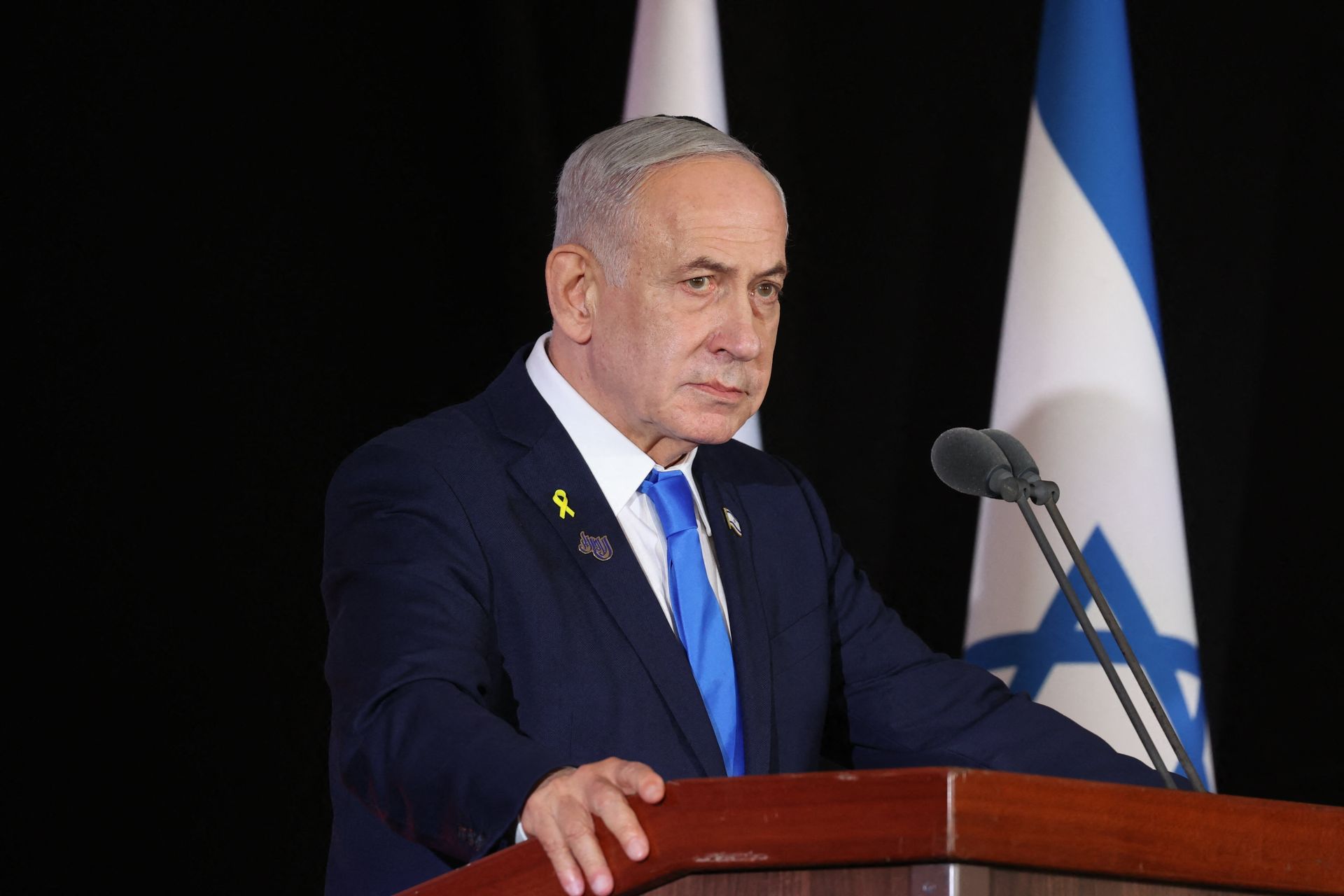
Israeli Prime Minister Benjamin Netanyahu participates in a state memorial ceremony for the fallen soldiers of the two-year Gaza war at the Mount Herzl military cemetery in Jerusalem on October 16, 2025. ©Alex Kolomoisky / POOL / AFP
Israeli Prime Minister Benjamin Netanyahu said Sunday in a recorded speech that Israel is capable of striking “anywhere in Iranian airspace" in a renewed warning to Tehran as indirect negotiations between Iran and the United States continue through Pakistani mediation.
Netanyahu emphasized that Israeli pilots are “ready” to carry out such missions if required, projecting confidence in the country’s operational reach and military preparedness.
The Israeli Prime Minister also underscored Israel’s growing military strength, stating that the country is “stronger than ever” and must maintain a decisive edge over its adversaries.
In parallel, Israeli authorities confirmed a major expansion of the air force’s capabilities, with the acquisition of two additional fighter jet squadrons, including advanced F-35 Lightning II and F-15EX Eagle II aircraft.
According to the Israeli Defense Ministry, the multibillion-dollar deal, approved by the ministerial procurement committee, forms part of a long-term strategy to reinforce Israel’s qualitative military edge. The package includes maintenance, logistics, and full integration into the air force, signaling sustained investment in potential future confrontations.
Escalating rhetoric toward Iran’s leadership
Separately, Israeli Energy Minister Eli Cohen issued a direct threat on Sunday to Iran’s new supreme leader, Mojtaba Khamenei, warning that he could face the same fate as his predecessor if he continues along a similar path.
“If he follows in his father’s footsteps, he will end up like him,” Cohen said in an interview with Israel’s Channel 14, referring to former supreme leader Ali Khamenei, who was killed at the outset of the U.S.-Israeli campaign against Iran on February 28.
Cohen added that Israel had demonstrated its willingness to act decisively against perceived threats, asserting that “those who seek to destroy Israel place themselves in danger.” He also claimed that Israel is currently at its strongest point, while Iran is at its weakest.
Military pressure and diplomatic uncertainty
The statements reflect a sharp escalation in Israeli rhetoric as uncertainty continues to surround diplomatic efforts.
Iran recently submitted a revised 14-point proposal via Pakistan, reportedly calling for a phased resolution beginning with maritime and blockade issues, while postponing negotiations over its nuclear program.
Israeli officials have expressed concern that a potential U.S.-Iran agreement may fall short of addressing the nuclear file comprehensively, raising fears in Tel Aviv that the current strategic window to weaken Iran could close without achieving long-term objectives.
Since the outbreak of the war in late February, Israeli operations have targeted senior Iranian military and political figures, significantly reshaping the regional balance. Against this backdrop, Netanyahu’s latest remarks signal that Israel is not only maintaining military pressure but also preparing for the possibility of further escalation if diplomatic efforts fail.
Read more


Comments