- 01
- May
- 2026


The ceasefire in Lebanon remains fragile amid the state’s inability to fully assert control on the ground. Hezbollah is continuing its military operations, while Israeli retaliation for the group’s attacks keeps Lebanon caught in a cycle of escalation with no clear end in sight.
The Lebanon-Israel truce announced by the U.S. on April 16 is being undermined by Hezbollah, analysts say. They point to the group's adherence to Iran's regional calculations and its opposition to the Lebanese state's diplomatic initiative for direct talks with Israel.
“At the core of the standoff is Hezbollah’s alignment with Tehran,” Amin told This is Beirut. “Hezbollah is following Iran’s guidelines and has openly said it is leading the battle in Lebanon in support of Tehran. It is not concerned with any agreement reached outside the Iranian framework.”
That dynamic, he warned, ties the Lebanese front directly to broader regional tensions. “If the conflict escalates between Iran and the U.S., Hezbollah will not abide by the ceasefire—it will escalate. Any military development in Iran will resonate in Lebanon.”
American University of Beirut Assistant Professor of History Makram Rabah agreed with this assessment. “At any moment, if Iran re-enters direct confrontation with Israel, the ceasefire will collapse,” Rabah told This is Beirut.
He added that while Hezbollah’s actions may serve Tehran tactically, they are unlikely to yield political gains. “They are giving Iran a card in negotiations with the U.S., but it won’t translate into real leverage,” he said.
Beyond the battlefield, Amin argued, the dispute is ultimately political. “The main issue is not the ceasefire itself, but who negotiates,” he said. “For Hezbollah, Iran—not the Lebanese state—should negotiate on Lebanon’s behalf.”
Retired Lebanese Armed Forces general Khalil Helou said Tehran has little interest in Lebanon’s stability. “The Iranians do not want the situation in Lebanon to settle,” he told This is Beirut. “They want the Lebanese file to remain closely linked to the Iranian file.”
Rabah downplayed the group’s ability to weaken the Lebanese state. “They are trying to discredit the government, but they are bound to fail,” he said.
He noted that Hezbollah’s main ally, Parliament Speaker Nabih Berri, continues to back President Joseph Aoun’s approach to negotiations with Israel. “Hezbollah is part of the government itself, and its so-called deterrence model has failed.”
Escalating Exchanges
While direct talks between Lebanon and Israel launched at the outset of the ceasefire are expected to continue, implementation of the truce remains uncertain. Since the start of the April 17 truce—initially set for 10 days and later extended to three weeks—Hezbollah and Israel have intensified exchanges of fire.
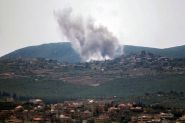
The Israeli military said that it struck and dismantled 40 Hezbollah military sites across southern Lebanon on April 30, with Lebanon’s state-run National News Agency reporting more than 70 airstrikes. Meanwhile, Hezbollah claimed 10 attacks that day, its highest tally since the start of the truce.
“The ceasefire gives Israel a margin to act militarily if it feels threatened, but this margin is not available to Lebanon,” Amin explained, adding that Hezbollah is “implicitly with the ceasefire, but according to its own rules,” maintaining what it sees as the right to respond.
Helou said both sides have violated the truce but argued Hezbollah bears greater responsibility for refusing to disarm, providing Israel with justification to maintain positions along the border and continue operations.
Ambiguities in the agreement have further fueled tensions. Israel accepted the ceasefire under U.S. pressure, he said, but ensured it could continue its military operations in southern Lebanon, where it has established what it calls a “forward defense line,” or “yellow line.”
“Hezbollah considers that presence an occupation and has attacked Israeli troops there, prompting retaliation,” Helou said. “Since then, the situation has been escalating.”
Hezbollah appears to be intent on reviving the rules of engagement with Israel that were in place before it opened a front in support of Hamas in October 2023, the retired LAF general said. Before then, Hezbollah and Israel engaged in infrequent, geographically restricted, and militarily limited exchanges.
“That arrangement suited Hezbollah because it gave a form of legitimacy to its armed resistance,” he said.
But Israel has rejected that framework, expanding the intensity and scope of its military actions against Hezbollah, including strikes on April 27 in the Bekaa Valley, while accusing Hezbollah of trying to derail direct negotiations between Beirut and Jerusalem.
“The more Israel expands its military operations, the more Hezbollah will justify the need for armed resistance,” Helou warned.
With exchanges of fire between Israel and Hezbollah intensifying, fears are growing within Lebanon of a renewed and potentially more destructive conflict. As the Lebanese state and Washington seek to separate the country’s fate from the U.S.-Iran conflict, the ceasefire is effectively a precarious pause that could unravel at any moment.


Comments