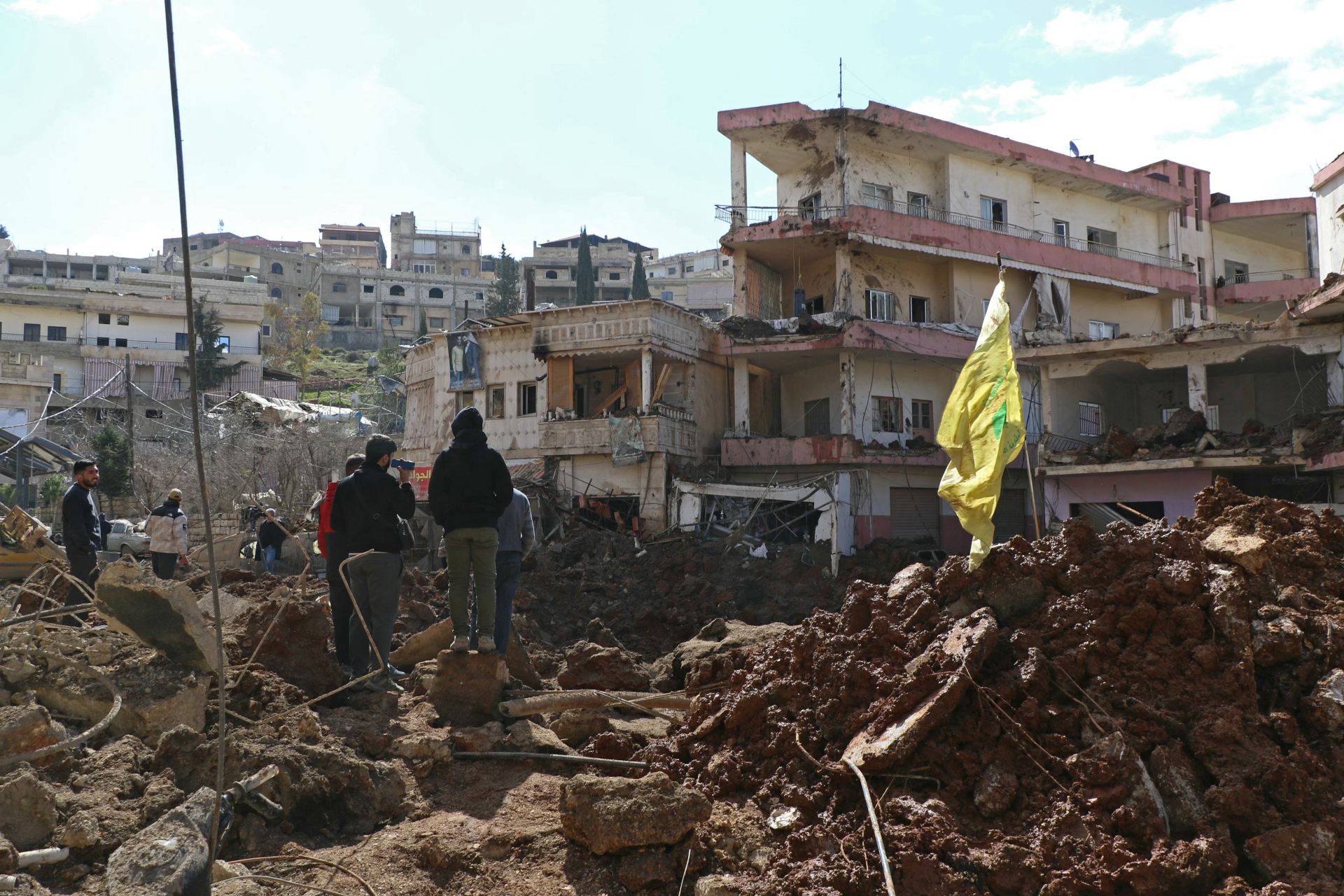
From Beirut’s suburbs to the Beqaa valley, to Druze strongholds in the eastern Chouf and Aley, and north across the Christian belt from the mountain resorts to the coast, fears are rising that Hezbollah operatives may be among the growing numbers of displaced Shia families. Israeli assassination strikes in historically-neutral parts of Lebanon have sharpened anxieties, prompting new security measures across the country.
In the predominantly Sunni Beqaa town of Majdal Anjar, the municipality has mandated the screening of new tenants’ names with the Internal Security Forces. A resident who hosted a displaced family without alerting the municipality was reported by his neighbor and subsequently fined 100 million Lebanese pounds ($1,100).
Similar rental restrictions have sprung up in towns across the country, often coordinated by national political parties, and in some places accompanied by informal intimidation campaigns. Supporters say the measures are neccesary to keep Hezbollah affiliates out.
A Growing Threat
Since the latest round of fighting began on March 2, Israel has carried out assassination strikes on Hezbollah operatives, allied militants, and members of Iran’s Islamic Revolutionary Guard Corps, in areas spanning the country’s sectarian patchwork.
Among the most high-profile were drone attacks targeting two hotels in Beirut’s upscale Raouché district and the Christian suburb of Hazmieh in early March. The campaign mirrors a pattern from the 2024 war, when Israel carried out targeted assassinations outside traditional Hezbollah strongholds, including along a busy motorway north of Beirut.
Some Hezbollah officials—who would normally be expected to remain on the front lines in southern Lebanon—are likely using false identities to rent informally in areas far from Israel’s usual bombardment, according to Ali al-Amine, editor-in-chief of the Janoubia outlet.
Caught between Hezbollah and Israel’s escalating crossfire are more than 800,000 displaced Lebanese civilians, mostly Shia, struggling to adjust in host communities already burdened by a deepening economic crisis.
War Spreading
Lebanon’s war-displaced are seeking refuge with host families, renting apartments, entering public shelters, and resorting to makeshift tents in open spaces. In the 2024 war, the Druze-majority Chouf district was the single largest destination for the displaced, followed by Beirut, Aley, Sidon, and Akkar.
“We didn’t need the excuse of [the strike in] Hazmieh to have stricter restrictions in the Chouf or Aley,” said Salah Takiedinne, a journalist and unofficial mouthpiece of the Druze Progressive Socialist Party (PSP).
In 2024, Druze-majority areas provided safe refuge to over 200,000 displaced people. When an errant Hezbollah official hid among civilians in Baadarâne, Takiedinne told This is Beirut, the Chouf saw its only Israeli airstrike of that war. Faced with the prospect of an even larger wave of displacement this week, the mountain communities are stepping up enforcement on existing regulations.
“Any refugee that wants to [stay] in a public school or private apartment must give their full names, original birthplace, and occupation [to be] coordinated with the information branch of the Internal Security Forces and Army Intelligence,” said Takiedinne. “If any of those names is suspected to be in direct relation with Hezbollah, they are to be excused from renting in the area.” Three individuals displaced to the Chouf and a local real estate agent confirmed the procedure.
Beirut on Alert
According to the Lebanese Forces—a highly-influential Christian political party—these rental restrictions are a necessary precaution. Charles Jabbour, the party spokesman, said that his constituents were concerned that the war could lead to extensive destruction and long-term displacement.
“In that case,” he told This is Beirut, “their stay in the areas to which they have fled could be prolonged, creating a new demographic and social reality that might be difficult to manage.”
In Beirut’s Christian-majority neighborhood of Achrafieh, two residents reported witnessing other local initiatives. This week, new flags appeared on lampposts throughout the neighborhood, bearing the red circle of the Lebanese Forces.
A local resident requested a flag from a member of the party, assuming they were intended to ward off Israeli drones—he told This is Beirut, referencing the party's ties with Israel during their time as a militia in Lebanon’s 1975-1990 civil war.
According to the resident, the party member said, “the drones can’t see the flags. These are for the Shia, if they come to invade the place.”
Jabbour told This is Beirut that state security services have asked their municipalities to stay vigilant—neighbors are to report rogue tenants to their local party office, the party office to the municipality, and the municipality to the Internal Security Forces.
Rental Blind Spots
Measures are less strict in urban centers outside of Beirut. Ashraf Rifi, an MP who represents the Sunni-majority city of Tripoli, told This is Beirut there were “no restrictions” on renting in the municipality.
“In Tripoli we don’t have anything like that,” said former MP Misbah el-Ahdab, who represented the northern city in Parliament from 1996 to 2009.
“With the PSP in the Druze areas, or even in certain Christian areas, the municipalities are very active. Hezbollah wouldn’t dare go in there, and nobody would dare rent to them,” he explained to This is Beirut.
“Here the municipalities don’t have the means to [act, nor is there] a team working on the matter,” Ahdab said, describing Tripoli’s local response as highly dysfunctional.
Further compounding the issue, Ahdab explained, “there are parts of Tripoli that are not registered [with the government], built during war, where there’s absolutely no official regulation.”
“Poor [tenants in] certain suburbs such as Shalfa, might be tempted to rent for money because they don’t really own the property anyway,” he said.
According to Ali al-Amine, Hezbollah members are likely exploiting these enforcement gaps, utilizing “informal rental arrangements,” in big cities like Saida or Tyre and poorer northern areas in Akkar.
Ahdab stressed that certain parts of Tripoli are known to have a growing Hezbollah presence, sometimes even protected by corrupt members of Lebanon’s security services.
“I’m a three-term member of parliament. They don’t give me a permit for carrying weapons to protect myself, while certain [Hezbollah-affiliated] sheikhs who have distributed weapons to shoot at the Lebanese army move around with fifteen armed guards.”
Road to Beirut
Minutes after Israeli evacuation orders on Monday, roads leading north from the border were packed with cars. Among them was Mowie Aoun, transporting his aunt and 68 year-old grandmother from Nabatieh along with two small children and a few hastily-packed bags.
Six hours later, outside the apartment he had rented in the Beirut neighborhood of Gemmayzeh, a neighbor saw the family approaching, shut the gate behind him, and raced upstairs. There he called his landlady, and two hours later, the family was back on the street.
“I said ‘we have a newborn baby, seven days old. Just allow us to stay here for one night,’” Aoun recounted. “She sent back a single line: ‘I want everyone out.’”
The family bounced around for five days, before finding an Airbnb in Aley, where they passed their IDs for inspection to the municipality.
That evening other cars took families to public spaces across central Beirut. At 10:00 pm, a father held his daughter on his back as he walked through Martyrs’ square. On all sides, there were families, huddled for warmth on blankets, pouring coffee.
A week later, many are still there. Tents continue to dot Beirut’s Corniche, a seaside promenade renowned by local runners for its even terrain.


Comments