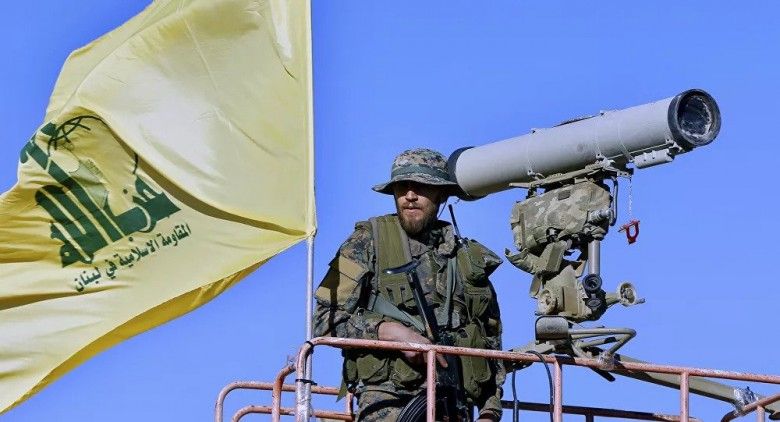
Hezbollah’s footprint in Syria has undergone a significant transformation in the post-Assad landscape, shrinking from what once resembled a parallel army into what officials describe as smaller, covert cells operating with limited and deniable capabilities, according to a report published by the Jerusalem Post.
For years, Hezbollah operated openly in Syria alongside the forces of former president Bashar al-Assad, deploying thousands of fighters, maintaining visible bases, and securing supply corridors that were clearly identifiable in satellite imagery. Its intervention was widely seen as instrumental in sustaining Assad’s rule during the height of the Syrian conflict.
However, Syrian authorities now point to a markedly different pattern of activity. According to the report, Hezbollah’s current presence is believed to be limited to small units operating near Damascus, allegedly using drones and Katyusha rockets. Syrian officials cited in the article acknowledged that some weapons used in recent incidents were traced back to Lebanon.
On February 1, Syria’s new government announced it had dismantled a cell accused of launching rockets toward the Mazzeh district and a nearby military airport. Hezbollah denied any involvement, stating it has “no presence or connection to armed movements in Syria.”
From supply corridor to constrained network
The Jerusalem Post report frames the shift as part of a broader strategic setback for Hezbollah, particularly the erosion of its once-crucial land corridor through Syria, which had served as a key logistical route for Iranian support.
In parallel developments, the Lebanese army reportedly uncovered a large Hezbollah tunnel in southern Lebanon used to store ammunition, rockets and drones, an operation carried out with U.S. intelligence assistance. U.S. Central Command commander Admiral Brad Cooper publicly praised the discovery, according to the report.
Lebanese authorities have also intensified efforts to shut down illegal crossings along the Syrian border, while the U.S. Treasury imposed sanctions on companies allegedly involved in facilitating shipments of Iranian fertilizer and converting Hezbollah’s financial reserves into cash for reconstruction efforts.
Brigadier General Fayez al-Asmar of Syria’s military media apparatus was quoted as saying that the new Syrian state faces pressure from multiple actors, including Israel, ISIS remnants, and armed groups operating outside government control, including Hezbollah.
David Des Roches, a U.S. defense expert cited in the report, described Hezbollah’s loss of freedom of land movement in Syria as a “strategic blow,” arguing that the group is transitioning from a structured military force with reliable supply lines to a network reliant on smuggling and constrained access.
Attempted recovery in the south
Yossi Kuperwasser, head of the Jerusalem Institute for Strategy and Security, told the Jerusalem Post that Hezbollah is attempting to recover from successive setbacks by reorganizing into smaller cells, particularly in southern areas, but that its gains remain limited due to Israeli readiness to intervene.
Hezbollah, according to the analysis, retains some activity near the Lebanese border and continues to rely on smuggling networks. Syrian authorities are reportedly able to disrupt some routes, though not eliminate them, a dynamic that partly explains Israel’s expanded activity in southern Syria aimed at preventing Iranian-backed elements from entrenching near its frontier.
Damascus signals consolidation of control
Syrian officials characterized the dismantling of the so-called “Mazzeh cell” as part of a broader effort to reassert state authority. Al-Asmar warned that security agencies are monitoring cells linked to external agendas and suggested that dormant networks could attempt to exploit regional developments, including the possibility of a U.S. strike on Iran.
He further noted that networks blending political activity, smuggling, and criminal financing present an ongoing challenge, allowing external actors to maintain influence even as the Syrian state seeks to consolidate control.
According to the report, Damascus views publicizing such operations not only as a security measure but also as a message that it will not tolerate activities that undermine national sovereignty or destabilize neighboring countries.

Comments