- Home
- Middle East
- Iran May Activate Regional Allies if U.S. Launches Major Strikes
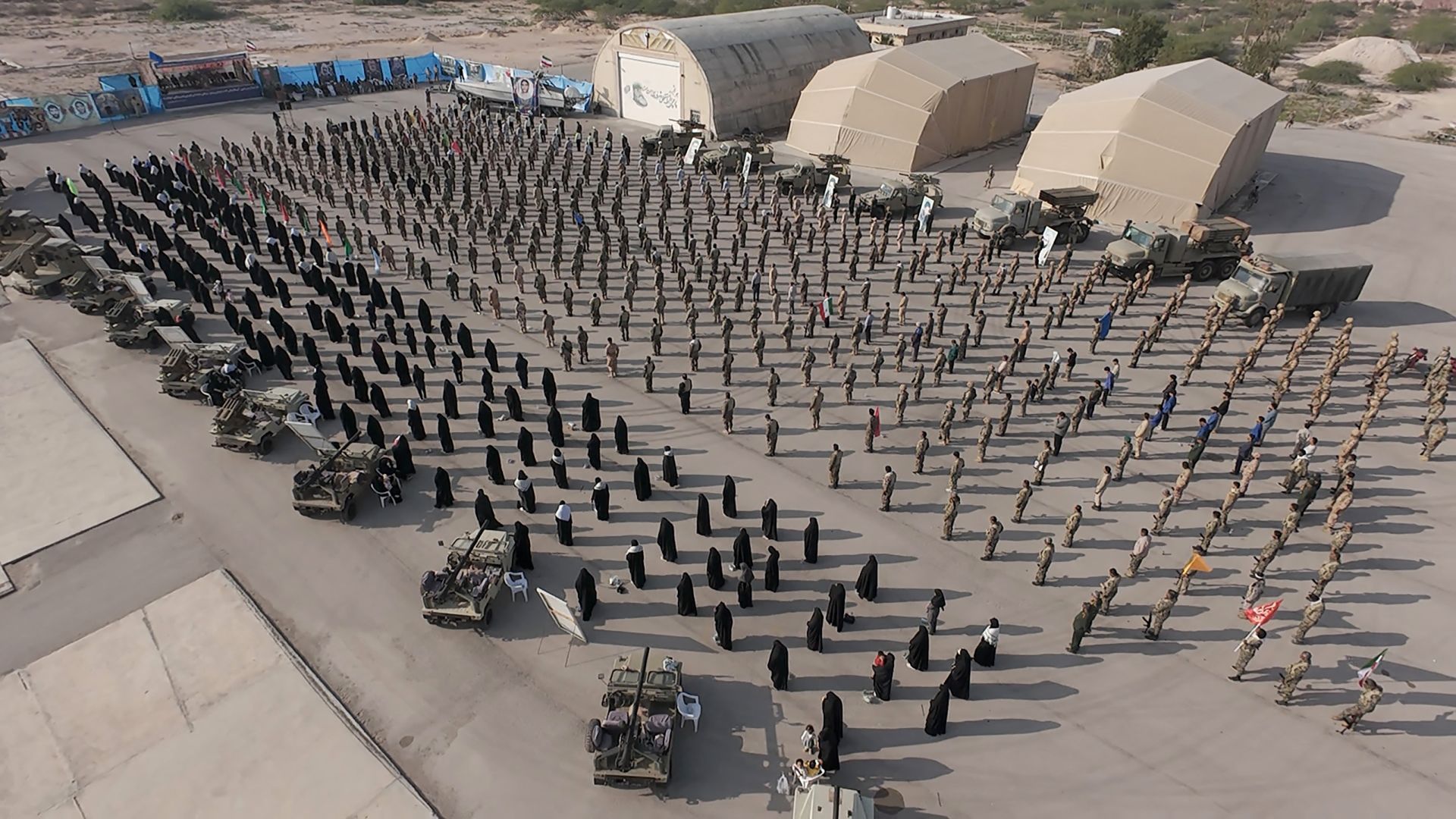
This handout photo released by Iran's Revolutionary Guards Corps (IRGC)'s official website Sepanews on February 16, 2026, shows members of the IRGC and navy taking part in a military exercise in the Gulf. ©- / SEPAH NEWS / AFP
Iran could direct allied armed groups to target U.S. interests worldwide if President Donald Trump authorizes large-scale military action against Tehran, according to U.S. and Western officials cited by The New York Times.
The newspaper reported that while no specific attack plans have been identified, intelligence services have detected an increase in intercepted communications among extremist networks, suggesting a higher level of coordination and preparation for potential operations.
Officials told the paper that Iran could respond through its regional allies, including renewed Houthi attacks on Western commercial shipping in the Red Sea or strikes by Hezbollah-linked networks against U.S. military bases and diplomatic missions in Europe and other parts of the world.
Colin P. Clarke, executive director of the Soufan Center in New York, said Tehran has the capacity to use proxy forces to raise the cost of any American military campaign. He added that if Iran’s leadership, including Supreme Leader Ali Khamenei and the Islamic Revolutionary Guard Corps, feels directly threatened, it could authorize attacks beyond the Middle East.
A senior Western official also warned of possible “hybrid attacks” targeting American and European interests, noting that such threats are under continuous assessment.
Pentagon reinforces defenses across the region
According to the report, the U.S. Department of Defense has moved in recent days to deploy additional Patriot air-defense batteries and other missile systems to protect American forces in the Middle East. However, officials cautioned that attacks on civilians or lightly protected targets remain more difficult to prevent.
The warning comes as Washington continues to expand its military presence in the region. Flight-tracking data cited by the newspaper shows the repositioning of refueling aircraft, fighter jets, and other military assets, including F-35 stealth aircraft.
Current U.S. deployments include two destroyers in the Mediterranean Sea, one in the Red Sea, four in the Persian Gulf, and the aircraft carrier USS Abraham Lincoln with its escort ships in the Arabian Sea. A second carrier group, led by the USS Gerald R. Ford, has also arrived in the Mediterranean.
The United States maintains military infrastructure across several countries, with fighter aircraft, drones, and helicopters stationed in Jordan, Syria, Iraq, and the United Arab Emirates.
Iranian lawmakers issue direct threats
In parallel, Iranian parliamentarian Amir Hayat Moghadam, a member of the national security and foreign policy committee, warned that Tehran would deliver a “crushing response” if attacked by the United States.
Speaking to Iranian media, Moghadam said Iran could sink U.S. warships in the Sea of Oman and target American bases and personnel across the region, including senior military officers. He also suggested that Iran could expand retaliation beyond the Middle East if a war breaks out.
Talks loom as military buildup accelerates
The report comes ahead of a third round of U.S.-Iran negotiations scheduled for Thursday in Geneva, at a time when Washington is reinforcing its regional military posture.
Officials cited by The New York Times said the current buildup reflects preparations for multiple scenarios, including the possibility that diplomacy fails and the confrontation escalates into open conflict.
Read more

Comments