- Home
- Middle East
- U.S. Deploys Nuclear Submarine as Trump Considers Return to Iran Escalation
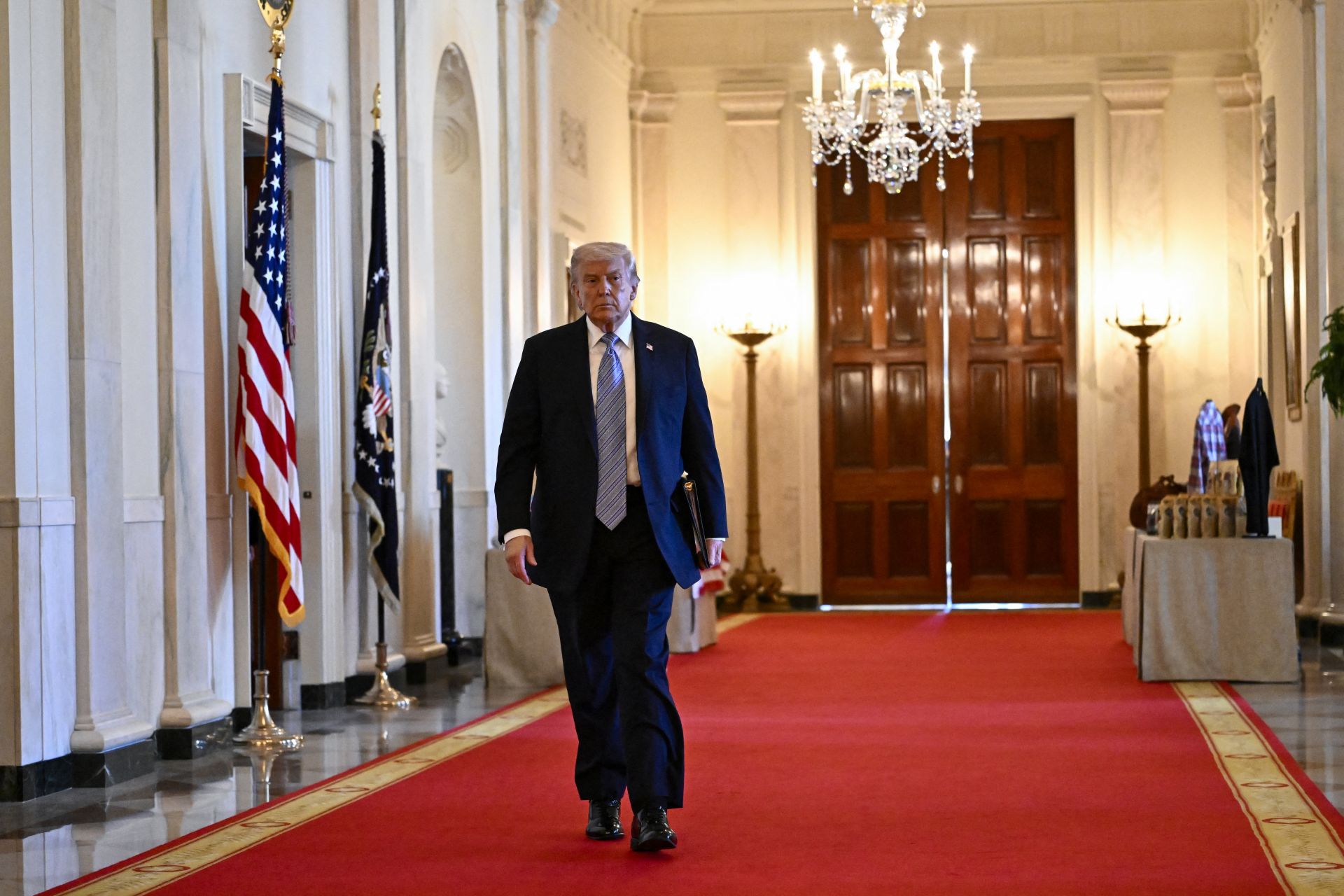
US President Donald Trump leaves after participating in a Small Business Summit in the East Room of the White House in Washington, DC on May 4, 2026. ©KENT NISHIMURA / AFP
The U.S. Navy confirmed Tuesday that an Ohio-class nuclear submarine had reached a British naval port near the entrance of the Mediterranean, in a rare public disclosure involving one of Washington’s most sensitive strategic military assets.
The U.S. Sixth Fleet said the deployment demonstrates America’s “capability, flexibility, and enduring commitment” toward NATO allies. The Pentagon did not disclose the submarine’s name.
Ohio-class submarines are considered among the most secretive components of the U.S. military’s nuclear deterrence system. They are capable of carrying Trident II ballistic missiles as well as long-range Tomahawk cruise missiles.
The deployment also came after reports that President Donald Trump held a high-level security meeting Monday in the White House Situation Room with senior national security officials to discuss next steps regarding Iran.
According to The Times of Israel, participants included Vice President JD Vance, Secretary of State Marco Rubio, Defense Secretary Pete Hegseth, CIA Director John Ratcliffe, and special envoy Steve Witkoff.
Israeli Channel 12 reported, citing two senior U.S. officials, that Trump is considering renewed military action to increase pressure on Iran.
Washington tightens sanctions pressure
Meanwhile, the U.S. Treasury announced sanctions against three individuals and nine companies based in Hong Kong, the United Arab Emirates, and Oman accused of helping facilitate Iranian oil shipments to China through networks allegedly linked to the Islamic Revolutionary Guard Corps (IRGC).
Treasury Secretary Scott Bessent said Washington would continue efforts to cut off the financial channels used by Tehran to fund military operations, missile development, and regional proxy groups.
The State Department also announced a reward of up to $15 million for information disrupting IRGC financial operations. The sanctions come only days before Trump’s expected summit with Chinese President Xi Jinping in Beijing, where Iran and the Strait of Hormuz crisis are expected to dominate discussions.
Iran warns it is ‘prepared for all options’
On the Iranian side, Parliament Speaker and senior negotiator Mohammad Bagher Ghalibaf warned Monday that Tehran is ready to respond to any escalation.
“Our armed forces are ready to deliver a well-deserved response to any aggression,” Ghalibaf wrote on X. He added that Iran is “prepared for all options.”
Iranian officials have continued insisting that Tehran’s response to the American proposal focused on what they described as Iran’s “legitimate rights,” including lifting sanctions, ending the U.S. naval blockade, securing guarantees against future attacks, and recognizing Iranian sovereignty over the Strait of Hormuz.
Tehran also reportedly linked any broader agreement to ending military pressure across the region, including in Lebanon, where clashes between Israel and Hezbollah have continued despite the ceasefire.
The latest developments highlighted the increasingly fragile state of diplomacy between Washington and Tehran, two months after the April 8 ceasefire.
While the ceasefire technically remains in effect, negotiations have stalled amid widening disagreements over Iran’s nuclear program, sanctions relief, and maritime control in the Gulf.
Read more


Comments