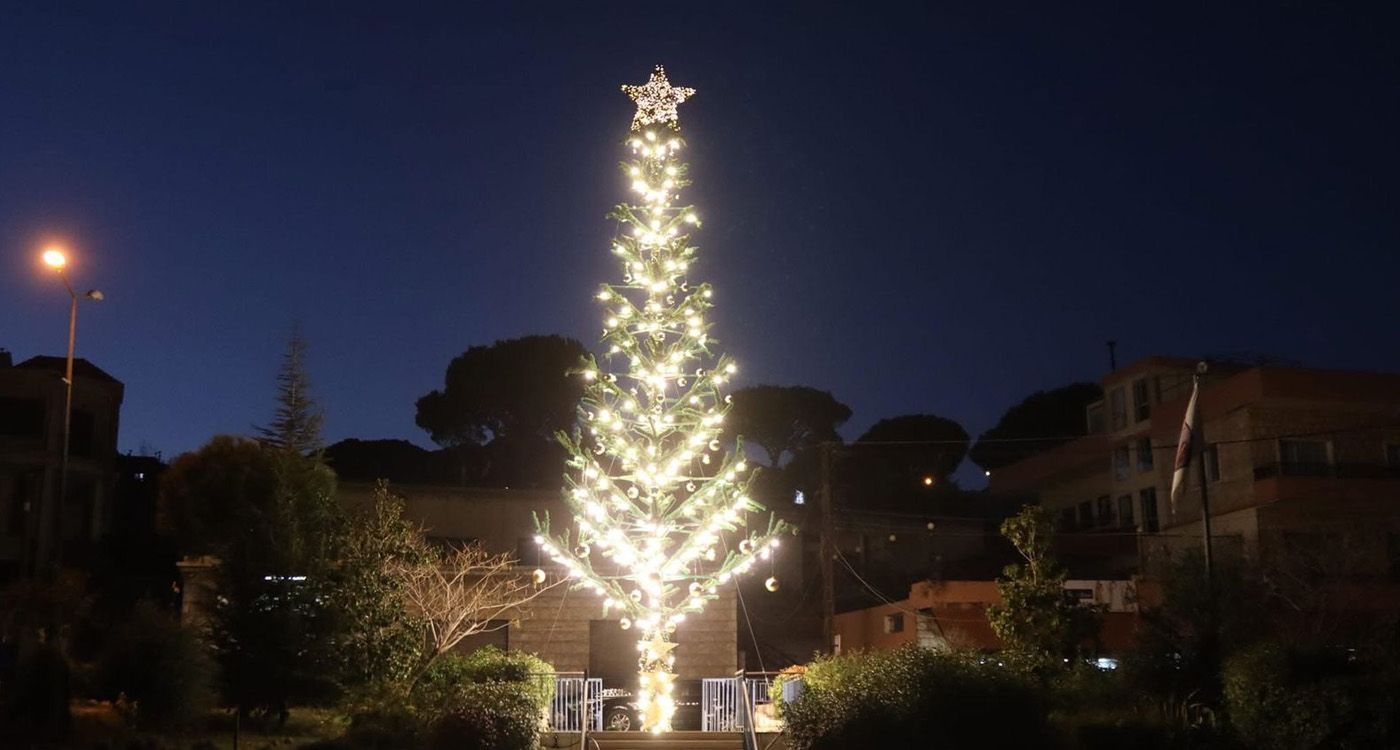
In the villages of South Lebanon, Christmas flickers like a fragile flame. Despite the ever-present fear and palpable tension, church bells toll and evening gatherings are held.
In Alma al-Shaab, Yaroun, Deir Mimas, Khiam, and Marjayoun, garlands and nativity scenes timidly pierce the deserted streets. Once alive with laughter and reunion, these streets now carry the heavy silence of exodus. The young have gone, and families have been displaced. Celebrating Christmas here is both an intimate act of faith and resilience.
The Youth Exodus: A Growing Void
In search of work, stability, and a horizon free of sirens, young people are fleeing to Beirut or leaving the country. Their departure leaves not only empty facades but also a deep fracture in the social fabric and collective memory. “They say youth is the future, but here the future has packed its bags,” reflects Rami, 30, an agricultural engineer now living in Beirut.
In several border villages, nearly half of all households have lost a young member. The social fabric is fraying, and families are scattering. The fear of renewed conflict discourages returns, even for the holidays. The youth now mostly exist in absentia. “Christmas celebrations are held from afar, through screens,” sighs Souad, mother of two sons abroad. “Christmas is a way of declaring that we still exist.”
Christmas in Resistance: Decorations Amid the Rubble
In Alma al-Shaab, residents hang garlands on walls still scarred by cracks. In Yaroun, amid the rubble, some decorate the interiors of their homes as a quiet act of defiance. “Christmas is proof that light can shine even in darkness,” says Mariam, a retired teacher from Alma al-Shaab.
Rola, displaced to Beirut for over a year, recalls celebrating Christmas in exile. “I thought I’d return just to light the nativity scene… then I saw the state of our house. This Christmas will be another Christmas somewhere else.”
In Deir Mimas, Randa returns to her village but not to the life she once knew. “Before, the house was overflowing: cousins, neighbors, children running everywhere. Today, there are just five of us around the table. The emptiness is deafening.”
The young are not the only ones missing. Entire families have yet to return: homes destroyed, neighborhoods unstable, areas still sensitive. Fouad, displaced for 18 months, says, “We thought we’d come back for the holidays. But the house isn’t safe, and then, come back for what? The children no longer have their friends here.”
Abou Elias, from Marjayoun, sums up the situation with disarming clarity: “Stones can be repaired. But when the youth leave, the future goes with them.”
Marjayoun: Between Sacred Memory and Wounded Reality
In Marjayoun, the decorations hung by the municipality and the Youth Club seem to float along empty streets, emphasizing the sense of exodus. Yet Christmas here also draws on a profound spiritual heritage: according to tradition, Christ passed through the region on his journey from Tyre to Galilee. This memory gives the holiday deep meaning, even amid the fragility of the present.
“Taking part in the evening gatherings is a way to reconnect with our history and identity. It is our anchor in the storm,” says Fahed.
The tension between contemporary vulnerability and spiritual legacy gives Marjayoun a unique aura: a city both blessed and wounded.
Churches: The Last Stronghold of Christmas
Despite sparsely filled pews, the churches of South Lebanon are once again adorned for the season: modest Christmas trees, carefully arranged nativity scenes, and garlands of lights around the altars. Decorating the church is not merely an aesthetic gesture, but a declaration of presence.
“We prepare the church as we would a home for a child about to arrive,” says Antoinette, a woman in her sixties from Marjayoun. “Even if there are fewer people, the faithful are here. And we welcome Jesus as we always have.” In Alma al-Shaab, adds Father Philippe, “Decorating is a way of saying that life goes on. People come, they pray, sometimes they cry, but they celebrate Christmas.” In Khiam, parishioners light candles. “As long as the church is open, the village still breathes,” says a local resident.
Solidarity Rekindled
In this fragile landscape, a few initiatives are striving to restore community bonds. As Christmas approaches, the chaplaincy of Saint Joseph University will lead a mission of solidarity across several villages in South Lebanon, in coordination with local associations. The aim is to provide moments of respite for children and adults affected by months of war and instability through psychosocial, educational, and community activities.
Christmas Under Watchful Eyes
In South Lebanon, Christmas has not vanished; it has transformed. Stripped of its crowds and depleted of youth, it is sustained by those who refuse to let their villages fade into oblivion. Amid destroyed homes, displaced families, and the enduring exile of young people, the holiday is observed with a new gravity. Decorated churches, celebrated masses, and lit lights are no longer mere tradition; they are deliberate acts: to stay, to bear witness, to pass on what remains.
“We light the candle to show that we are still here. Not many, but standing,” says Abou Georges. Yet a heavy, lingering question hangs over the empty streets: how long can a land endure without its youth?



Comments