- 20:40

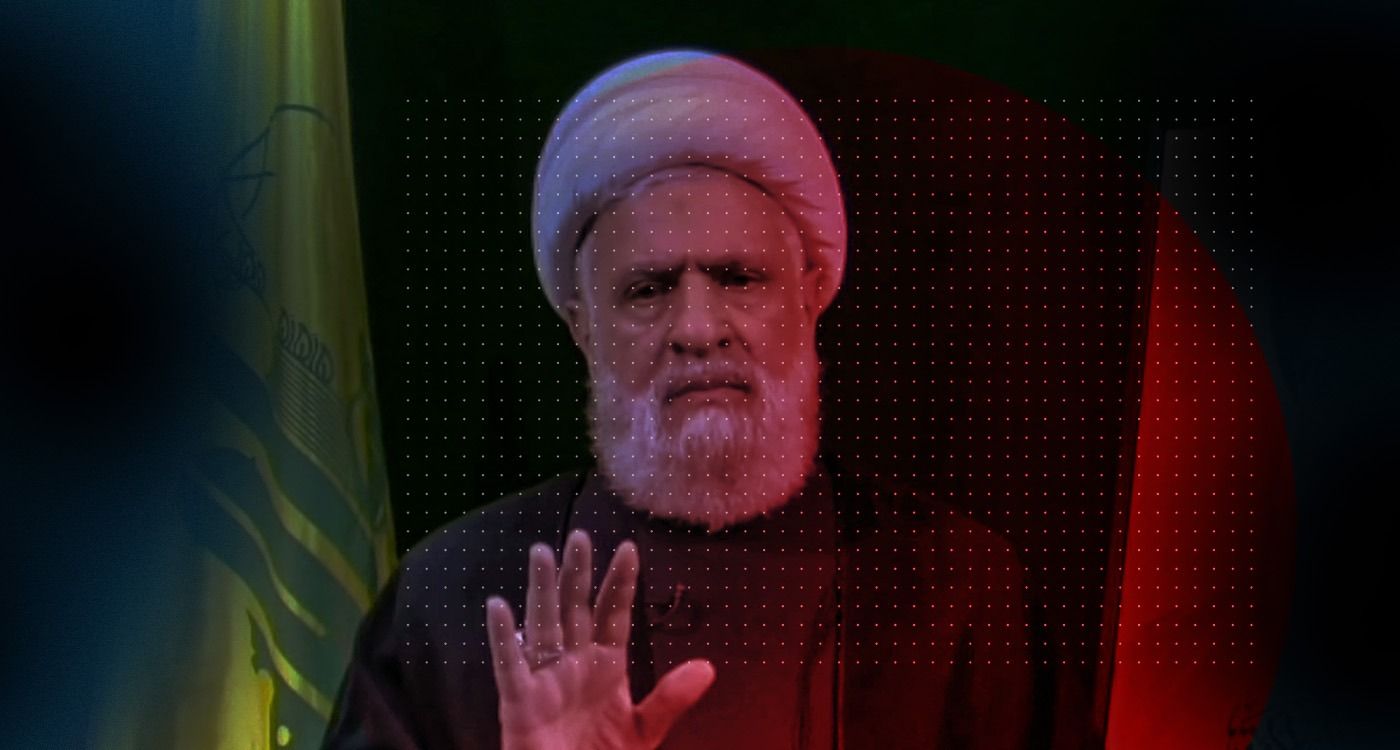
Hezbollah Secretary-General Naim Qassem sharply escalated his rhetoric against the Lebanese government on Sunday, openly rejecting direct negotiations with Israel, defending the group’s weapons, and warning that “the people have the right to overthrow the government if authorities fail to protect Lebanon’s sovereignty”.
The speech, delivered during Hezbollah’s annual “Resistance and Liberation Day” commemoration, comes as Lebanon’s government moves forward with a political and security track aimed at consolidating state authority over all weapons following the devastating war that erupted earlier this year between Israel and Hezbollah.
A Weakened Hezbollah
Lebanese Forces MP Pierre Bou Assi said in an interview with This Is Beirut that Hezbollah no longer possesses the same ability it once had to impose major internal confrontations, however he emphasized that Qassem’s speech reflects Hezbollah’s growing weakness could push it toward destabilizing Lebanese politics through intimidation or assassinations.
“A return to assassinations is possible,” Bou Assi told This is Beirut. “Every time Hezbollah weakens, instead of rebuilding its own strength, it weakens those it considers enemies, especially internally.”
“Hezbollah today is weaker and no longer capable of large-scale internal confrontation,” he said. “But there remains a serious possibility that it could resort to assassinations, as it has done before,” as the militant group could now attempt to compensate politically inside Lebanon.
“Every failed ‘liberation war’ Hezbollah dragged Lebanon into could lead to an internal elimination war,” he warned.
“An Attempt to Shift Responsibility”
Bou Assi described Qassem’s speech as an attempt to deflect responsibility for the destruction caused by the war, particularly in southern Lebanon.
The speech was an “empty intimidation aimed at diverting attention from the scale of destruction that Naim Qassem and his group caused in the South, economically, socially and nationally,” he said.
According to Bou Assi, Hezbollah is attempting to shift blame onto the Lebanese state after emerging politically and militarily weakened from the conflict.
“It is an attempt to replace failure and transfer responsibility onto the Lebanese state,” he said. “And at the same time, to create a new battle for its supporters after the defeat, by presenting the Lebanese state itself as the new enemy.”
Qassem had directly attacked Lebanese authorities during his speech, accusing the government of making “concession after concession” to Israel and criticizing its decision to engage in direct negotiations.
“If this government is incapable of ensuring sovereignty, then it should leave,” Qassem declared, while insisting Hezbollah would continue confronting Israel and “everyone who stands with it.”
He also reiterated the group’s categorical refusal to disarm, saying Hezbollah’s weapons would remain in its hands until the Lebanese state is capable of “protecting Lebanon, its people and its resources.”
Hezbollah “No Longer Controls the Negotiation Track”
Political analyst Wajih Kanso told This Is Beirut that the speech reflects Hezbollah’s growing frustration after losing control over Lebanon’s political and negotiation process following the war.
“Hezbollah’s problem today is no longer only military,” Kanso said. “The real issue is that the Lebanese state itself has become the reference point for negotiations and political decisions.”
According to Kanso, Hezbollah previously maintained indirect influence over negotiations through Speaker of Parliament Nabih Berri, but the current phase marks a major shift.
“Today, Hezbollah no longer controls the path of negotiations or the decision to make peace, however it still controls the decision for war” he said, adding that Qassems attacks constitute an attempt to portray diplomacy as a surrender of sovereignty.
“The negotiations themselves are a form of resistance,” Kanso said. “The Lebanese state is trying to obtain through diplomacy what weapons failed to secure.”
Weapons and State Legitimacy
Qassem also warned that disarming the group would mean stripping Lebanon of its “defensive power,” claiming such demands pave the way for “submission” to Israel.
But according to Kanso, the government’s position has fundamentally altered Hezbollah’s legal and political standing inside Lebanon.
“When the state officially says that weapons belong exclusively to the state, then any weapons outside that framework become illegitimate,” he said.
“Today Hezbollah is in contradiction with the concept of the state itself.”
Bou Assi similarly argued that Hezbollah’s influence can only survive through weak state institutions. “A deep state only survives when political authority is weak,” he said.
He stressed that the solution lies in strengthening state institutions rather than engaging in fear politics.
Threats Against the Government
Qassem’s most charged remarks came when he declared that Lebanese citizens had “the right to go to the streets and overthrow the government,” while warning that Hezbollah would confront “everyone who stands with Israel” just as it confronts Israel itself.
Despite its attacks on the government, Hezbollah and its allies still maintain representation within the current cabinet, including Health Minister Mohammad Haidar and Labor Minister Rakan Nassereddine, both affiliated with the Amal-Hezbollah political alliance.
Kanso also noted that any attempt to overthrow the government or impose internal force would be suicidal for the party and could trigger broad international and regional intervention.”
He also noted growing frustration within parts of the Shiite community itself following the war, suggesting that there are “serious questions and anger” regarding Hezbollah’s influence.
Rubio Condemns Hezbollah Threats
U.S. Secretary of State Marco Rubio also condemned Qassem’s speech, particularly the threats directed at the Lebanese government.
Kanso said Washington’s unusually rapid response reflects growing American involvement in the Lebanese file.
“The Americans today are far more invested in Lebanon than before,” he said. “Years ago, Hezbollah could move internally and the international reaction remained limited. Today the situation is completely different.”
Washington now sees Lebanon as a central part of broader regional negotiations tied to Hezbollah’s disarmament, border security, and the future balance of power after the war, according to Kanso.



Comments