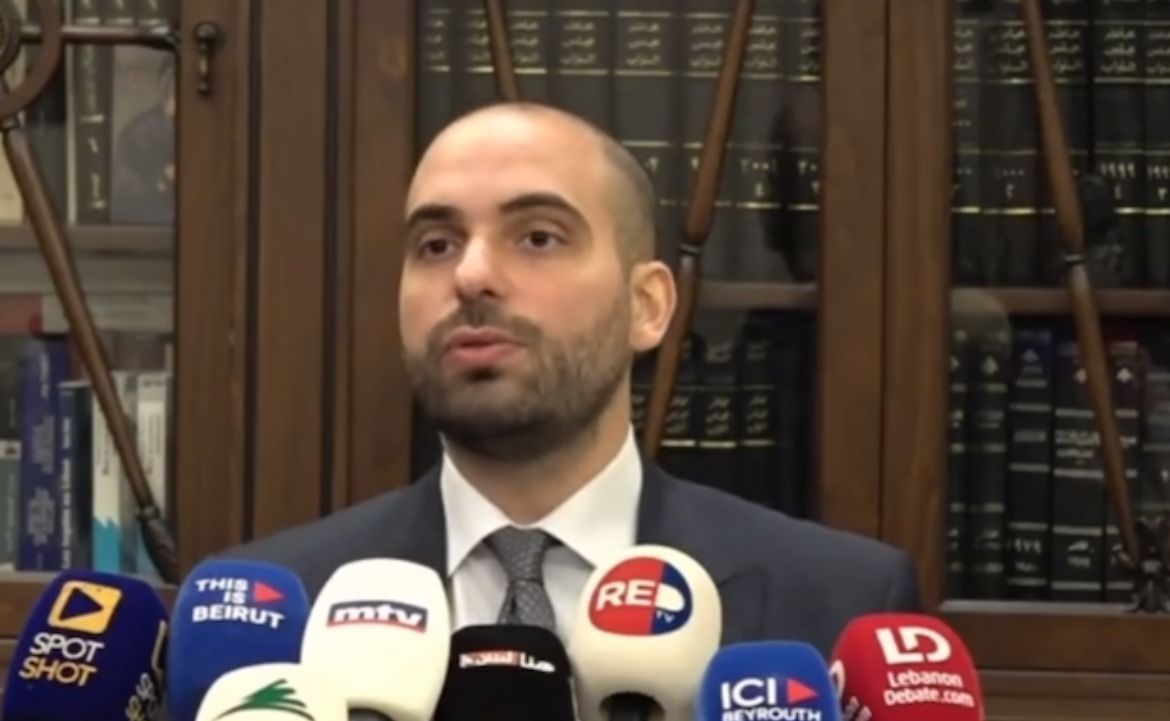
Lebanese attorney and political activist Majd Harb announced on Thursday that he is preparing two draft laws aimed at amending Lebanon’s legislation related to “collaboration with Israel,” saying he intends to present the proposals to supportive MPs and parliamentary blocs following the conference.
Harb said the first proposal seeks to amend key provisions in existing laws, particularly Article 285 of the Penal Code and the 1955 Israel Boycott Law. Under Lebanon’s current legal framework, these provisions form part of a broader set of statutes that criminalize various forms of contact with Israel, which Lebanese law classifies as an “enemy state.” These include provisions under the Penal Code related to treason and communication with Israel, as well as the 1955 Boycott Law, which broadly prohibits direct or indirect dealings with Israeli individuals or entities.
He described these laws as among the “most dangerous legal provisions” currently being used internally in Lebanon.
According to Harb, these laws have increasingly been applied against activists, journalists, expatriates, and ordinary citizens who have “absolutely no connection whatsoever” to Israel or to threats against Lebanon’s internal security. He argued that the legislation, drafted in the context of 1955, no longer reflects the realities of modern communication and globalization.
Harb claimed that under the current wording, broadly defined prohibitions on “contact” or “collaboration” can extend to digital communication, professional interactions abroad, or indirect links through international companies, exposing Lebanese citizens and expatriates to legal risk even in non-security-related contexts. Legal experts have similarly noted that the laws’ vague wording allows for wide interpretation, sometimes treating ordinary interactions as potential violations depending on judicial or political framing.
He further criticized what he described as the broad discretion given to military courts and judicial authorities in interpreting these laws, warning that prosecutions may be influenced by political considerations rather than strict legal definitions. Under Lebanese practice, cases involving alleged collaboration are often referred to military courts, which handle a wide range of national security-related offenses.
Harb also addressed what he described as the practical consequences of these laws for civilians in southern Lebanon, saying that some residents may need to communicate across the border for essential needs such as medicine or movement between nearby villages during times of war, particularly in sensitive border areas. He argued that such interactions should not be criminalized, stressing that affected individuals “should not be ashamed” and should instead be protected under a clearer legal framework.
He added that journalists face similar risks when reporting on individuals or sources located in Israel or holding Israeli documentation, warning that current legal interpretations can blur distinctions between legitimate reporting and acts treated as collaboration.
Harb said the second proposed law aims to protect civilians and journalists from prosecution in such cases, arguing that Lebanon must distinguish between espionage or security threats and ordinary civilian or humanitarian communication. He stressed that any broader political decisions regarding peace or normalization remain a matter for the Lebanese state, but that until then, citizens should not be exposed to legal uncertainty or prosecution for basic or necessary contact.
He concluded that, in his view, the proposed reforms are necessary to modernize Lebanon’s legal framework, protect civilians and expatriates, and reduce what he described as the overreach of military court prosecutions. He said he believes a significant number of MPs will support advancing the amendments through parliament.



Comments