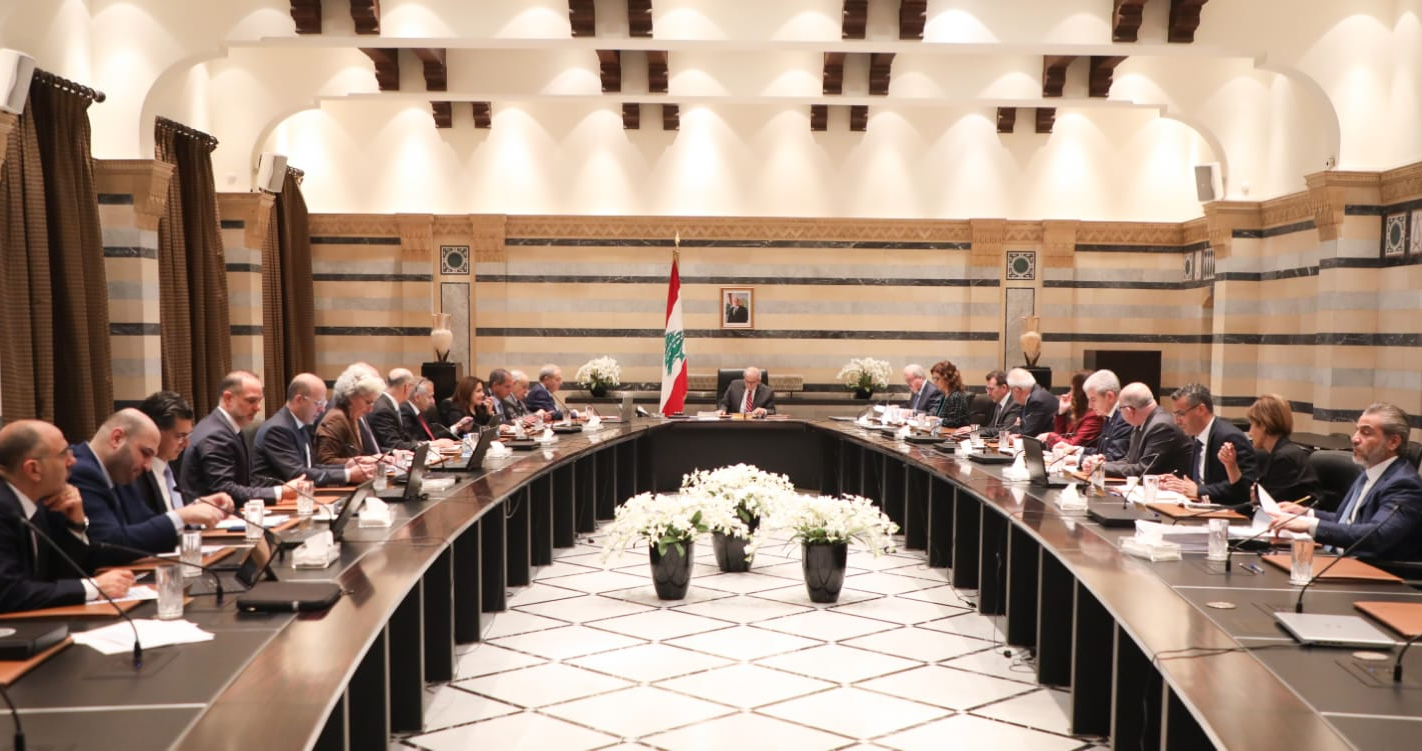
Lebanon’s government moved to reassert its authority in a cabinet meeting on Thursday, as Prime Minister Nawaf Salam warned that the country is being dragged into a war it neither chose nor controls amid growing concerns over the role Hezbollah is playing to escalate the conflict.
Speaking after a cabinet session at the Grand Serail, Salam delivered one of his clearest messages yet: Lebanon, he said, has become “a victim of a war whose outcome no one can predict,” as the conflict enters a more dangerous phase.
His remarks come as Israeli operations intensify across southern Lebanon and beyond, raising fears that the confrontation is no longer confined to previous frontlines.
“War and Peace Must Belong to the State”
At the heart of Salam’s speech was a reaffirmation of a principle the government has repeatedly stressed since the outbreak of the war: that decisions of war and peace must remain exclusively in the hands of the Lebanese state.
“One month has passed since the government clearly rejected any military action outside state institutions,” Salam said, reiterating that this position remains unchanged despite mounting pressure on the ground.
The statement also carried a clear political subtext.
Without naming Hezbollah directly, Salam warned against linking Lebanon to wider regional conflicts, particularly through what he described as “joint and synchronized military operations” with external actors, a reference widely understood to point to coordination with Iran and its allies—the first confirmed instance of which took place during a March 11 missile attack on central Israel.
In doing so, he implicitly raised the central dilemma facing Lebanon today: a state attempting to assert sovereignty while armed actors continue to operate beyond its control.
A War Expanding Beyond Its Initial Scope
Salam’s warning was not limited to internal dynamics. He pointed to what he described as a significant shift in Israeli military objectives, suggesting that the current escalation goes far beyond previous patterns of confrontation.
According to the prime minister, Israeli actions now indicate a broader strategy that could include deeper territorial incursions, the establishment of buffer zones, and large-scale displacement.
More than one million people have already been forced from their homes, in what officials describe as one of the most severe humanitarian consequences Lebanon has faced in recent years.
“The war is no longer limited to what we have known over the past sixteen months,” Salam said, describing a conflict whose trajectory is increasingly unpredictable.
Economic Collapse Threat Looms
Behind the political and military developments, the economic toll of the war is rapidly deepening.
During the cabinet session, ministers presented a stark assessment of the country’s financial situation. Officials warned that global economic slowdown, rising oil prices, and disrupted trade flows are compounding Lebanon’s internal crisis.
The economy is now expected to contract by between seven and ten percent, while unemployment continues to rise amid large-scale displacement.
At the same time, international aid has declined compared to previous crises, leaving the government with fewer options to respond.
Finance Minister Yassine Jaber confirmed that a delegation will travel to Washington to meet with the World Bank in an effort to secure additional support, including the possibility of converting loans into humanitarian assistance.
Mounting Humanitarian Pressure
The humanitarian situation is deteriorating alongside a compounding economic crisis.
Figures presented to the cabinet revealed extensive damage to the healthcare sector, including repeated attacks on hospitals and medical teams. Several facilities have been forced to shut down, while dozens of healthcare workers have been killed or injured.
These developments are placing unprecedented strain on essential services, as the government struggles to maintain basic support for displaced populations.
In response, the cabinet approved a $200 million World Bank loan aimed at strengthening social safety nets, while also adopting measures to stabilize access to essential goods and curb market abuses.
A State Under Pressure
Beyond the immediate measures, the session reflected a broader reality: a state operating under intense pressure, attempting to maintain cohesion in the face of both external aggression and internal fragmentation.
Salam emphasized the need for national unity, warning against divisive rhetoric and internal tensions at a time when the country faces what he described as an existential challenge.
He also reiterated the government’s commitment to pursuing diplomatic efforts to halt the war while mobilizing Arab and international support.
The Unresolved Question
Yet despite these efforts, a fundamental question remains unresolved.
As long as military actions continue to be carried out outside the framework of the state, Lebanon’s ability to control its own fate remains deeply constrained.
Salam’s speech made clear that the government is attempting to draw a line, reaffirming the principle of state authority in the face of a widening conflict.
Whether that line can be enforced, however, remains uncertain.
As the war expands, Lebanon finds itself once again at the intersection of regional confrontation and internal fragility, caught in a conflict it did not initiate and struggling to contain its consequences.


Comments