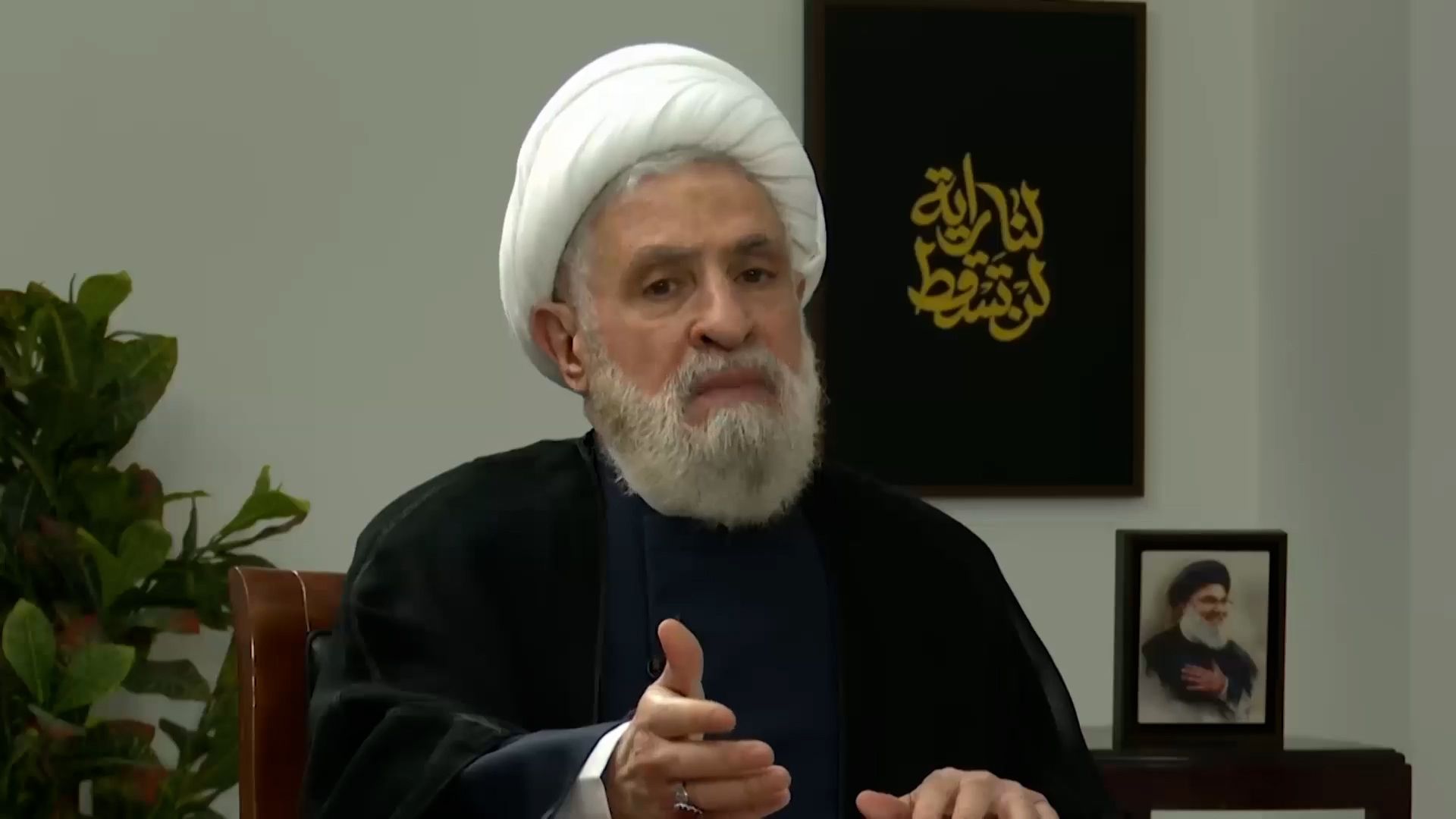
Hezbollah Secretary-General Naim Qassem called for “national unity” in Lebanon on Wednesday, framing it as essential in confronting what he described as a year-long campaign of Israeli-American aggression.
In his address, Qassem presented Lebanon as facing a stark choice between “surrender” and “resistance,” portraying Hezbollah’s military actions as a defensive response to ongoing attacks despite previous ceasefire agreements with Israel.
Qassem framed the conflict as an existential confrontation with the United States and Israel, while rejecting both disarmament and negotiations under current conditions. The statement comes at a time of intensifying military operations and growing international pressure for a negotiated settlement.
Framing the Conflict as a Regional Project
Qassem placed the war within a broader ideological narrative, warning of what he described as a U.S.-Israeli project to reshape the region, often referred to by Hezbollah as “Greater Israel,” extending influence across multiple countries, including Lebanon.
He argued that recent attacks were not isolated incidents but part of a longer campaign aimed at weakening Lebanon, undermining its sovereignty, and reshaping its political and security landscape.
Rejection of Disarmament and Negotiations
A central message of the speech was a categorical rejection of calls to limit Hezbollah’s weapons.
Qassem criticized efforts to impose state monopoly over arms during ongoing hostilities, arguing that such demands align with Israeli objectives and would leave Lebanon vulnerable. He also rejected the prospect of negotiations with Israel while military operations continue, describing talks under fire as equivalent to forced surrender.
These positions directly challenge ongoing domestic and international efforts to push for a political settlement and reinforce the group’s longstanding stance that its weapons remain essential to national defense.
Call for National Unity on Hezbollah’s Terms
The Hezbollah leader called for “national unity” in confronting the war, urging alignment between the government, the army, and various political factions.
However, the framework he outlined conditions such unity on reversing recent government decisions that criminalize Hezbollah’s military activity, a demand that places the group at odds with Lebanon’s current political leadership.
Prime Minister Nawaf Salam has previously insisted that there will be no reversal of the state’s policy to restrict weapons to official institutions.
Narrative of Resistance and Mobilization
Qassem emphasized the role of Hezbollah fighters and displaced civilians, portraying both as part of a broader resistance effort. He framed displacement as a sacrifice within a larger struggle and described continued fighting as necessary to prevent further Israeli advances.
The rhetoric reflects an attempt to maintain internal cohesion and support amid mounting human and economic costs.
Linking Lebanon to the Wider War
The statement also drew direct connections between the conflict in Lebanon and the broader confrontation involving Iran.
Qassem praised Iran’s response to U.S.-Israeli actions, suggesting that outcomes in that theater could shape the balance of power across the region.
This linkage underscores the extent to which the conflict in Lebanon is embedded within a wider regional dynamic, where multiple fronts are interconnected.

Comments