- Home
- Middle East
- Gulf States Urge U.S. to Neutralize Iran for Good
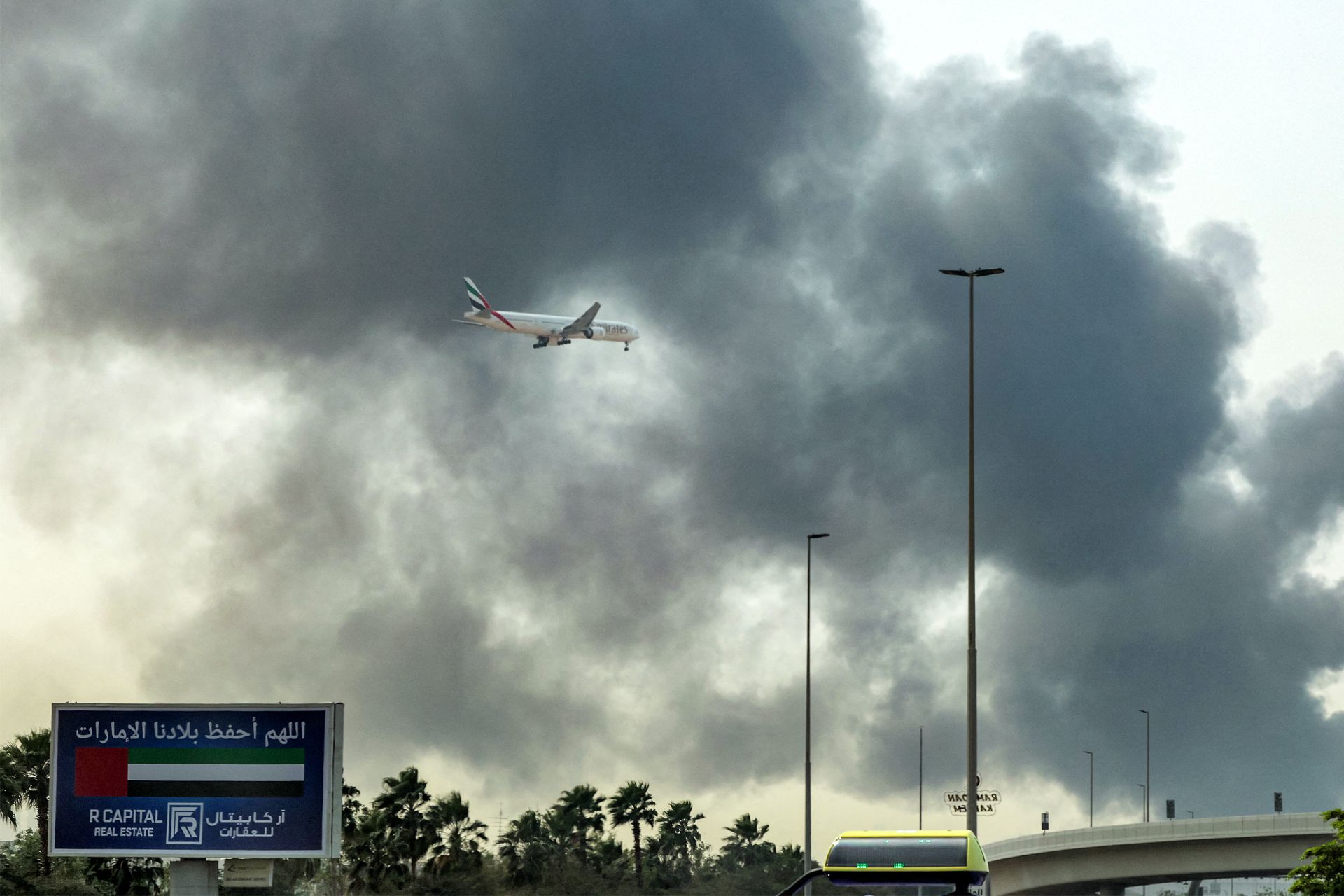
A billboard with a prayer in Arabic wishing safety for the United Arab Emirates is pictured along a highway while above an Emirates aircraft prepares for landing as a smoke plume rises from an ongoing fire near Dubai International Airport in Dubai on March 16, 2026. ©AFP
Gulf Arab states are increasingly pressing the United States to continue its military campaign against Iran, warning that a premature halt could leave Tehran capable of threatening the region’s critical energy infrastructure and economic stability, according to sources cited by the Times of Israel.
While Gulf governments initially opposed the outbreak of the U.S.-Israeli war, the scale and scope of Iran’s retaliatory attacks, targeting oil facilities, ports, airports, and commercial hubs, have reshaped strategic calculations across the region.
From Reluctance to Strategic Alignment
Three Gulf sources told Reuters that regional leaders did not advocate for war but now see continued U.S. military pressure as necessary to prevent Iran from maintaining the ability to disrupt energy flows.
“There is a wide feeling across the Gulf that Iran has crossed every red line,” said Abdulaziz Sager, chairman of the Gulf Research Center. “At first we opposed the war. But once strikes were directed at us, the perception changed.”
Iran has demonstrated its reach by launching drone and missile attacks across Gulf states while simultaneously targeting Israel and disrupting maritime traffic through the Strait of Hormuz, a chokepoint through which roughly 20 percent of the global oil supply passes.
These actions have reinforced long-standing fears among Gulf governments that Iran could weaponize its regional influence and military capabilities to pressure global energy markets.
Economic Stakes Drive Strategic Urgency
Beyond the immediate physical damage, Gulf officials are increasingly concerned about the broader economic impact.
The region’s long-term development strategies, including diversification into trade, tourism, and financial services, depend heavily on perceptions of stability. Repeated strikes on infrastructure risk undermining investor confidence and reversing years of economic positioning.
One Gulf source described the dilemma starkly: without a significant degradation of Iran’s capabilities, the region could face “constant threat” and recurring disruptions.
The concern is not hypothetical. Past incidents, including the 2019 attacks on Saudi oil facilities that temporarily cut production in half, remain a reference point for policymakers assessing current risks.
Washington Seeks Regional Backing
At the same time, the United States is actively encouraging Gulf allies to demonstrate support for the ongoing campaign, according to several Western and Arab diplomats cited by the Times of Israel.
President Donald Trump is reportedly seeking broader regional backing to strengthen both international legitimacy and domestic political support for the war effort.
The White House has stated that U.S. operations are focused on “crushing” Iran’s ability to deploy and manufacture weapons while maintaining close coordination with regional partners.
However, Gulf states have so far stopped short of direct military involvement.
Restraint Amid Growing Pressure
The United Arab Emirates emphasized that it does not seek escalation but retains the right to defend its sovereignty. Across the Gulf Cooperation Council (GCC), consensus on collective military action remains limited.
Regional sources indicate that unilateral intervention is unlikely, as individual states fear becoming direct targets of Iranian retaliation. Even coordinated action remains uncertain, with only limited high-level consultations taking place so far.
Analysts describe this as a calculated strategy: maintaining defensive readiness while avoiding full-scale entry into a conflict largely driven by Washington and Israel.
A Strategic Dilemma
According to Fawaz Gerges of the London School of Economics, Gulf states must weigh the immediate threat posed by Iran against the longer-term risks of deeper entanglement in a widening war.
Joining the campaign could increase exposure to retaliation without significantly altering the military balance, while inaction risks leaving Iran’s capabilities intact.
The situation is further complicated by Iran’s demonstrated ability to disrupt maritime traffic through the Strait of Hormuz, effectively influencing global energy flows.
“Now that Iran has shown it can shut down Hormuz, the Gulf faces a fundamentally different threat,” said Bernard Haykel of Princeton University.
Global Implications and Uncertain Path Forward
The strategic importance of the Gulf extends far beyond the region. Much of its oil and gas exports are directed toward Asian economies, raising questions about whether countries such as China and Japan will play a more active role in securing maritime routes.
For now, Gulf states appear aligned on one point: the risks associated with leaving Iran’s military capabilities intact may outweigh those of a prolonged conflict.
Yet with no unified regional strategy and continued fears of escalation, the path forward remains uncertain, defined by cautious positioning, rising economic pressure, and a conflict whose outcome will shape the region’s security architecture for years to come.
Read more


Comments