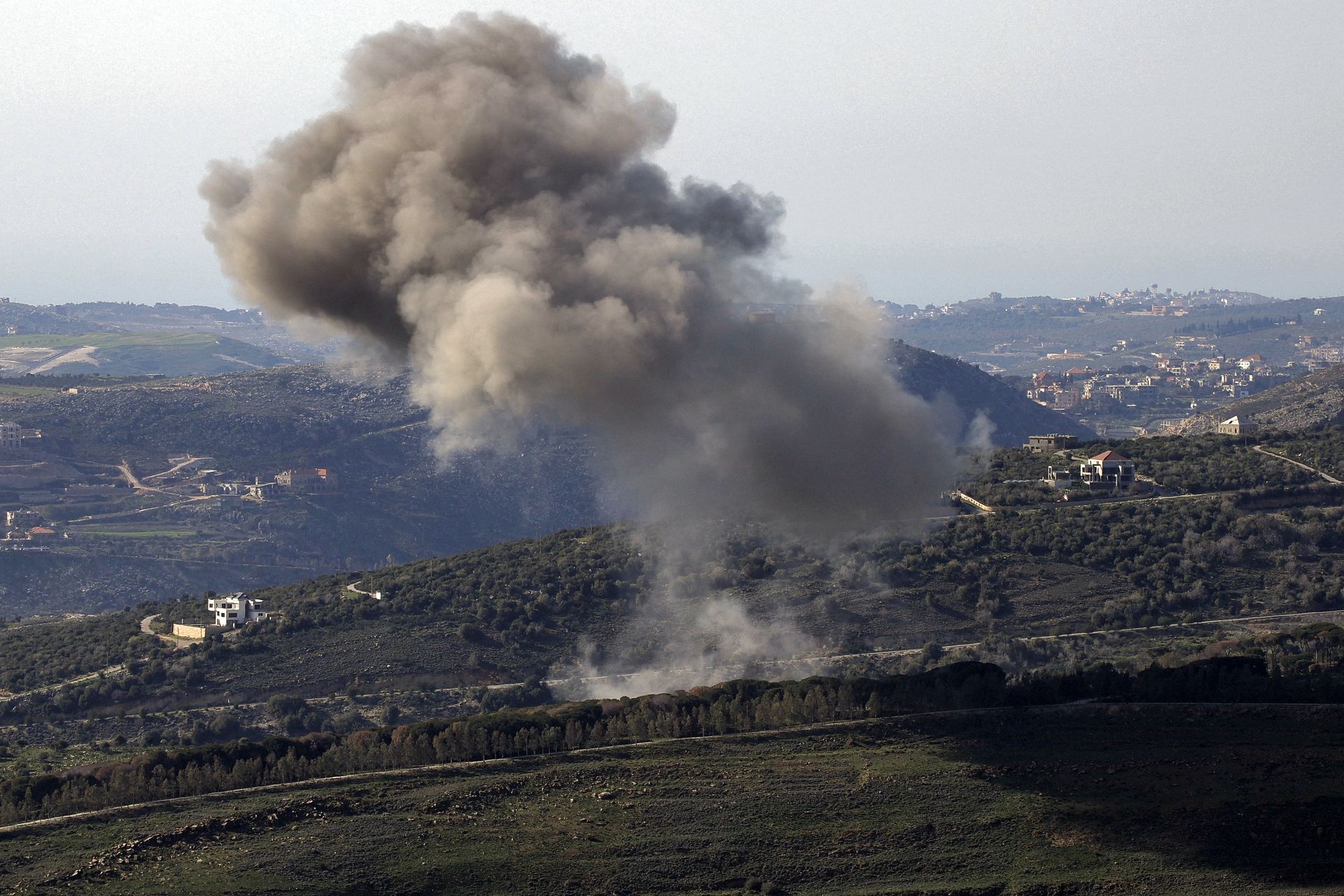
Fresh Israeli strikes hit Beirut's southern suburbs and southern Lebanon on Tuesday after the Israeli army warned people to evacuate and the United Nations said 100,000 people had been displaced in a single day.
Lebanon was drawn into the Middle East war last week when the Iran-backed militant group Hezbollah attacked Israel in response to the killing of Iranian supreme leader Ayatollah Ali Khamenei in U.S.-Israeli strikes.
Israel, which kept up strikes targeting Hezbollah despite a 2024 ceasefire, has since launched waves of attacks across Lebanon and sent ground troops into border areas.
"Israeli warplanes launched a raid... on the southern suburbs" of Beirut, Lebanon's state-run National News Agency said.
AFPTV footage showed smoke rising from the area, where Hezbollah holds sway, while the Israeli military said it began "striking Hezbollah infrastructure" there.
In Lebanon's south, the NNA said "the Israeli enemy launched a strike" in Abbassiyeh near Tyre city, after the Israeli military said it would strike a building there and in the coastal city of Sidon.
It also reported strikes in other areas.
Lebanese authorities have said Israel's attacks since March 2 have killed at least 486 people and wounded more than 1,300 others.
The government has said more than 660,000 people have registered as displaced, with some 120,000 sleeping at official shelters as of Monday.
The United Nations said on Tuesday that among the displaced were more than 100,000 who had fled in just 24 hours.
This is "a faster pace of displacement compared to 2024," during Israel's last war with Hezbollah, said Karolina Lindholm Billing, the UN refugee agency's representative in Lebanon.
'Starting from zero'
Among those taking refuge in Beirut's Camille Chamoun Sports City Stadium, which has been turned into a shelter, was Fatima Shehadeh, 35, a mother of four who fled the southern suburbs last week.
"I was pushing my baby in a stroller. "We left on foot at 2:00 am and spent the night outside before coming to the shelter," she said.
She expressed worry about the impact of Israeli raids on her children, one of whom hid inside their tent a day earlier in fear.
"He didn't come out because of the strikes. They were really close," she said.
Dozens of family-sized tents have been set up inside the stadium, with families sleeping inside on thin mattresses on the concrete floor.
Beirut mayor Ibrahim Zeidan said the site could shelter more than 3,000 people.
Malak Jaber, 35, a mother of three from south Lebanon's Nabatiyeh, said, "We spent two or three days living under a bridge until they opened up this place."
"My home was bombed yesterday," she said. "If I want to go back... we'll be starting from zero."
Meanwhile, Lebanese President Joseph Aoun and his Syrian counterpart, Ahmed al-Sharaa, agreed on the need to control their shared border, a Lebanese presidency statement said, after Syria accused Hezbollah of firing artillery shells into its territory overnight.
A day earlier, Aoun accused Hezbollah of working to "collapse" the state and expressed Beirut's readiness for "direct negotiations" with Israel, while the head of the Iran-backed group's parliamentary bloc, Mohamed Raad, vowed that his group would "defend our existence whatever the cost."
Also Tuesday, the last residents of the Christian village of Alma al-Shaab near the Israeli border fled, a UN source and an AFP correspondent said, after locals had for days defied an Israeli order to leave.
AFP


Comments