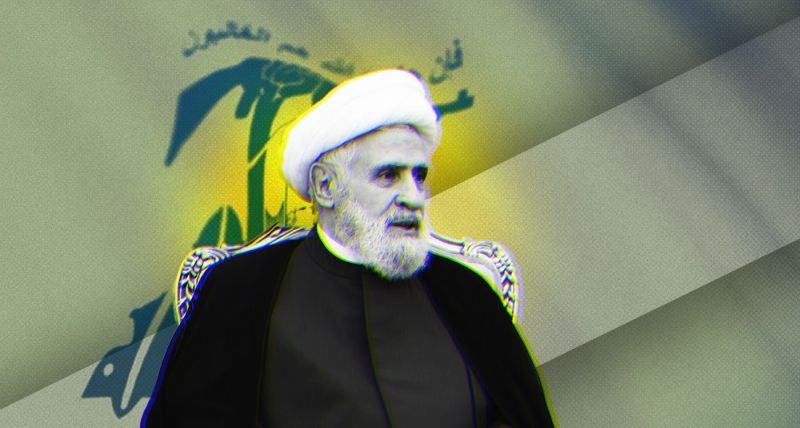
Hezbollah Secretary-General Naim Qassem delivered televised remarks amid Israeli strikes in Beirut’s southern suburbs.
Qassem’s speech marked his first appearance since Hezbollah opened fire on Israel on Monday morning. He spoke on issues including the ongoing U.S. and Israeli strikes in the region, the internal displacement of Lebanese citizens, and the Lebanese state’s disarmament efforts.
Increasing Pressure on Hezbollah
During the speech, the Israeli army carried out an offensive in Beirut’s southern suburbs and targeted a member of Hezbollah in Jnah. Heavy gunfire was also reported in the area.
Hezbollah has faced pressure from both the Lebanese government, the U.S., and Israel for retaining arms and taking part in the Iran conflict.
On Monday, the Lebanese government banned non-state military activity outright, in response to Hezbollah’s missile attacks on Israel.
On Wednesday, the Lebanese army arrested 27 people this week for “illegally possessing weapons and ammunition” as the government adopts a more offensive stance against non-state arms.
Qassem’s Speech
In Qassem’s Wednesday speech, he articulated Hezbollah's decision to initiate missile strikes on Israel as a “response of 15 months of daily violations” and that “Israel opened the war.”
“Our patience is limited, and Israel’s aggression has become great,” he said. He commented that Israel’s counterattack was not a response, but a prepared aggression.
He added that amidst escalation with Israel, “we are facing aggression” and “our choice is to confront it until the ultimate sacrifice, and we will not surrender.”
Qassem mentioned the mass displacement of Lebanese citizens in the south, east, and Beirut’s southern suburbs, saying that “displacement aims to create a rift between the resistance and the people, but the people know that displacement happened as a result of aggression.”
Qassem criticized efforts to disarm Hezbollah, stating that the Lebanese government’s approval of an August 2025 plan to restore a state monopoly on arms possession weakened the government and gave Israel legitimacy.
“The government is responsible for Lebanon,” Qassem stated, “not for implementing American decisions.”


Comments