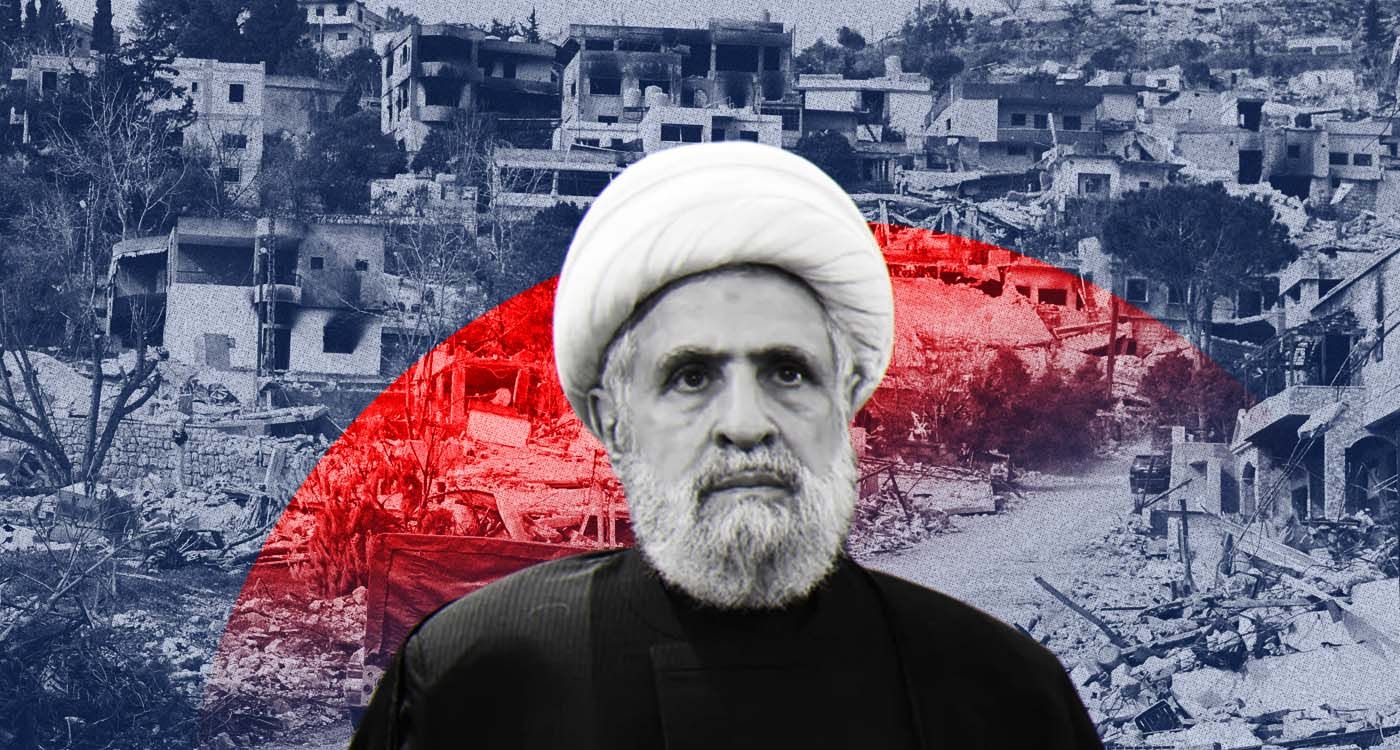
Naim Qassem, Hezbollah’s Secretary-General, delivered a speech amid rising tensions between the U.S. and Iran on Monday, stating that any attack on Iran would also target his group, and warned that any new war on the Islamic Republic would ignite the region.
On the question of Hezbollah’s engagement in a conflict scenario, Qassem left ambiguous remarks, stating that the organization reserves the right to get involved as they see fit, and that they may or may not intervene.
“We have the authority to do what we feel is appropriate to counter the threat,” Qassem asserted.
However, he stated that “When Khamenei is threatened, we are not neutral” and linked any attack on Iran as an attack on Hezbollah itself.
He issued a warning that any escalation into direct confrontation between the U.S. and Iran would further deteriorate the region’s stability, suggesting that attacks would lead to a “total war.”
Qassem’s speech comes in light of recent blows to Hezbollah’s position within Lebanon. The organization is compelled to display strength in the face of weak optics, but it knows that it is not capable of direct intervention on behalf of Iran without risking even further decimation of its limited power-projecting capabilities.
Hezbollah’s Recent Setbacks
Directly preceding Naim Qassem’s speech, Hezbollah has faced notable defeats within Lebanon over the course of last week. The optics of weakness of Hezbollah’s power prompts him to portray an image of strength, further incentivizing the organization to speak out on behalf of Iran and Ayatollah Khamenei.
On Thursday, Prime Minister Nawaf Salam announced that Lebanon has achieved full operational control over the region south of the Litani river.
On Friday, During a period of heightened scrutiny of President Joseph Aoun from Hezbollah-affiliated media, Speaker of Parliament Nabih Berri met with Aoun at the Baabda palace to discuss Lebanon’s security. The two discussed the need to expand the role of the Lebanese Armed Forces in southern Lebanon.
Berri denounced Hezbollah-affiliated newspaper al-Akhbar’s coverage of him in his meeting with Aoun, calling it false and deceptive. A long-time ally of Hezbollah in the Lebanese parliament, Berri’s rift with the organization suggests that it is losing the political support it needs to maintain leverage over the Lebanese state.
On Saturday, al-Akhbar experienced widespread funding cuts and terminations, serving as a significant blow to Hezbollah’s information ecosystem. Hezbollah’s media outlets have been a primary pillar of its power in the country, and its breakdown indicates a broader weakening of Hezbollah’s broader institutional apparatus.


Comments