- Home
- Middle East
- Gulf on Edge as Maritime Incidents, Airspace Closures, and Explosions Signal Dangerous Expansion of Conflict
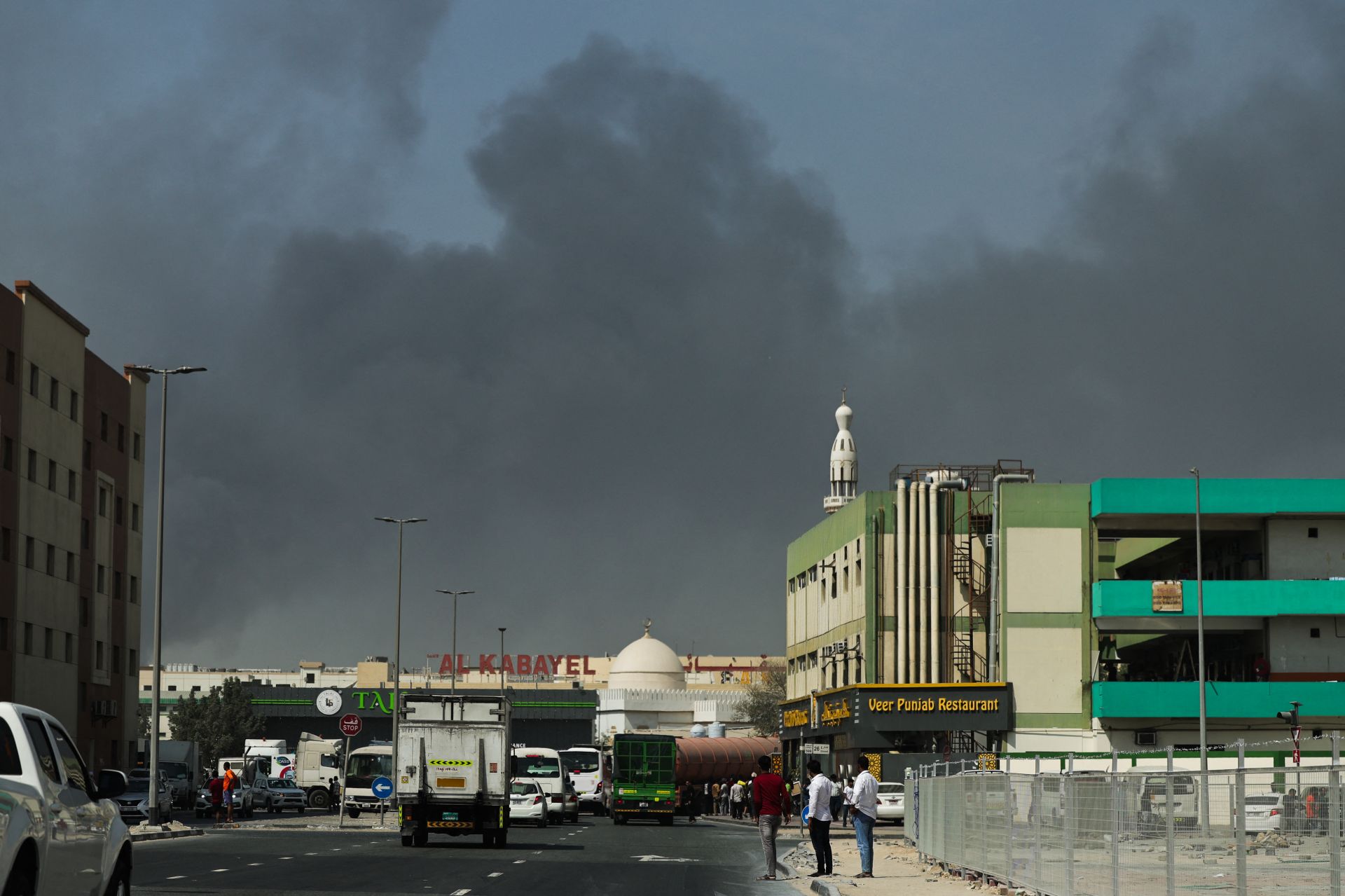
People look at thick smoke rising from the site of a reported Iranian strike in Dubai on March 1, 2026. ©FADEL SENNA / AFP
The regional confrontation widened dramatically on Sunday as maritime incidents in the Gulf, renewed missile activity, airspace closures, and fresh security alerts pushed tensions to one of their most volatile points since the start of the U.S.–Israeli strikes on Iran.
Maritime Flashpoint in the Strait of Hormuz
The Secretary-General of the Gulf Cooperation Council (GCC) condemned what he described as an Iranian attack on the Port of Duqm in Oman and on an oil tanker, calling it a “rejected escalation that threatens regional stability.”
Iranian state television reported that Iranian forces targeted an oil tanker attempting to cross the Strait of Hormuz after it allegedly ignored warning signals. The claim has not yet been independently verified.
Reuters reported that approximately 150 oil tankers are currently halted in open waters across the Gulf, avoiding transit through the Strait of Hormuz, one of the world’s most critical energy chokepoints. Additional shipping vessels were seen anchored off the coasts of Iran, Iraq, Kuwait and the United Arab Emirates.
The UK Maritime Trade Operations (UKMTO) authority confirmed it had received a report of an incident two nautical miles north of Khasab, in Omani waters, though details remain limited.
The growing disruption to maritime traffic raises serious concerns about global energy supply routes and the security of international shipping lanes, which is a red line for many, including China, the largest economic partner and trading partner of Iran. And that may represent a turning point in the ongoing war.
Explosions Across the Region
Multiple Gulf capitals reported more renewed sounds of explosions on Sunday.
Air raid sirens sounded again in Bahrain, while witnesses reported hearing explosions in the skies over Doha. Explosions were also reported in Erbil, in Iraq’s Kurdistan region, as the conflict’s ripple effects continued to spread geographically.
Iraq extended the closure of its airspace for an additional 24 hours, citing the deteriorating security situation.
Diplomatic and Security Alerts Intensify
The United Kingdom advised its citizens to avoid travel to Gulf states except when absolutely necessary.
The U.S. Embassy in Bahrain urged American citizens to avoid staying in hotels in Manama, warning they could become potential targets amid the escalating situation.
Meanwhile, the U.S. Embassy in Jordan instructed its personnel to avoid approaching the embassy compound as a precautionary measure against possible targeting.
These alerts reflect growing fears that diplomatic facilities, commercial infrastructure, and symbolic locations could become secondary targets in the expanding confrontation.
A Region at Risk of Strategic Spillover
The latest developments mark a significant shift from state-to-state missile exchanges toward broader regional instability affecting maritime security, civilian aviation, energy transit routes, and diplomatic infrastructure.
With shipping routes disrupted, airspace closures expanding, and Gulf states increasingly drawn into the crisis, the confrontation is no longer confined to Israel and Iran. Instead, it is evolving into a multi-domain regional crisis with global economic implications.
Read more


Comments