- Home
- Middle East
- Inside the Historic 2026 U.S. Military Buildup Leading to the Iran Strikes
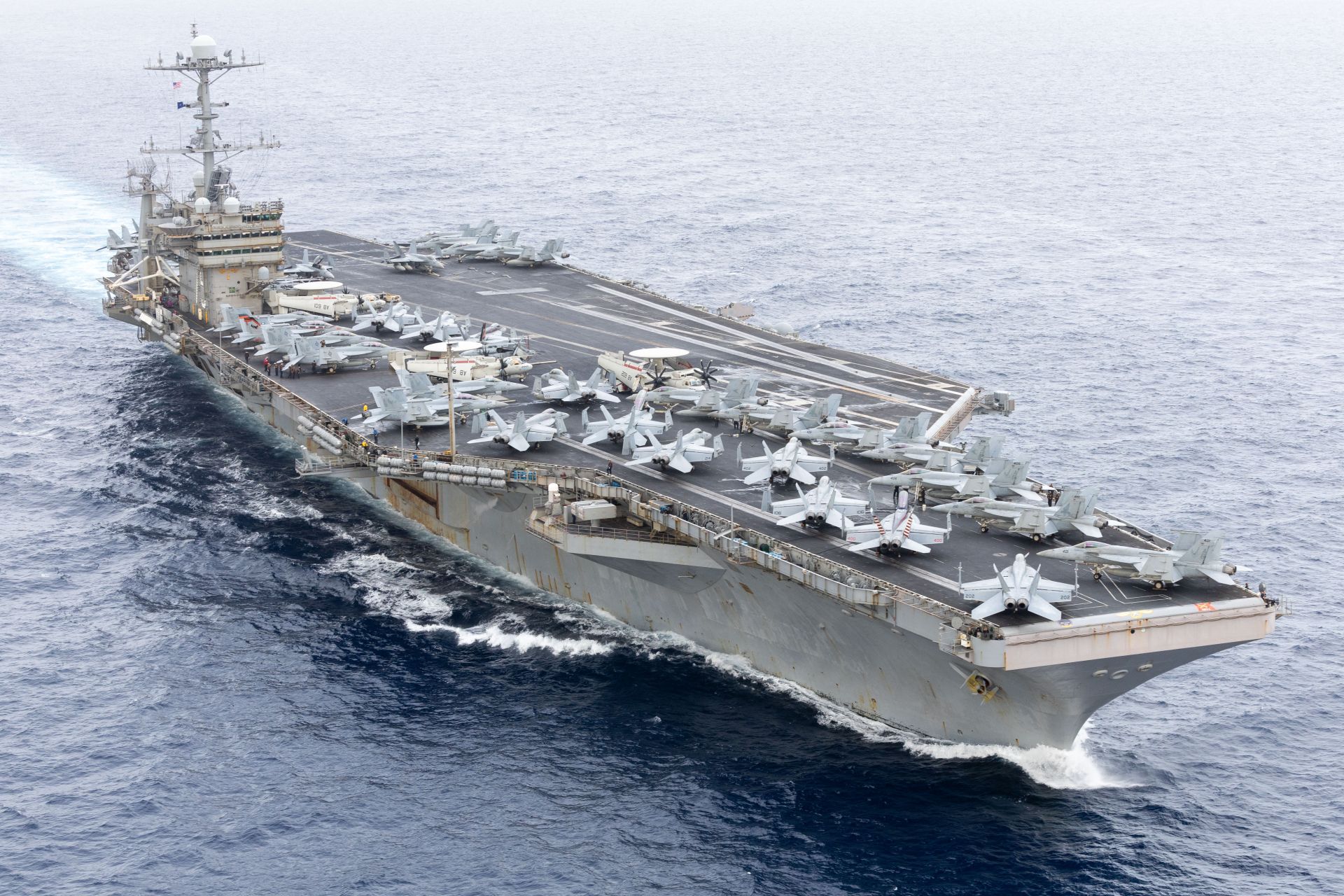
©Michael Gomez / US NAVY / AFP
The U.S. and Israel have begun conducting joint strikes on Iran on February 28 following a historic U.S. military buildup in the Middle East.
This is Beirut compiled a timeline of the 2026 buildup leading up to the attacks, revealing preparations for using large amounts of force against Iranian targets.
The 2026 U.S. Military Buildup
The U.S. rapid military buildup in the Middle East has not occurred continuously, but rather in tandem with stages of negotiations and threats between the U.S. and Iran.
On January 13, amid the Iranian regime’s brutal crackdown on protesters under a telecommunications blackout, President Donald Trump stated that “help is on its way,” proposing the option of U.S. intervention in Iran.
In mid-January, the U.S. demanded that Iran "come to the table" for a new nuclear deal while ordering the U.S.S. Abraham Lincoln aircraft carrier strike group–what Trump called an “armada”–to the Middle East.
On February 6, the U.S. and Iran held their first set of nuclear talks in Muscat, Oman as the U.S.S. Abraham Lincoln arrived in the Arabian Sea. Despite both parties expressing that they were pleased with the dialogue, President Donald Trump ordered the U.S.S. Gerald Ford aircraft carrier to reposition from the Caribbean towards the Eastern Mediterranean.
The second set of nuclear talks, on February 17 in Geneva, occurred amidst an increase of warplanes to the region and an influx of U.S. military cargo flights–over 200–delivering hardware to its Middle Eastern bases.
The February 26 Geneva talks coincided with the arrival of 12 F-22 Raptor jets to the Ovda base in Israel, which is the first U.S. deployment of offensive and stealth jets in the country.
Senior U.S. officials expressed disappointment with the February 26 talks, going into the meeting with a demand for zero uranium enrichment, and prompting Trump’s comment that “sometimes you have to” use the military. The U.S.S. Gerald Ford also departed Greece to position itself in the Eastern Mediterranean.
The U.S. incurs large costs in its operation of military assets, with the two aircraft carrier strike groups each requiring over $6.5 million per day. Utilizing them for attacks is even more costly, with June 2025’s limited strikes on Iran may have cost over $2 billion. It is estimated that the 2026 military buildup has already cost over $200 million overall.
As of February 27, over 330 U.S. warplanes are stationed in bases around the Middle East, and non-essential personnel were evacuated from bases in Bahrain and Kuwait and the Al-Udeid air base in Qatar, the headquarters of CENTCOM.
The morning of February 28 saw the first U.S.-Israeli strikes on Iran.
History of U.S. Military Presence in Middle East
The U.S. has been undertaking a sizable military buildup in the Middle East since January, the largest concentration of military assets in the region since the 2003 U.S. invasion of Iraq.
The U.S. has maintained a consistent military presence in the Middle East since the onset of the Cold War with the stationing of the Middle East Force in Bahrain in 1948. The U.S. held limited troops in the region until the end of the Cold War with its largest intervention being the 1958 “Operation Blue Bat” in Lebanon to prevent a coup.
Aircraft carriers have been used by the U.S. as a deterrent in the region since the 1970s, in which 3 aircraft carriers were deployed during the 1973 Yom Kippur War as a signal to the Soviet Union and its allies.
In the 1970s and 1980s, the U.S. prioritized protecting its access to energy resources in the Gulf, particularly following the 1979 Iranian Revolution. President Jimmy Carter had established a doctrine of viewing any obstruction to Gulf energy as an attack on vital U.S. interests.
However, U.S. military presence grew considerably with the 1990-1991 Gulf War where a tripwire force was inflated to 500,000 U.S. troops stationed in Saudi Arabia to push Iraqi troops out of Kuwait.
Heavy deployment of U.S. assets and personnel remained in the region since, particularly in 2003 with the U.S. invasion of Iraq with 250,000 troops.
Preceding the 2026 buildup and attacks, B-2 bombers were used in June 2025 to strike Iran in “Operation Midnight Hammer” during the 12-Day War between Israel and Iran.
Read more

Comments