- Home
- Middle East
- Trump Announces “Wide-Scale Combat Operations” in Iran
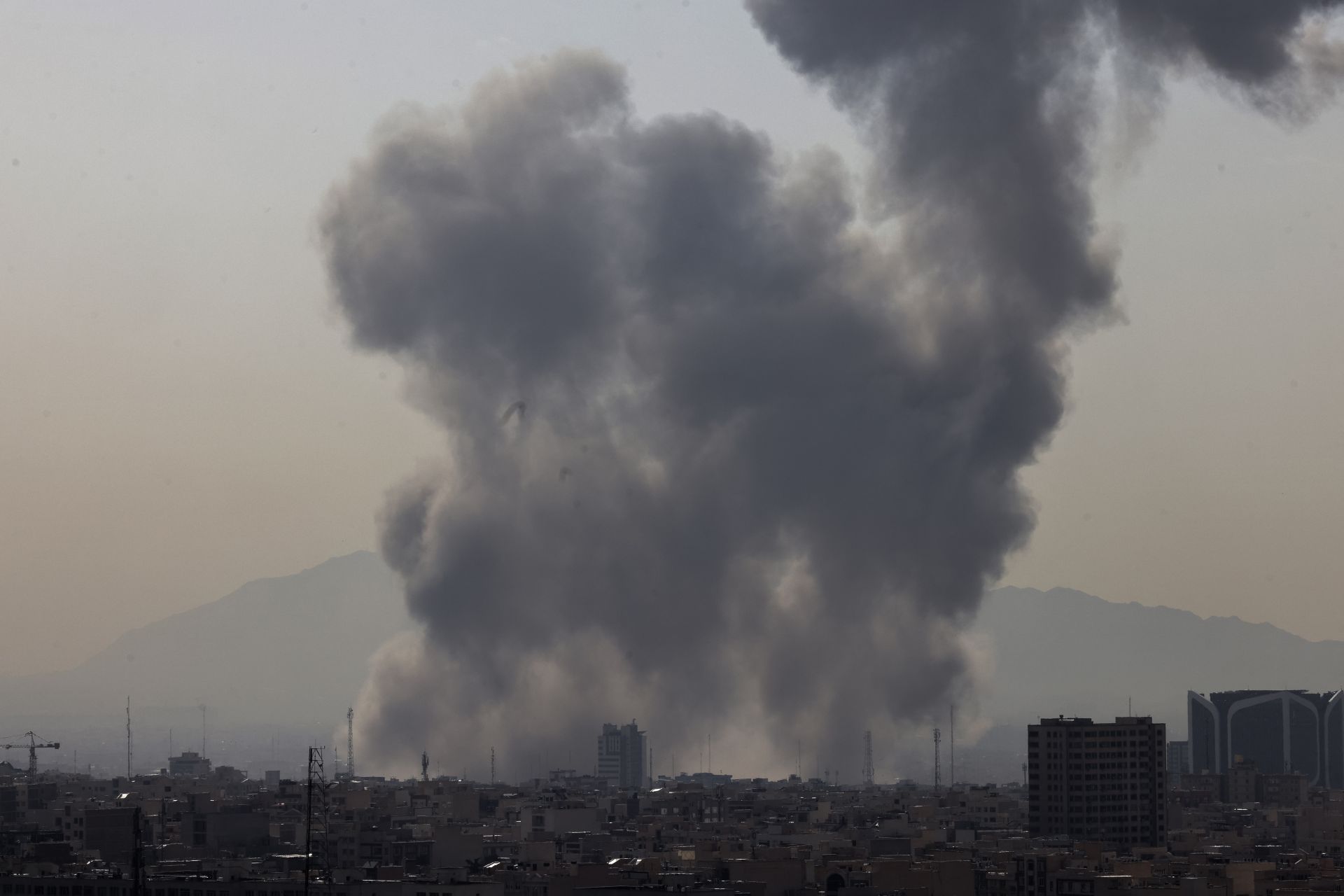
A plume of smoke rises following a reported explosion in Tehran on February 28, 2026. Two loud blasts were heard in Tehran on February 28 morning by AFP journalists, and two plumes of thick smoke were seen over the centre and east of the Iranian capital. ©ATTA KENARE / AFP
U.S. President Donald Trump announced early Saturday that the United States has begun what he described as “wide-scale combat operations” in Iran, marking a dramatic escalation in tensions and signaling the start of direct military engagement.
“Moments ago, we began large-scale combat operations in Iran,” Trump said in a televised address, stating that the objective is “to defend the American people by eliminating imminent threats from the Iranian regime.”
The president described Iran’s leadership as a “dangerous regime” and reiterated that Tehran “can never possess a nuclear weapon.” He accused Iran of developing long-range missiles that pose a threat to the United States and allied nations, vowing to “destroy Iran’s missiles” and warning that Washington would “eliminate their naval fleet” if necessary.
In a direct message Trump said, “To the members of the IRGC, the armed forces, and all of the police, I say tonight that you must lay down your weapons and have complete immunity, or in the alternative, face certain death.”
President Trump warned the people of Iran to take cover and emphasized, "When we are finished, take over your government. It will be yours to take."
U.S. Strike Focus and Explosions in Tehran
According to The New York Times, citing a U.S. official, the current wave of American strikes is primarily focused on Iran’s military apparatus.
Reuters, citing a U.S. official, reported that the American military expects the operation against Iran to last several days, suggesting the campaign may extend beyond an initial wave of strikes.
Meanwhile, Iran’s Tasnim News Agency reported that seven missiles fell near the presidential palace and the compound of Supreme Leader Ali Khamenei in Tehran. The report could not be independently verified, and Iranian authorities have not yet issued a detailed statement confirming the extent of the damage.
Iran’s Ministry of Health announced that hospitals nationwide have been placed on full alert and said casualty figures would be released once confirmed.
Historical Framing and Escalation Rhetoric
In his remarks, Trump referenced the 1983 Beirut Marine barracks bombing, an attack that killed 241 U.S. service members, blaming Iranian-backed groups and framing the current operation as part of a broader effort to counter long-standing Iranian threats.
“From Lebanon to Yemen and Syria to Iraq, the regime has armed, trained, and funded terrorist militias that have soaked the earth with blood," he said.
The president’s rhetoric suggested that Washington views the campaign not as a limited strike but as a broader effort to dismantle Iran’s military capabilities and prevent it from advancing its missile and nuclear programs.
A Rapidly Developing Conflict
Saturday’s developments represent one of the most serious direct confrontations between the United States and Iran in decades. While details remain fluid, the combination of confirmed U.S. military action, reported missile impacts in Tehran, regional flight suspensions, and hospital mobilization signals a significant escalation with potentially wide-ranging regional consequences.
Read more

Comments