- 27
- Feb.
- 2026


As regional tensions mount over the possibility of U.S. military action against Iran, Israel has escalated its operations in Lebanon, signaling that Jerusalem will not accept any attempt by Hezbollah to open a front in support of Tehran.
Israel’s recent waves of bombardment in Lebanon’s eastern Bekaa Valley were “clearly pre-emptive,” according to security analyst Riad Kahwaji. “Israel’s broader goal is unmistakable. Its main target right now is Hezbollah’s missile capability,” he added.
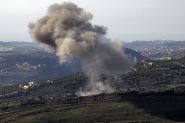
On February 20, eight Hezbollah members — including a military commander — were killed in Israeli strikes in eastern Lebanon. Six days later, Israel struck eight training compounds belonging to Hezbollah’s Radwan Forces.
Notably, Israel did not characterize its strikes last week in the Bekaa as part of its routine operations to prevent Hezbollah from reconstituting militarily. Instead, the Israeli military signaled that its attack was preemptive in nature, saying it had identified Hezbollah operatives working to “accelerate the organization’s readiness and force build up processes” while planning fire attacks on Israel.
“Hitting the command of the missile force — especially the heavy missiles — is comparable to what we saw in the previous war with the elimination of Hezbollah’s elite Radwan Force leadership,” Kahwaji told This is Beirut.
A Western diplomatic source, speaking to This is Beirut on condition of anonymity, said the latest attacks carried “a firm message that Israel will not let Hezbollah rebuild itself.”
Retired Lebanese Armed Forces (LAF) Brig. Gen. Hisham Jaber said Israel’s target map in Lebanon has shifted beyond the border areas where the LAF has been conducting disarmament operations against Hezbollah. “It is no longer south of the Litani — that phase is over. It has moved north of the Litani and into the Bekaa,” he told This is Beirut.
However, Jaber said the strikes in the Bekaa did not carry a specific message. “It is part of continued attacks by Israel since the November 2024 ceasefire,” he said.
He added that despite the escalation and expansion of the strikes, “Hezbollah won’t be deterred if there is a decision to enter a potential war.”
Kahwaji argued that Israel was signaling with its recent strikes that no area in Lebanon was beyond its reach. The operations, he said, aim to dissuade Hezbollah and its allies, including Hamas, from opening a front in support of Iran in the event of a U.S. attack.
On February 20, Israel’s navy fired missiles at a Hamas facility inside Ain al-Hilweh that killed and wounded several people, including Hamas officials.
Political and security sources told the Lebanese daily Nidaa al-Watan that recent field indicators suggest Hamas-linked elements are operating in coordination with Hezbollah. These dynamics raise concerns that Lebanon could be drawn into a “support war” for Tehran.
According to the sources, one scenario would see Palestinian factions launching attacks against Israel from Lebanese territory while Hezbollah initially distances itself, allowing it to frame any subsequent involvement as defensive rather than offensive.
“Hamas in Lebanon operates under Hezbollah,” Kahwaji said, noting that the Palestinian faction has refused to surrender its weapons to the Lebanese state. Hamas would comply with Lebanon’s disarmament efforts only if Hezbollah ordered it to do so, he added.
He added that Hamas has previously carried out attacks against Israel when Hezbollah sought to avoid direct responsibility. “If Hezbollah decides to open the front from Lebanon, Hamas will certainly be part of it,” he said.
Jaber downplayed the likelihood that Hamas in Lebanon would join a broader confrontation if Hezbollah were to open a front in response to a U.S. strike on Iran. “I don’t think Hamas would be part of such a war,” he said. “If it did engage, it would disrupt the agreement over Gaza,” he added, referring to the ceasefire inked in October 2025 that ended hostilities in the enclave.
However, Jaber acknowledged the presence of armed Palestinian factions—including Hamas and Palestinian Islamic Jihad—operating outside refugee camps in Lebanon. “These elements could be used against Israel,” he said, noting that they are directed and guided by Hezbollah.
Beyond warning Hezbollah against opening a front in support of Iran, the recent Israeli strikes also signal that the group’s internal security remains compromised and its military leadership is vulnerable to targeted assassinations.
In recent months, Hezbollah has claimed it had rebuilt its capabilities and purged collaborators. Yet the scale and precision of the Bekaa strikes suggest significant infiltration at the group’s core.
“It is a message that Hezbollah is exposed and that Israel is monitoring its movements and that of its allies closely and that it can strike them anywhere and anytime,” the Western diplomatic source told This is Beirut.
This view was echoed by Jaber, who noted ongoing security breaches within Hezbollah’s ranks.
“There are still agents inside the group,” he said. “They have uncovered many, but they continue to discover others every day.”
Analysts also view the recent Israeli escalation as part of mounting pressure on both the Lebanese state and Hezbollah to push for expedited disarmament of non-state weapons. On February 16, Lebanon’s cabinet gave tacit approval to an LAF plan for the next phase of disarmament between the Litani and Awwali rivers. As the region holds its breath over potential U.S. strikes on Iran, Israel’s latest operations highlight how Lebanon could once again become a flashpoint in a regional confrontation.


Comments