- Home
- Middle East
- Graham: U.S. Decision on Iran “Has Been Made” as Military Buildup Accelerates
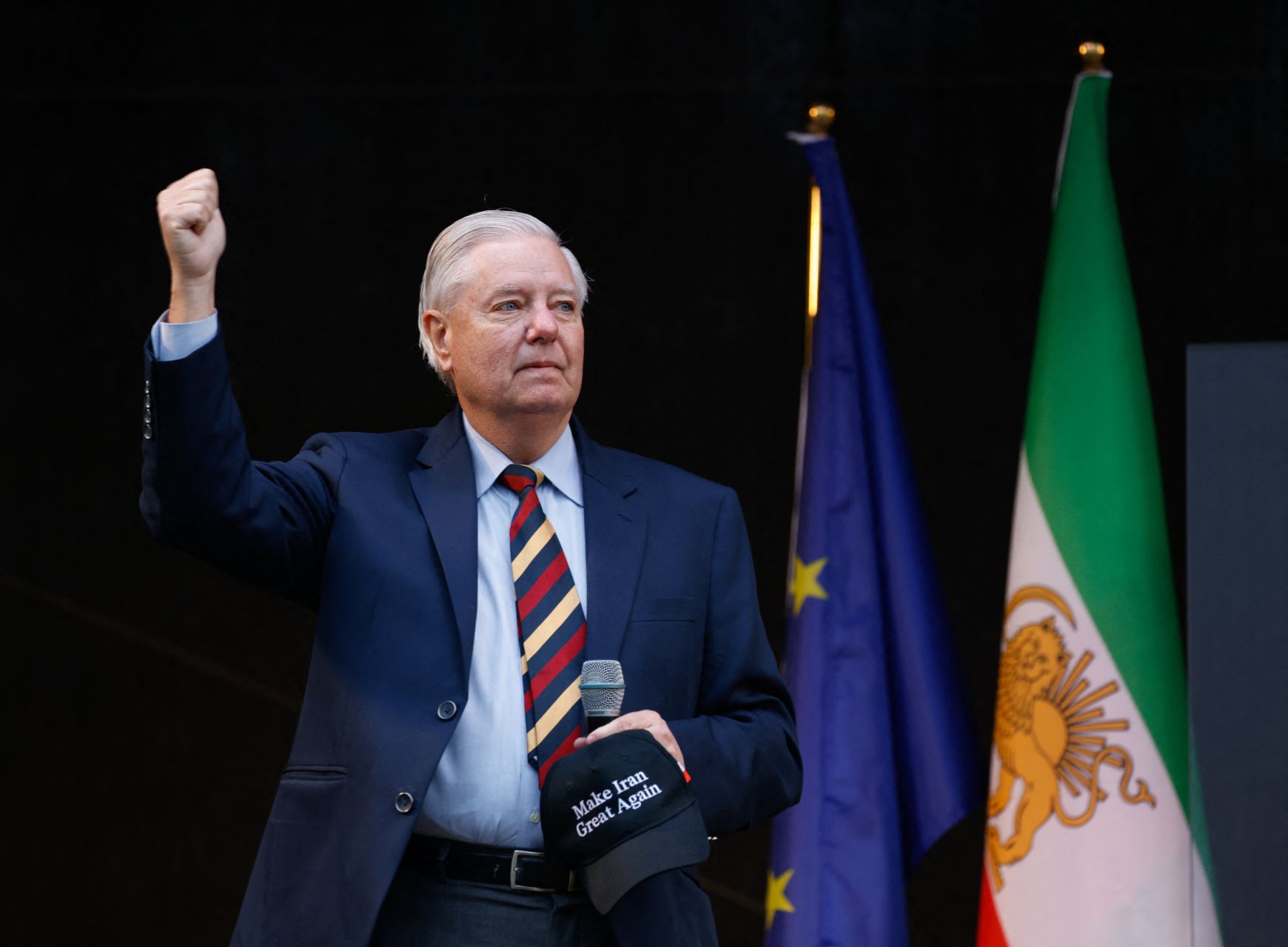
U.S. Senator Lindsey Graham, Republican of South Carolina, gives the thumbs-up on stage next to an European and the historic Iranian "Lion and Sun" national flag during a demonstration of the Iranian opposition on February 14, 2026 at the Theresienwiese fair grounds in Munich, southern Germany, on the sidelines of the 62nd Munich Security Conference (MSC). ©MICHAELA STACHE / AFP
U.S. Senator Lindsey Graham said Wednesday that Washington has already taken its decision on Iran, signaling that military action is increasingly likely as American forces continue to deploy across the region and diplomatic talks show limited progress.
Speaking in an interview with Sky News Arabia’s The Truth with Hadley Gamble, Graham declared that the United States “needs military action” against Iran, adding pointedly: “All these ships don’t come here just because the weather is nice this time of year.”
The Republican senator described the current military mobilization as deliberate and advanced, saying U.S. capabilities are now being put in place and that a decisive moment is approaching “within weeks, not months.”
He framed the looming confrontation as a joint U.S.-Israeli effort, arguing that weakening Iran’s leadership would also help curb domestic repression following recent protests inside the country.
“Real change doesn’t come without sacrifice,” Graham said, asserting that assistance to the Iranian people is on the way and that Washington is prepared to alter the situation “one way or another.”
The buildup of U.S. air power in the Middle East is the biggest since the 2003 invasion that launched the Iraq War, according to a report by the Wall Street Journal.
Regime change rhetoric resurfaces
Graham also echoed remarks by U.S. President Donald Trump, who has openly suggested that Iran needs new leadership. According to Graham, Trump’s message to Iranians to continue protesting marked a turning point.
“He made the choice clear,” Graham said, adding that Trump believes the best path forward is for Iranians themselves to reclaim control of their country.
Pressed on what would follow the collapse of Iran’s leadership, Graham said the responsibility lies solely with the Iranian people. “It’s not our job to build a new Iran,” he said. “It’s our job to give Iranians the chance to build a new Iran.”
He warned that the coming month could prove decisive, suggesting that failure to resolve the standoff within 30 days could close what he described as a historic window.
Diplomacy falters as pressure mounts
Graham’s remarks come as indirect U.S.-Iran negotiations continue to stall. Following a second round of talks in Geneva on Tuesday, both sides said discussions had made “progress,” but U.S. officials acknowledged that major gaps remain.
Washington has maintained that any agreement must go beyond Iran’s nuclear program to include its missile capabilities and regional influence. Tehran, for its part, insists negotiations should remain limited to nuclear issues.
Earlier this year, Trump repeatedly threatened military action after Iran’s deadly crackdown on protesters before pivoting to a dual-track strategy combining diplomacy with an extensive military buildup.
That buildup has since intensified, with U.S. forces deployed across the Middle East in what officials describe as a posture designed to support negotiations while preparing for the possibility of war.
Despite continued talks, U.S. officials have expressed little optimism about bridging the divide, reinforcing Graham’s assertion that Washington is now moving closer to a military option.
Read more


Comments