- Home
- Middle East
- Major U.S.‑Israel Military Operation Against Iran Could Be Imminent: Report
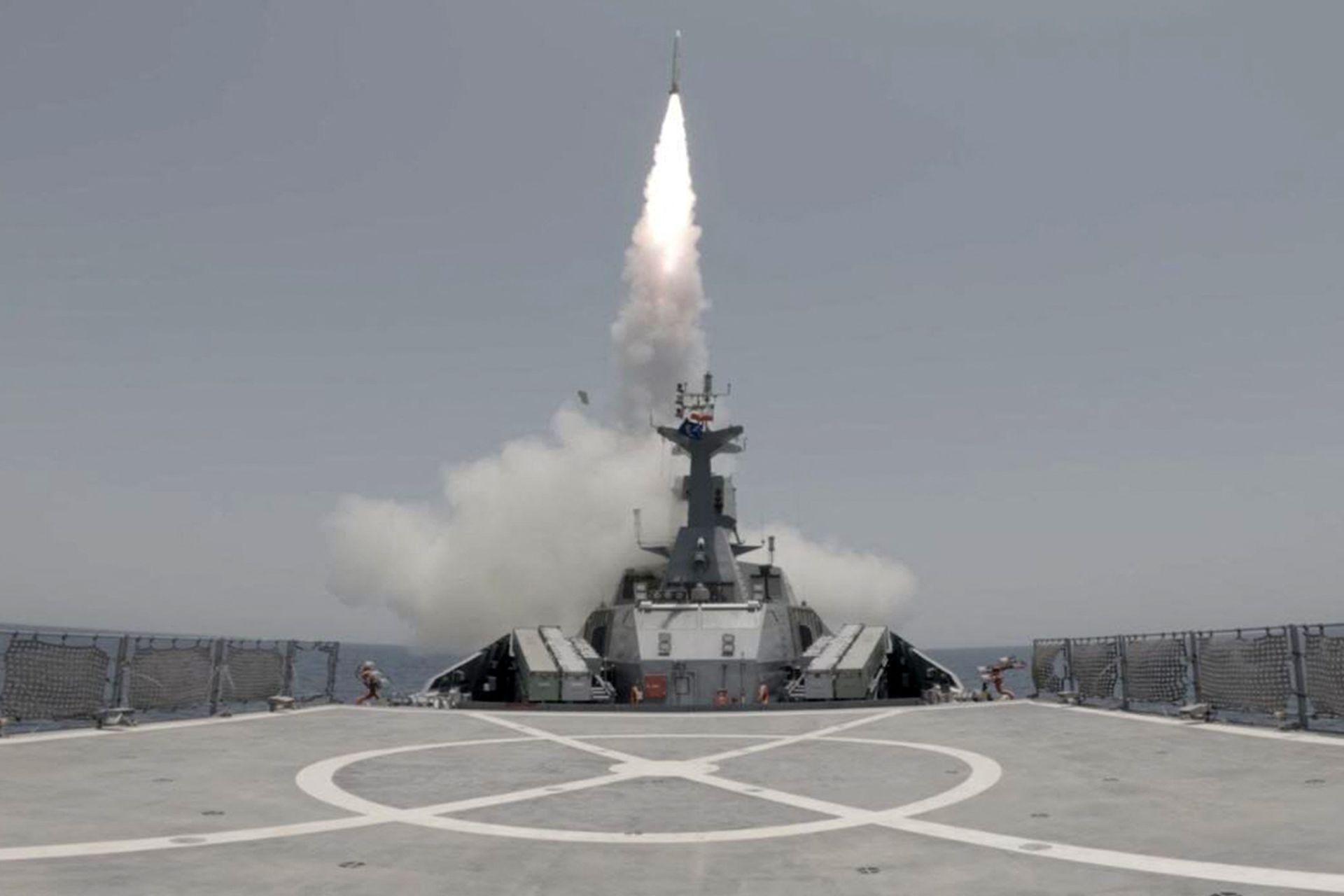
This handout photo released by Iran's Revolutionary Guards Corps (IRGC)'s official website Sepanews on February 17, 2026, shows a rocket being fired during a military exercise by members of the IRGC and navy in the Strait of Hormuz. ©- / SEPAH NEWS / AFP
Israeli officials say preparations are underway for a potential war with Iran within days, as U.S. President Donald Trump escalates military pressure on Tehran while warning that diplomacy may be nearing its limit.
Two Israeli officials told Axios that Tel Aviv is bracing for a rapid deterioration of the standoff, assuming indirect nuclear talks fail. The officials said Israel is advocating for a far-reaching operation that would go beyond Iran’s nuclear facilities to include missile infrastructure and, potentially, elements of the regime itself.
U.S. sources cited by Axios describe any American intervention not as a limited strike but as a multi-week campaign, likely a joint U.S.-Israeli effort, broader in scope than last year’s 12-day conflict and closer in scale to a full regional war.
A senior Trump adviser put the likelihood of kinetic action in the coming weeks at 90 percent, saying the president is “getting fed up” with stalled negotiations.
Republican Senator Lindsey Graham, speaking during a visit to Israel, said Washington’s decision-making timeline is now measured in “weeks, not months,” adding that Iran’s leadership is at its weakest point since 1979.
“There are two lines right now,” Graham said in Tel Aviv. “One is diplomacy. The other is the military option.”
Talks Continue, But Gaps Remain Wide
The warnings come just days after Trump’s envoys, Steve Witkoff and Jared Kushner, held three hours of talks in Geneva with Iranian Foreign Minister Abbas Araghchi. While both sides publicly described the discussions as making “progress,” U.S. officials privately acknowledge that major gaps remain.
Vice President JD Vance said the talks were constructive in parts but emphasized that Tehran has yet to accept Washington’s “red lines,” warning that Trump could soon conclude diplomacy has reached its “natural end.”
Trump himself said he is participating in the negotiations indirectly and expressed hope Iran would choose a deal, adding that Tehran does not want the consequences of failure.
U.S. officials have now given Iran roughly two weeks to return with a detailed proposal, echoing a similar deadline last year that ultimately preceded American strikes on Iranian nuclear facilities.
Massive U.S. Military Buildup Underway
Even as negotiations continue, Washington has dramatically expanded its military footprint across the Middle East.
According to U.S. sources, Trump’s growing “armada” now includes two aircraft carriers, more than a dozen warships, hundreds of fighter jets, and multiple air-defense systems. More than 150 U.S. military cargo flights have transported weapons and ammunition to the region, with an additional wave of F-35s, F-22s, and F-16s deployed in the past 24 hours alone.
Trump’s rhetoric and force posture have raised expectations that, if talks collapse, any military response would be decisive.
Iran Responds With Naval Drills and Sharp Warnings
Tehran has answered the buildup with its own show of force.
Rear Admiral Shahram Irani, commander of Iran’s regular navy, said regional countries are fully capable of securing their own waters and warned that Iran would confront any “non-regional fleet” with greater strength.
“If outsiders believe they arrive with power, they should know Iran will respond with more power,” he said.
Iran also announced joint naval exercises with Russia beginning Thursday in the Sea of Oman and the northern Indian Ocean. Iranian media said the drills aim to enhance maritime security cooperation between the two countries.
Earlier this week, Iran’s Revolutionary Guards launched separate exercises in the Strait of Hormuz, temporarily closing parts of the waterway for “security reasons.” Iranian commanders reiterated that they retain the capability to shut the strait entirely if ordered, a threat Tehran has made repeatedly but never carried out.
The Strait of Hormuz remains a vital artery for global oil and liquefied natural gas shipments, making any disruption potentially destabilizing for international markets.
A Narrowing Diplomatic Window
The current standoff reflects a two-track strategy by Trump: sustained negotiations paired with overwhelming military pressure.
Israeli officials say they are planning for the worst-case scenario, assuming talks collapse. U.S. sources caution that Washington may require additional time before acting but acknowledge momentum is shifting rapidly toward confrontation.
With no clear diplomatic breakthrough in sight and military assets already in motion, regional observers warn that the coming days, not months, may determine whether the crisis tips into war or pulls back from the brink.
Read more

Comments