- Home
- Middle East
- Graham Warns U.S. Strike Decision ‘Weeks Away’ as Iran-U.S. Talks Open in Geneva
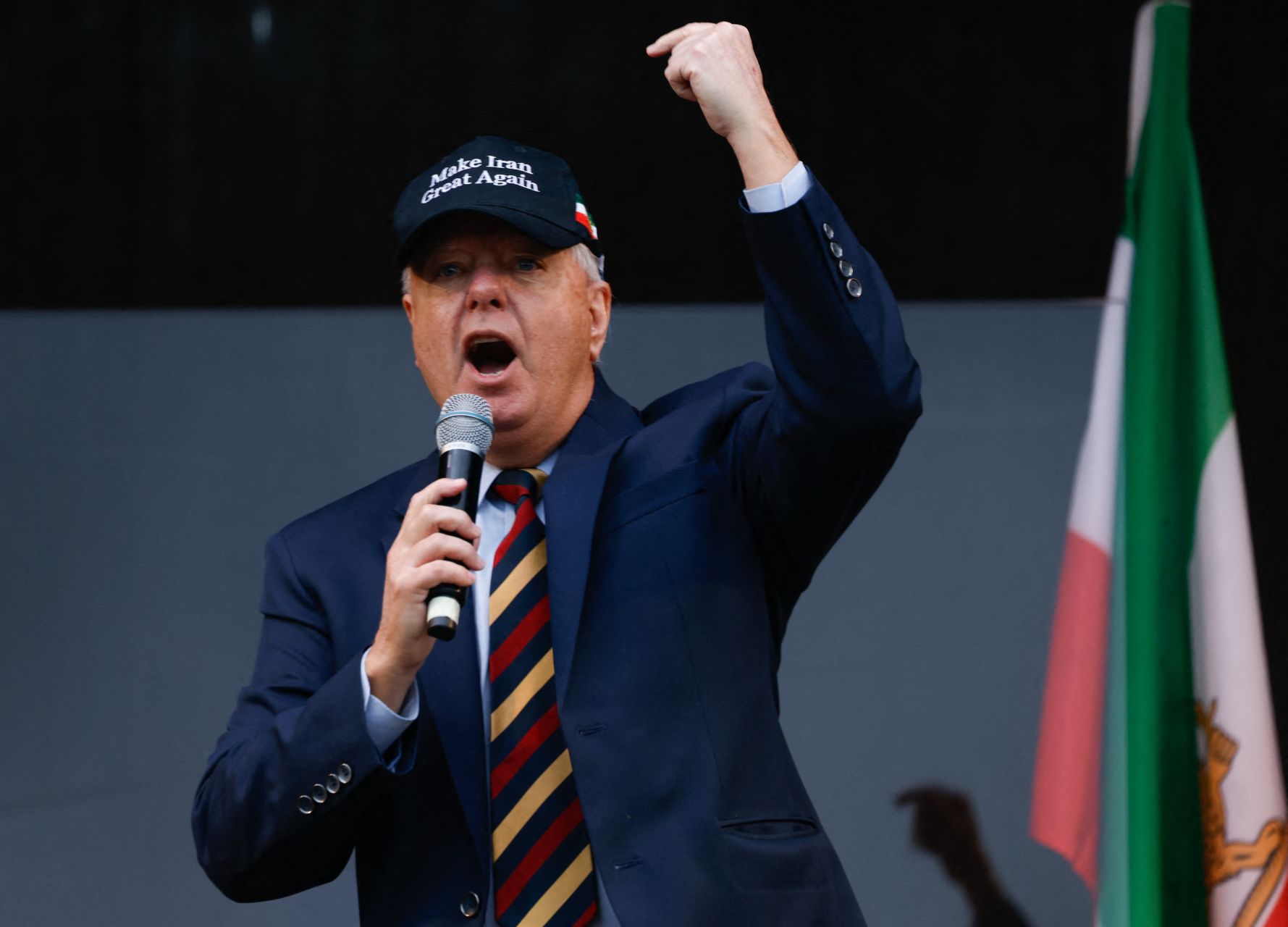
US Senator Lindsey Graham, Republican of South Carolina, stands on stage next to an European and the historic Iranian "Lion and Sun" national flag during a demonstration of the Iranian opposition on February 14, 2026 at the Theresienwiese fair grounds in Munich, southern Germany, on the sidelines of the 62nd Munich Security Conference (MSC). ©MICHAELA STACHE / AFP
Republican Senator Lindsey Graham warned Monday that Washington is only “weeks, not months” away from deciding on potential military action against Iran, just hours before the United States and Tehran opened a second round of indirect nuclear negotiations in Geneva.
Speaking during a visit to Israel, Graham said the U.S. is pursuing parallel diplomatic and military tracks, stressing that there is “no daylight” between Washington and Jerusalem on Iran.
“There are two lines in the water right now,” Graham told reporters in Tel Aviv after meeting Prime Minister Benjamin Netanyahu. “One is diplomacy. The other is the military option. Bottom line, we’re in the weeks, not months, in terms of decision-making.”
Graham described Iran’s leadership as being at its weakest point since 1979, citing economic collapse, military degradation, and growing domestic unrest. He added that if Supreme Leader Ali Khamenei remains in power after months of pressure, it would represent a “strategic victory for Iran and radical Islam.”
“The risk of regime change is real,” Graham said. “There are unknowns, but I’m willing to take that risk.”
Trump joins talks ‘indirectly’
Graham’s remarks came as U.S. and Iranian delegations convened Tuesday in Geneva for a new round of Oman-mediated negotiations focused on Tehran’s nuclear program.
Trump confirmed he would participate “indirectly” in the talks, telling reporters aboard Air Force One late Monday, the discussions would be “very important.”
Calling Iranians “tough negotiators,” Trump said he hoped Tehran would be more flexible than during last year’s failed diplomacy, which culminated in U.S. strikes on Iranian nuclear facilities.
“I think they want to make a deal,” Trump said. “I don’t think they want the consequences of not making a deal.”
Washington has reinforced military pressure ahead of the talks, deploying a second aircraft carrier to the Middle East. U.S. officials cited by Reuters said contingency planning is underway for a prolonged campaign should diplomacy collapse.
Tehran holds firm on enrichment
Iran has reiterated that negotiations must remain limited to nuclear restrictions in exchange for sanctions relief, rejecting U.S. efforts to broaden talks to ballistic missiles or regional alliances.
Foreign Minister Abbas Araghchi arrived in Geneva leading a diplomatic and technical delegation and met with Rafael Grossi for what he described as “deep technical discussions.”
Iranian officials insist enrichment is a sovereign right under the Nuclear Non-Proliferation Treaty, even as the International Atomic Energy Agency continues to press Tehran to account for roughly 440 kilograms of uranium enriched to 60 percent, just short of weapons grade, last verified before Israeli and U.S. strikes in June.
Meanwhile, Iran conducted naval maneuvers in the Strait of Hormuz on Monday, warning that any attack would have regional consequences.
U.S. Secretary of State Marco Rubio acknowledged during a visit to Hungary that reaching an agreement would be difficult, saying only that Washington “hopes” diplomacy succeeds.
Hawks push military option
Graham later told The Times of Israel that Washington must follow through on promises to support Iranian anti-government protesters. “If the ayatollah is still standing after all this bluster,” he said, “that would be a strategic victory for Iran.”
Echoing Graham’s tone, U.S. Ambassador to Israel Mike Huckabee said he hopes for a diplomatic breakthrough but doubts Iran will abandon its nuclear ambitions.
“At some point, the United States needs to say: enough is enough,” Huckabee told Jewish leaders in Jerusalem, warning that Tehran cannot be allowed to remain a nuclear and missile threat.
Narrowing window
The Geneva talks follow months of rising tension after last year’s 12-day war between Israel and Iran and Tehran’s deadly crackdown on protests at home.
While Trump has publicly suggested regime change “would be the best thing that could happen,” senior U.S. officials continue to frame Washington’s goal as preventing Iran from acquiring nuclear weapons.
With diplomacy underway and military assets already in motion, regional and Western officials say the coming days could determine whether negotiations gain traction or whether the standoff accelerates toward another dangerous escalation.
Read more


Comments