- Home
- Middle East
- U.S. Moves Missile Defense Components From South Korea to Middle East Amid Escalating Iran War
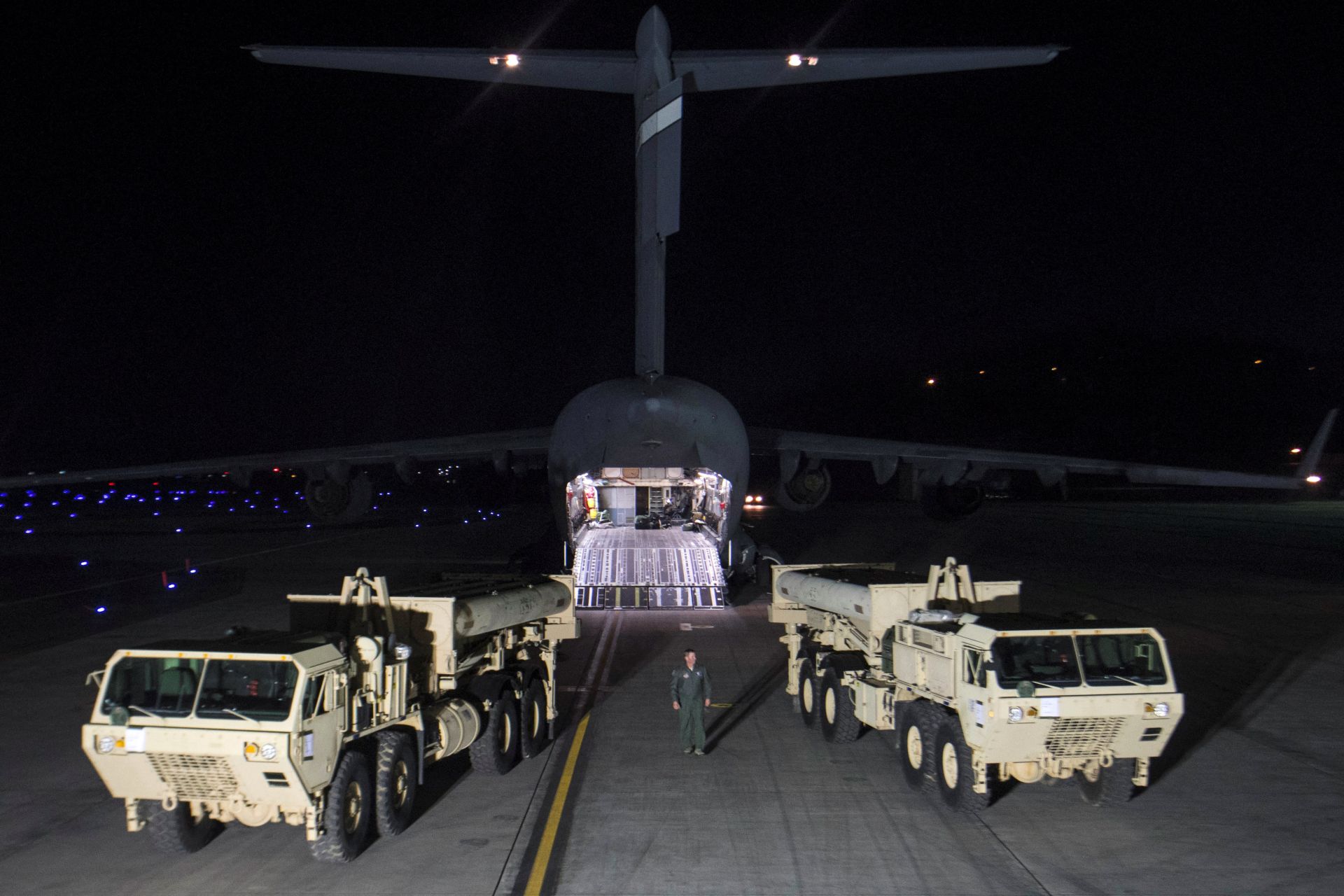
This handout photo from the US Forces Korea (USFK) taken on March 6, 2017 and released on March 7, 2017 shows the first elements of the US-built Terminal High-Altitude Area Defense (THAAD) arriving at Osan US Air Base in Pyeongtaek, south of Seoul. The US military has begun deploying an anti-ballistic missile defense system to South Korea, following a string of missile tests by North Korea, the US Pacific Command said on March 6. ©HANDOUT / US FORCES KOREA / AFP
The United States has begun transferring components of its advanced Terminal High Altitude Area Defense (THAAD) missile defense system from military bases in South Korea to the Middle East, according to a report published Tuesday by The Washington Post, citing two U.S. officials familiar with the operation.
The move comes as Washington seeks to reinforce regional defenses amid the rapidly expanding conflict between Iran and the U.S.-Israeli alliance, which has triggered missile and drone attacks across the Gulf and raised fears of broader regional escalation.
According to the report, the Pentagon has started redeploying elements of the THAAD system, designed to intercept ballistic missiles during the final stage of their flight. The equipment is being relocated from U.S. forces stationed in South Korea, where the system was originally deployed to counter potential missile threats from North Korea.
The redeployment underscores Washington’s growing concern about the volume of missile and drone attacks launched by Iran and its allies across the Middle East since the war began on February 28, when the United States and Israel launched large-scale strikes on Iranian territory.
Strengthening Regional Missile Defense
THAAD is one of the most sophisticated missile defense systems in the U.S. arsenal, capable of intercepting short- and medium-range ballistic missiles at high altitudes. The system is often deployed alongside Patriot batteries and other air-defense platforms to create layered missile defense networks.
U.S. officials have increasingly focused on strengthening such defenses in the Middle East as Iran has launched waves of ballistic missiles and drones targeting Israel, U.S. military facilities, and strategic infrastructure across the Gulf.
Energy installations in Saudi Arabia and Bahrain, as well as U.S. diplomatic and military sites across the region, have been repeatedly targeted during the conflict.
The deployment of additional missile defense assets is widely seen as part of a broader effort by Washington to protect U.S. bases and allied infrastructure, particularly energy facilities and shipping routes in the Gulf that are critical to global oil markets.
South Korea Seeks Reassurance
The transfer raised questions in South Korea about whether redeploying U.S. missile defense assets could weaken deterrence against North Korea.
However, South Korean President Lee Jae-myung sought to reassure the public during a cabinet meeting Tuesday, stating that any potential repositioning of U.S. military equipment would not undermine the country’s defensive posture against Pyongyang.
Officials in Seoul emphasized that the United States continues to maintain strong military capabilities on the Korean Peninsula despite the redeployment.
A War Reshaping Global Military Deployments
The relocation of THAAD components highlights how the war with Iran is beginning to reshape global military deployments, forcing Washington to rebalance its defensive capabilities between regions.
Since the conflict erupted, Iran has launched repeated missile and drone attacks across the Middle East, while maritime traffic in the strategic Strait of Hormuz, through which roughly one-fifth of the world’s oil passes, has been severely disrupted.
Analysts say the redeployment of advanced missile defense systems suggests the United States is preparing for the possibility of sustained missile exchanges across the region, as the conflict continues to expand beyond Iran and Israel.
While the Pentagon has not publicly detailed the full scope of the operation, the transfer signals that Washington expects the confrontation with Iran to remain a major security challenge in the region in the coming weeks.
Read more
Comments