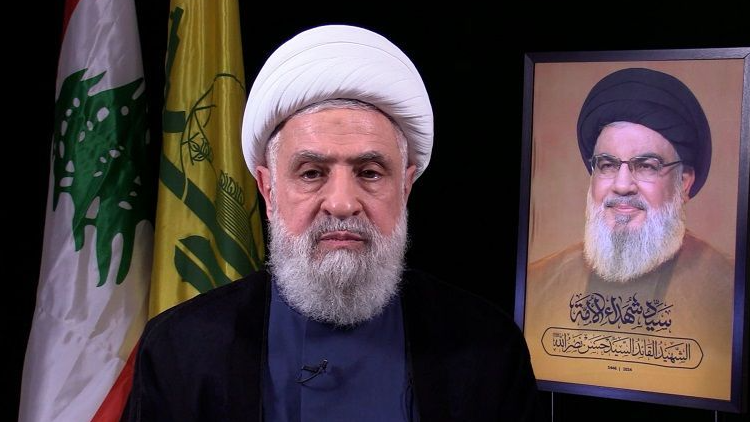
Hezbollah Secretary-General Naim Qassem on Monday sharply criticized the Lebanese government’s growing focus on restricting weapons outside state control, calling it a “major mistake” that serves Israeli interests, as he reaffirmed the group’s refusal to disarm under pressure.
Qassem called on the Lebanon’s government to “declare that it has fulfilled its duties, that it has nothing more to offer, and to stop all action aimed at restricting weapons to the state.”
The remarks came as Lebanon’s cabinet convened on Monday to discuss a Lebanese Army report on expanding state authority over weapons north of the Litani River, a key component of an initiative aimed at consolidating state control over all arms.
Speaking during commemorations for Hezbollah’s slain commanders, Qassem said efforts to prioritize disarmament over confronting Israeli violations undermine Lebanon’s sovereignty and amount to implementing foreign agendas.
“What the Lebanese government is doing by concentrating on disarming the resistance is a grave error, because it directly fulfills the objectives of the Israeli enemy,” Qassem said.
His remarks come as Lebanese authorities prepare to advance the second phase of a U.S.-backed plan aimed at consolidating state authority north of the Litani River, a move widely interpreted as targeting Hezbollah’s military presence.
Ceasefire respected by Lebanon, violated by Israel
Qassem pointed to the November 2024 ceasefire agreement between Lebanon and Israel, saying Beirut had honored its commitments while Israel continued to breach the deal through airstrikes, surveillance flights, and cross-border attacks.
“The November agreement was implemented by Lebanon. Israel did not implement it,” he said.
He dismissed any Israeli commitments as meaningless, arguing that past agreements demonstrate a consistent pattern of violations.
“If the enemy entity signs an agreement, it remains ink on paper,” Qassem said, citing precedents from Oslo to Madrid, adding that the United States is not merely a guarantor but “a full partner that manages the operations.”
Israeli strikes inside Lebanon have continued since the ceasefire, with Lebanese security sources estimating hundreds of casualties, while Tel Aviv accuses Hezbollah of attempting to rearm, a claim the group denies.
Support for strengthening the army, but not surrender
Qassem said Hezbollah supports equipping the Lebanese army to secure the country and assert sovereignty but rejected replacing resistance with what he described as conditional international assistance.
“We want the Lebanese army to be armed so it can protect security and sovereignty in the face of Israel,” he said. “We do not want war, and we are not seeking it, but we will not surrender. We are ready to defend against aggression.”
He warned against what he called “free concessions” and rejected complying with U.S. or international dictates aimed at satisfying Israeli demands.
“We will not submit to threats. If we don’t submit, they cannot impose anything,” he said.
Addressing calls for Hezbollah to relinquish its weapons, Qassem invoked Lebanon’s constitution, which mandates resistance against occupation.
“If you want to surrender, amend the constitution, because the principle is fighting for liberation,” he said.
Rejecting U.S. tutelage and Israeli conditions
Qassem also criticized what he described as growing foreign interference in Lebanese decision-making, warning that accepting externally imposed conditions risks turning Lebanon into a dependent state.
“We are not with free concessions, and we are not with executing American and international guardianship orders or fulfilling Israel’s aggressive demands,” he said.
He framed Hezbollah’s stance as rooted in national sovereignty, insisting the resistance is part of Lebanon’s social fabric and not an external force.
A broader regional warning
The Hezbollah leader linked Lebanon’s situation to wider regional dynamics, citing Gaza and the West Bank as evidence of Israel’s expansionist ambitions, and warned that developments across the Middle East are interconnected.
He concluded by saying Hezbollah remains patient to allow the Lebanese state to fulfill its responsibilities and to protect social stability, but cautioned that the current reality cannot persist indefinitely.
“This situation cannot continue. When and how it changes will be determined by events,” he said.


Comments