- Home
- Middle East
- Netanyahu to Prioritize Discussions on Iran During Washington Visit
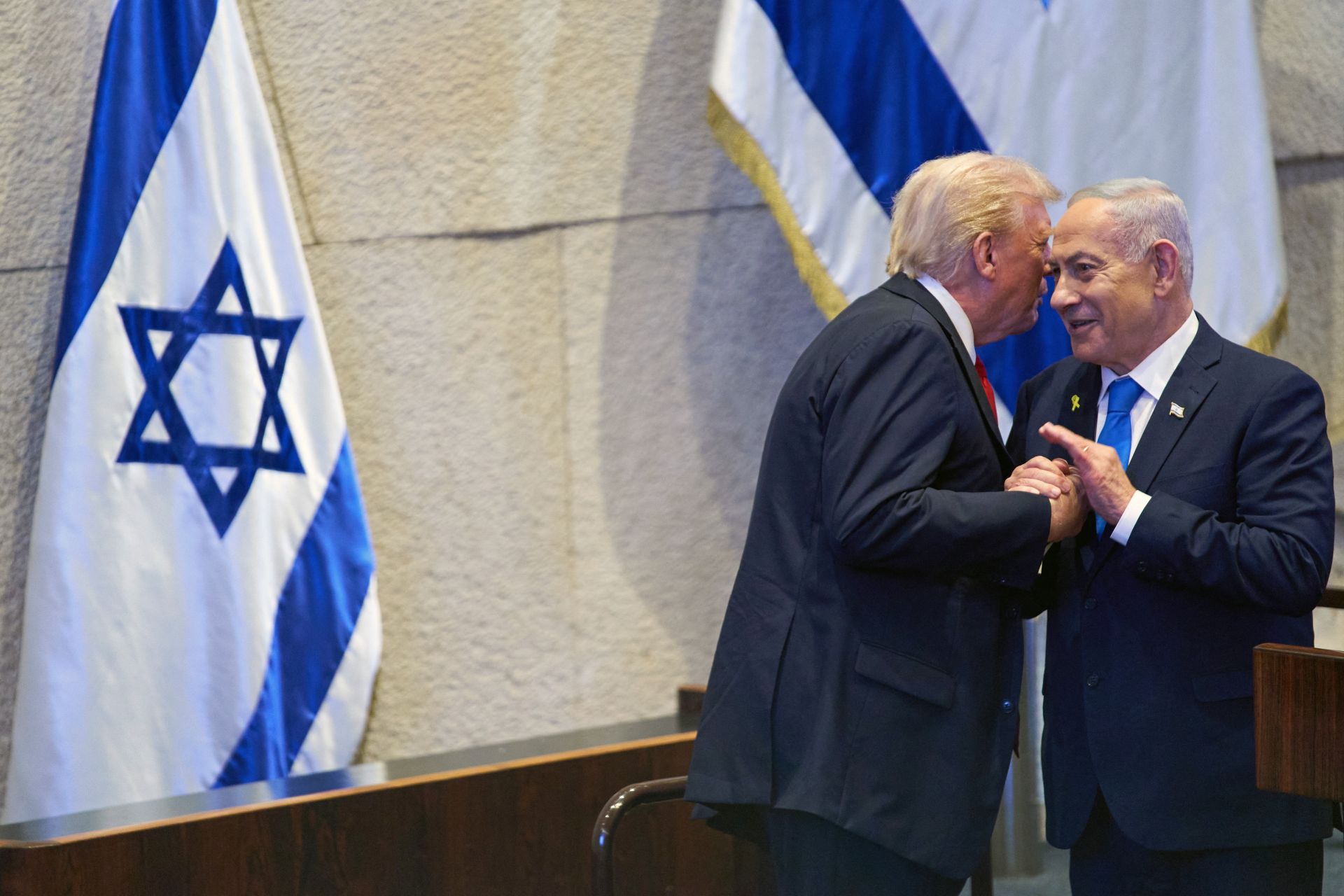
U.S. President Donald Trump (L) speaks with Israel's Prime Minister Benjamin Netanyahu at the Israeli parliament, the Knesset, in Jerusalem on October 13, 2025. ©Evan Vucci / POOL / AFP
Israeli Prime Minister Benjamin Netanyahu on Tuesday said he would prioritise discussions on negotiations with Iran when he meets with U.S. President Donald Trump in Washington this week.
"On this trip we will discuss a range of issues: Gaza, the region, but of course first and foremost the negotiations with Iran. I will present to the President our views regarding the principles for the negotiations," Netanyahu said before heading to the United States, where he will meet Trump on Wednesday.
Netanyahu is seeking to shape American negotiations with Iran and push for a tougher agreement that goes beyond Tehran’s nuclear program to include ballistic missiles and regional proxy networks, Israeli officials said.
The visit comes as the United States and Iran prepare to resume nuclear talks in Turkey on Friday, amid rising regional tensions and a growing U.S. military buildup near Iran.
According to Israeli security and political assessments cited by Channel 13, Netanyahu views the meeting as a “last opportunity” to influence Trump’s position before any potential deal with Tehran is finalized.
West Bank Tensions Add Pressure to Talks
The visit also comes amid mounting friction over Israeli policy in the occupied West Bank.
A senior U.S. official confirmed this week that Trump firmly opposes any Israeli move to formally annex West Bank territory, arguing that stability there is essential to Israel’s own security and to Washington’s broader goal of regional calm.
Despite that position, Israel’s security cabinet approved a series of measures on Sunday that expand Israeli authority in parts of the West Bank, including easing restrictions on Jewish land purchases, transferring construction oversight in some Palestinian cities to Israeli control, and granting wider enforcement powers over environmental and infrastructure issues.
According to Israeli media, the changes effectively deepen Israel’s administrative grip over large parts of the territory, where more than 500,000 Israelis live alongside roughly three million Palestinians. The United Nations says settlement expansion reached its highest level in at least eight years in 2025, with Israel approving 19 new settlements in December alone.
Trump’s rejection of annexation reflects concern that further escalation in the West Bank could destabilize an already volatile region at a moment when Washington is attempting to de-escalate tensions with Iran.
A Converging Crisis
Netanyahu’s trip underscores how multiple pressure points, Iran’s nuclear program, regional proxy networks, Israel’s military posture, and the future of the Palestinian territories, are converging into a single diplomatic and security test for the Trump administration.
While Tehran weighs renewed negotiations under the shadow of U.S. naval deployments, Israeli leaders are working to ensure any agreement addresses what they see as Iran’s full threat architecture, not just its nuclear activities.
At the same time, Washington is attempting to balance support for Israel with efforts to prevent a wider regional conflict and contain unrest fueled by economic hardship, political repression, and unresolved territorial disputes.
With talks set to resume and military assets already in motion, the coming days could determine whether diplomacy gains traction or whether the region edges closer to another dangerous escalation.
Read more


Comments