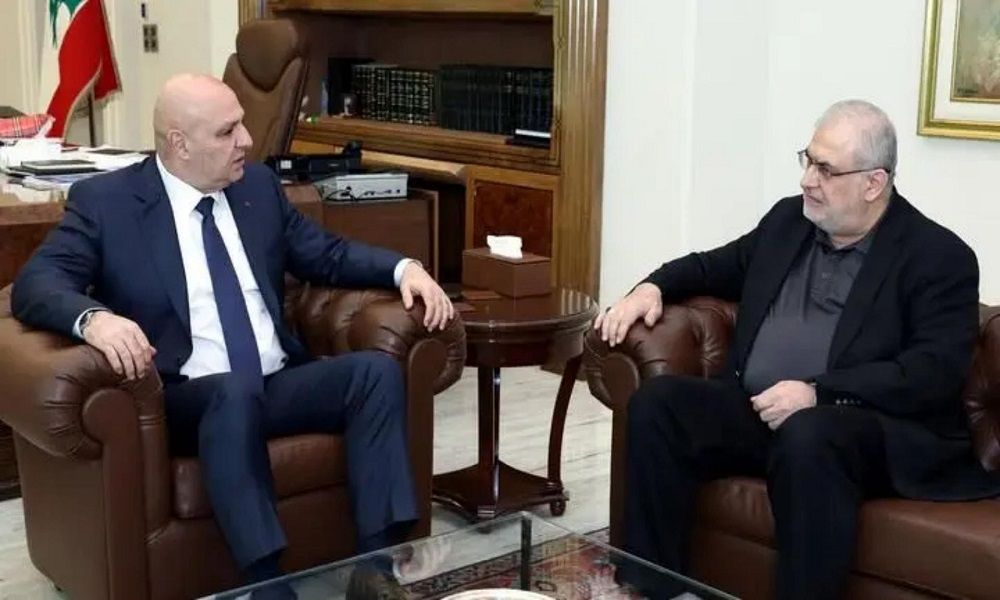
Senior Hezbollah parliamentarian Mohammad Raad met President Joseph Aoun at the presidential palace on Thursday as Hezbollah moved to de-escalate its dispute with the presidency.
The visit, requested by Raad himself, marks a notable shift in tone following a period of near-freeze between the two sides and comes amid heightened regional uncertainty as Washington and Tehran edge toward renewed nuclear talks.
According to political sources, the meeting was held in a calm atmosphere and attended by presidential adviser Brigadier General André Rahal and Hezbollah liaison Ahmad Mehna. Discussions ranged from domestic political issues to regional developments, including Iran’s negotiations with the United States.
Despite persistent disagreements, particularly over the issue of weapons outside state authority, both sides agreed to maintain open communication channels, signaling an effort to cool tensions and prevent further political escalation.
Presidential sources said Aoun reiterated his firm position rejecting any attempt to drag Lebanon into a new conflict, stressing that safeguarding national stability remains a priority.
Army Chief’s Washington Visit Draws Attention
The political maneuvering in Beirut coincides with a closely watched visit by Lebanese Army Commander General Rodolphe Haykal to Washington, where he is holding meetings with U.S. political and security officials, including closed-door discussions at CIA headquarters.
Haykal’s agenda reportedly focuses on security coordination, counterterrorism funding, and the future of military assistance to Lebanon. He is also meeting members of Congress involved in defense and intelligence committees, with border stability and the army’s role in preventing escalation expected to dominate talks.
Officials familiar with the meetings say Washington is pressing for continued reforms and emphasizing the Lebanese Army’s central role in enforcing state authority, particularly in southern Lebanon.
Lebanon Pushes Ahead With Sovereignty Plan
A senior Lebanese political source told local media that Beirut has asked the U.S. to pressure Israel into taking reciprocal steps following Lebanese deployments south of the Litani River. However, there are currently no indications of a shift in Israel’s military posture.
The source added that ongoing Israeli strikes complicate efforts to advance the next phase of Lebanon’s plan to centralize weapons under state control north of the Litani, warning that such measures require a minimum level of security stability.
Still, officials insist the government remains committed to extending state authority across all Lebanese territory. Haykal is expected to brief the Cabinet upon his return, outlining scenarios for expanding army deployment and reinforcing sovereignty.
“This is no longer a matter of principle,” the source said. “The decision to restore state control has been made. What remains under discussion is timing and implementation.”
France Steps In to Support Lebanese Army
On the diplomatic front, French Foreign Minister Jean-Noël Barrot is due in Beirut on Friday as part of a regional tour that also includes Syria and Iraq.
French officials say the visit will focus on preparations for an international conference to support the Lebanese Army, jointly organized by Paris, Washington, Riyadh, and Cairo. President Emmanuel Macron is expected to co-chair the conference alongside President Aoun.
The goal, according to French sources, is to bolster the army’s capabilities and advance efforts to place all weapons under state control, with particular emphasis on armed groups operating outside official institutions.


Comments