- Home
- Middle East
- U.S., Iran Signal Readiness for Talks as Mediators Move to Arrange Ankara Meeting
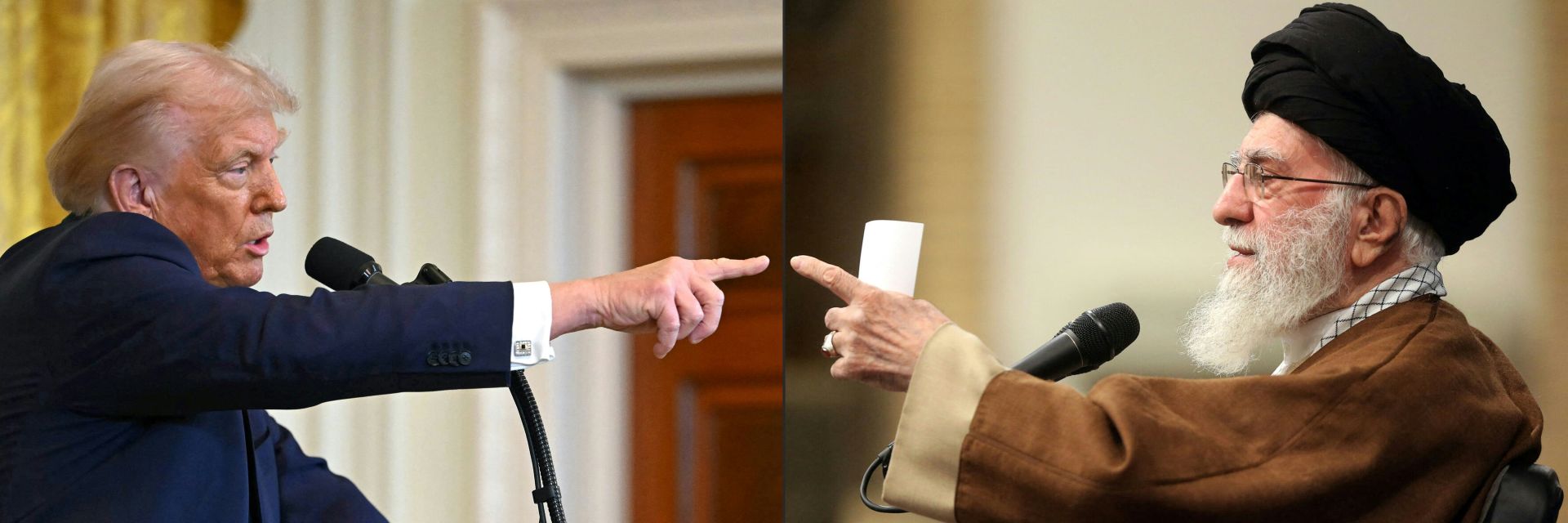
(COMBO) This combination of pictures created on June 18, 2025 shows (L to R) US President Donald Trump during a press conference at the White House in Washington, DC, on February 4, 2025; and a handout picture provided by the office of Iran's Supreme Leader Ayatollah Ali Khamenei on December 11, 2024 of him addressing supporters in Tehran. ©ANDREW CABALLERO-REYNOLDS / VARIOUS SOURCES / AFP
The United States and Iran have signaled openness to renewed negotiations aimed at easing escalating tensions, according to officials cited in multiple reports, as regional mediators work to organize a potential meeting in Ankara and Washington maintains a heightened military posture in the Middle East.
A senior US official told Axios that President Donald Trump’s administration has conveyed its readiness to engage in talks with Tehran as early as this week. Turkish, Egyptian, and Qatari intermediaries are reportedly coordinating efforts to bring together U.S. special envoy Steve Witkoff and Iranian officials in the Turkish capital.
Additionally, Iranian President Masoud Pezeshkian has ordered the start of nuclear talks with the U.S., the news agency Fars reported on Monday, after President Trump said he was hopeful of a deal to avert military action.
"Iran and the United States will hold talks on the nuclear file," Fars said, without specifying a date. The report was also carried by the government newspaper Iran and the reformist daily Shargh.
The developments come amid mounting regional unease following recent US military deployments and sharp rhetoric from both sides, even as Washington insists its calls for diplomacy are genuine.
Diplomatic Openings, Red Lines Intact
Iranian Foreign Minister Abbas Araghchi said Tehran believes an agreement is possible, particularly on the nuclear file, but warned that negotiations must remain narrowly focused. Speaking to CNN, Araghchi stressed that Iran’s ballistic missile program and its regional alliances are “non-negotiable,” rejecting US and Israeli demands to curb Tehran’s support for allied armed groups.
“Let’s not talk about impossible things,” Araghchi said, adding that while trust in Washington has eroded, mediated talks could still yield results if centered on preventing nuclear weapons development.
Iran continues to deny seeking nuclear arms, though Western governments point to Tehran’s high-level uranium enrichment, restrictions on international inspections, and expanding missile capabilities as evidence of broader strategic ambitions.
Trump Signals Openness, Keeps Pressure On
President Trump publicly welcomed the prospect of negotiations while underscoring US military leverage. Responding to a warning from Iran’s supreme leader, Ayatollah Ali Khamenei, that a US attack could trigger a regional war, Trump said Iran was seeking a deal to avoid confrontation.
“We have the biggest, most powerful ships in the world very close,” Trump told reporters, referring to the recent buildup of US naval forces. “Hopefully we’ll make a deal. If we don’t, we’ll see what happens.”
US officials have emphasized that the military deployments are intended as deterrence rather than preparation for imminent strikes, though uncertainty persists over Washington’s next move.
Israeli Security Consultations Intensify
In Israel, Prime Minister Benjamin Netanyahu convened senior security officials following the return of IDF Chief of Staff Lt. Gen. Eyal Zamir from high-level meetings in Washington focused on Iran. Defense Minister Israel Katz and Mossad Director David Barnea were also reported to have taken part in the consultations.
Israeli media quoted officials as saying Washington appears closer to potential military action than it was a week ago, though no decision has been confirmed and the scope of any strike remains unclear.
Meanwhile, the US Navy confirmed that a guided-missile destroyer that docked at Israel’s Red Sea port of Eilat has since departed following a scheduled visit, underscoring ongoing military coordination between the two allies.
Persistent Anxiety Over Escalation
Despite diplomatic momentum, concerns over miscalculation remain high. Former Israeli military intelligence chief Amos Yadlin warned that Iran could act in unpredictable ways, urging Israeli forces to remain prepared for surprise escalation.
“Iranians may do something that does not seem logical,” Yadlin said, noting that recent conflicts have shown that first movers often gain strategic advantage. He added that Israel and the United States are closely coordinating contingency planning and sharing lessons from past confrontations, including last year’s conflict in which Israeli forces targeted Iranian missile infrastructure.
Diplomacy Under the Shadow of Force
The renewed diplomatic push comes after months of rising tensions fueled by Iran’s internal unrest, US military reinforcements in the region, and lingering fallout from last year’s direct Israel-Iran confrontation. While mediators are racing to seize a narrow window for talks, deep mistrust and hard red lines on both sides continue to cast doubt on how far negotiations can realistically go.
For now, Washington and Tehran appear to be testing diplomacy while keeping military options firmly on the table, a familiar but volatile pattern in a region where missteps can rapidly spiral beyond control.
AFP
Read more


Comments