- Home
- Middle East
- Syria Says Hezbollah Weapons Used in Damascus Airport Attacks
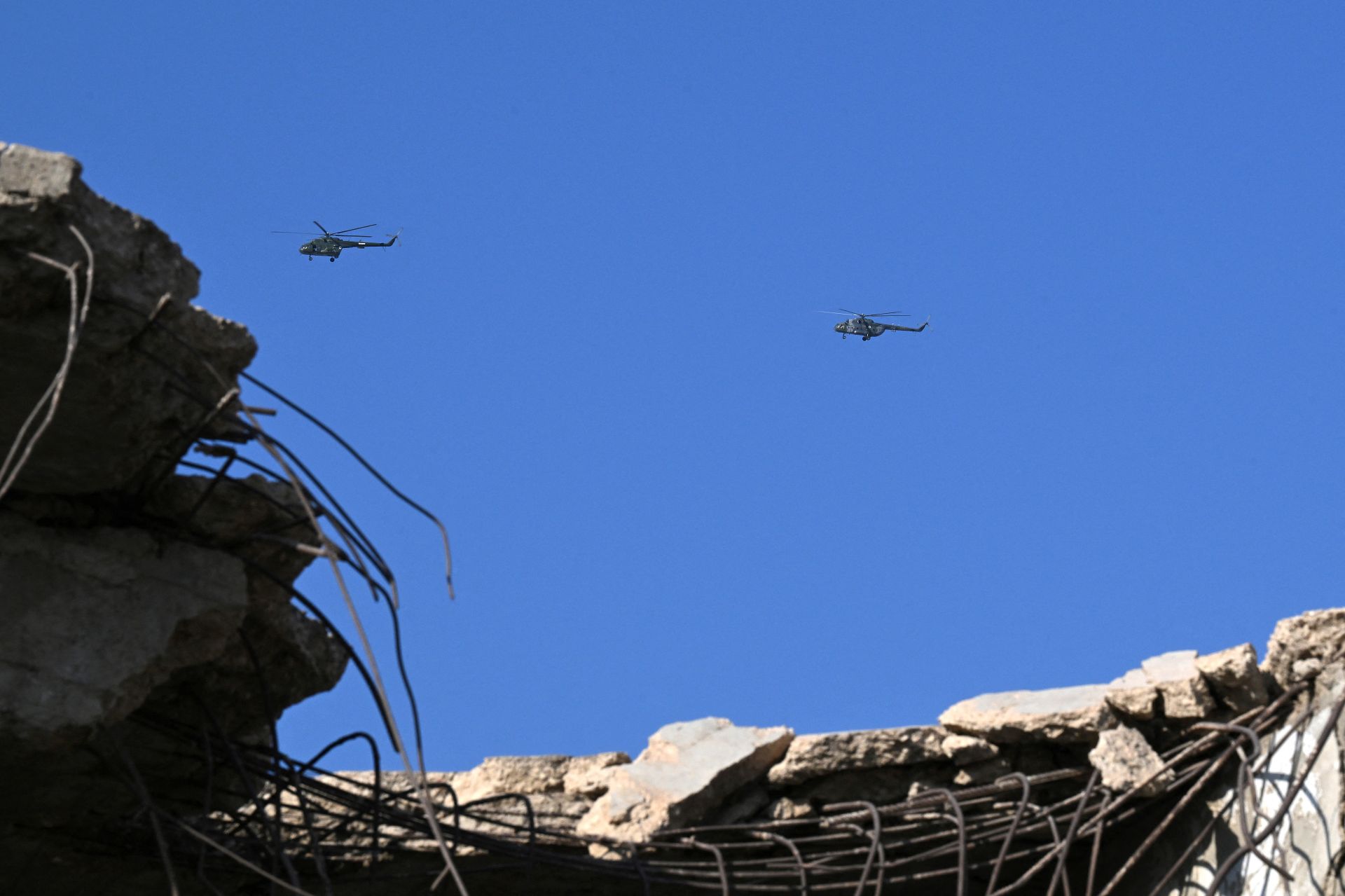
Syrian army helicopters hover near Mezzeh military airport in Damascus on November 10, 2025. ©LOUAI BESHARA / AFP
Syrian authorities said on Sunday they had detained a group responsible for a series of rocket attacks targeting the Mezzeh military airport in the capital, adding that investigators traced the weapons used in the strikes to Hezbollah.
In a statement, the Syrian Interior Ministry said security units arrested all members of the group after weeks of surveillance of suspected launch sites across several areas of Damascus. The ministry said the group carried out multiple attacks on the airport in recent months.
Officials said the rockets used in the strikes originated from Hezbollah, the Iran-backed Lebanese group that was closely allied with former Syrian president Bashar al-Assad and maintained a significant military presence in Syria during the civil war.
Hezbollah denied the allegations, saying it has no operational presence or links to any armed group inside Syria.
Arrests and seized equipment
Syrian authorities said they also confiscated a number of drones that the group was preparing to deploy in further operations. In a later clarification, the Interior Ministry said the detainees had ties to unidentified “foreign entities,” without publicly naming Hezbollah or Iran.
The Mezzeh military airport, located near central Damascus, has been hit by several strikes amid heightened instability following the collapse of Assad’s rule in December 2024.
Security vacuum after Assad’s fall
Security sources say Hezbollah withdrew most of its forces from Syria after Assad’s ouster but left behind weapons stockpiles, including drones and rockets, in several locations. Some of those arms are believed to have been seized or repurposed by local armed groups operating amid the power vacuum.
In November, Reuters reported that Washington was considering establishing a military presence at an airbase in Damascus as part of a U.S.-brokered security arrangement between Syria and Israel, a report the Syrian government denied.
Following Assad’s fall, Israel deployed troops to southwestern Syria, moving into a buffer zone along the border in what it described as a measure to prevent hostile actors from exploiting the instability. On Friday, the Israeli military said its forces in Syria came under fire for the first time since the deployment, with no reported casualties.
Regional backdrop
Assad’s removal followed a U.S.-mediated ceasefire between Israel and Hezbollah after two months of open conflict in Lebanon that severely weakened the group’s leadership. The fighting included an Israeli ground operation in southern Lebanon aimed at enabling the return of tens of thousands of displaced residents in northern Israel.
The broader escalation dates back to October 8, 2023, one day after Hamas launched an attack on southern Israel, triggering the war in Gaza and a sharp rise in regional tensions.
Read more


Comments