- 27
- Jan.
- 2026


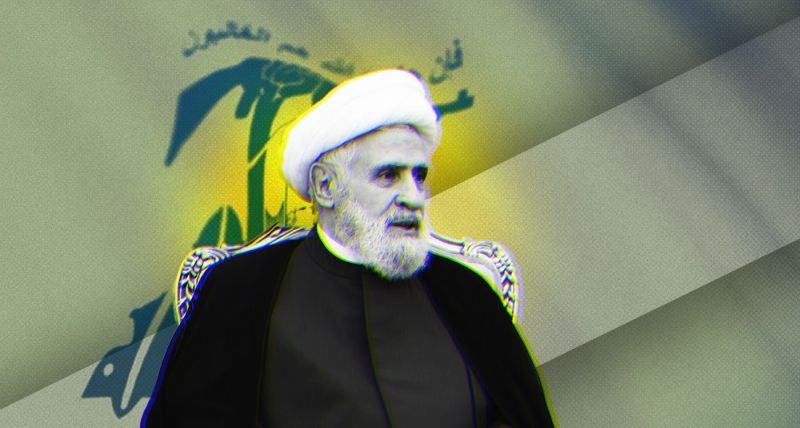
On Tuesday, Hezbollah Secretary-General Naim Qassem said in an address that the pro-Iranian militant group would not remain neutral in the event of any aggression against Iran, stressing that Hezbollah is prepared to defend itself and would determine the timing and nature of any response.
Hezbollah “will not remain silent about Trump’s or anyone else’s threats against Supreme Leader Khamenei,” Qassem asserted, claiming that Hezbollah is “committed to taking all necessary measures to counter this threat.”
After the USS Abraham Lincoln carrier strike group arrived in the Middle East on Monday, speculation intensified that President Donald Trump may be preparing to order a military strike against Iran.
Trump warned last week that an “armada” was heading to the region, saying his administration was “watching” Tehran closely following deadly protests and a subsequent crackdown by the Islamic Republic’s regime that may have killed more than 30,000 protesters.
Qassem’s speech reignited concerns over Hezbollah’s continued encroachment on the Lebanese state’s exclusive authority to decide matters of war and peace. He claimed it was his “duty” to confront any threat to Iran’s Supreme Leader, arguing that harm to Supreme Leader Ali Khamenei would destabilize the region and the world.
Critics note that such rhetoric ignores the heavy cost of Hezbollah’s previous “support front,” launched on October 7, 2023, resulting in thousands of deaths, widespread destruction of southern Lebanese villages, and the assassination of senior military and political figures within the organization.
Hezbollah Unlikely to Mount a Military Response
Amid growing questions over whether Hezbollah would open a new “support front” against Israel in the event of a U.S. attack on Iran, prominent analysts said the group is unlikely to deliver any meaningful response.
Ali al-Amin, editor-in-chief of the outlet Janoubia, said in the event of a U.S.-Iran war, Hezbollah would be unlikely to respond militarily. Speaking in an interview with This is Beirut, al-Amin stated, “If Hezbollah fires one rocket, it will be unable to fire a second one.”
Al-Amin emphasized that Qassem exaggerates Hezbollah’s role to project an image of strength and deterrence.
Similarly, Jad al-Akhawi, President of the Lebanese Democratic Coalition and senior journalist, noted that if Hezbollah were to respond in the case of escalation in Iran, it would mean “political suicide for the group.” He emphasized, “It would be the end of Hezbollah, and they would be left with no arms and no political entity.”
Al-Akhawi said the group is unlikely to launch a military response because it has very few weapons left. Even if Hezbollah did strike back, he argued, Israeli drones would immediately destroy what remains of its capabilities. “I don’t think they have the arms or power to do more right now,” he said.
Hanin Ghaddar, an expert focused on Shia politics throughout the Levant, echoed this assessment, telling This is Beirut that Hezbollah is “unlikely to take any action” due to its limited military capabilities and dwindling popular support. “Any response would be suicide,” she said, adding that the only scenario in which Hezbollah might act would be the collapse of the Iranian regime itself. “In that case, they may choose a suicidal option because they would feel they have nothing left to lose.”
Asked how Hezbollah’s popular base might react if the U.S. were to strike Iran without a response from the group, al-Amin suggested that many supporters would be “secretly relieved” because they now recognize the serious costs that would come with renewed confrontation.
Symbolic Threats Amid Strategic Weakness
Al-Akhawi underscored that if Hezbollah does not respond militarily, it will almost certainly respond with heightened rhetoric aimed at intimidation through interviews and speeches. “Hezbollah will respond symbolically because the only arms they have are intimidation through rhetoric,” he emphasized.
According to a retired military officer who spoke to This is Beirut on the condition of anonymity, Qassem’s declaration that “Hezbollah will not remain neutral in the face of any threat to Iran” reflects desperation rather than strength. “This is not about military capability,” he said. “It is an ‘all-in’ gamble by a group that believes it has little left to lose.”
The retired military officer noted that Hezbollah’s arsenal prior to the Gaza war was largely unknown within Lebanon. However, he said the conflict revealed a reliance on imprecise rockets and suicide drones that failed to hit strategic targets. “The disparity in casualties between Israel and Hezbollah during the war makes the capability gap between both sides clear,” he added.
Al-Akhawi said Hezbollah’s failure to respond to continued Israeli aggression after the 2024 ceasefire underscores how weak the group’s strategic leverage has become. “Every day Israel is killing one or two high-ranking Hezbollah operatives and there is no retaliation from Hezbollah. This is very telling,” al-Akhawi noted.
The Cost of Escalation: Hezbollah’s Political and Financial Decline
An escalation between Iran and the U.S. could have significant repercussions for Hezbollah, which is already facing unprecedented public dissatisfaction among its base and crippling financial constraints.
Al-Akhawi stated that escalation “will further restrain Hezbollah’s funding and logistics, and this will significantly weaken the group.” Al-Akhawi emphasized that the militant group would further devolve into a local militia, facing even tighter financial constraints due to a weakened regime in Tehran.
Al-Akhawi argued that should the Iranian regime collapse and Hezbollah disarm, Lebanon’s Speaker of Parliament Nabih Berri remains no better than Hezbollah. “While Hezbollah destroyed the country, Berri destroyed the constitution, the government, and the state,” al-Akhawi concluded, noting that Berri continues to systematically internalize corruption within the government.
In a final address to Western policymakers, al-Akhawi emphasized, “Do not rely on Berri. He is worse than Hezbollah.”

Comments