- Home
- Middle East
- U.S. Launches Regional Air Readiness Drill in the Middle East
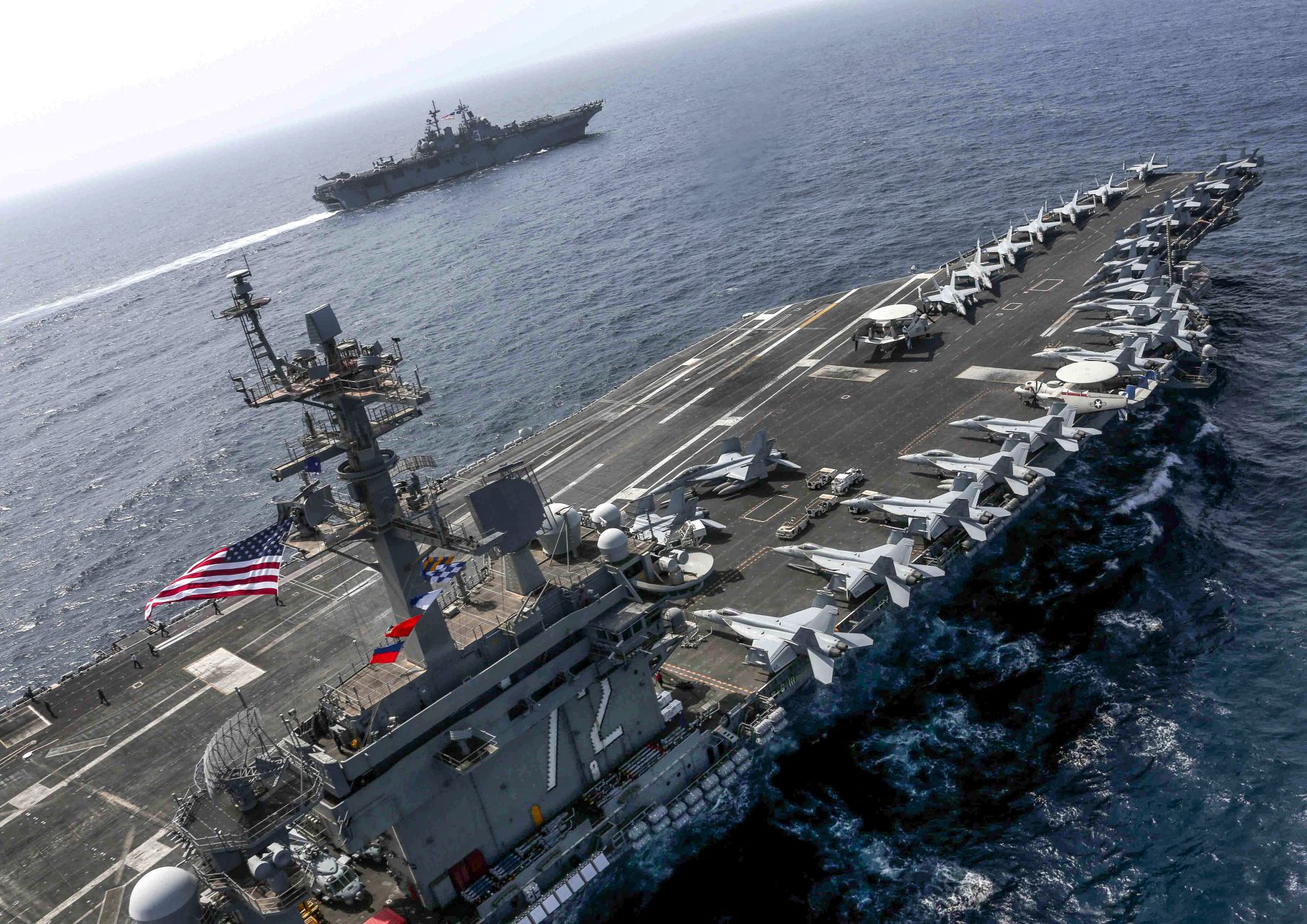
This handout picture released by the US Navy on May 17, 2019 shows the Nimitz-class aircraft carrier USS Abraham Lincoln and the Wasp-class Amphibious Assault Ship USS Kearsarge sailing alongside as the Abraham Lincoln Carrier Strike Group and Kearsarge Amphibious Ready Group conduct joint operations in the Arabian Sea. ©BRIAN M. WILBUR / VARIOUS SOURCES / AFP
The United States will conduct a multi-day air readiness exercise across the Middle East, aimed at demonstrating the ability to deploy, distribute, and sustain combat air capabilities throughout the region, according to a statement issued Sunday by U.S. Central Command, as the aircraft carrier USS Abraham Lincoln arrived in the region following a deployment from the South China Sea.
U.S. Central Command said the drill is being conducted by the Ninth Air Force and is designed to demonstrate operational reach, flexibility, and endurance across a wide geographic area, while reinforcing coordination with regional partners.
Testing Rapid Deployment and Logistics
According to the statement, the exercise focuses on the swift movement of personnel and aircraft, distributed operations across contingency locations, and logistical support under constrained conditions.
U.S. forces will be deployed to multiple sites, with all activities conducted in coordination with host nations and in compliance with civil and military aviation authorities. Central Command stressed that the drills prioritize safety, precision, and respect for national sovereignty.
The exercise is also intended to test the military’s ability to execute what it described as a “flexible response,” ensuring readiness for a range of contingencies with minimal resources.
Carrier Strike Group Boosts U.S. Options
The drills coincide with the arrival of the Abraham Lincoln carrier strike group in the Middle East, a move Israeli media described as part of a broader effort to intensify pressure on Iran and expand the range of military options available to U.S. President Donald Trump.
The carrier’s arrival follows reports that the strike group was redirected from the South China Sea, signaling a shift in U.S. military focus back toward the Middle East amid rising regional tensions.
Israeli military radio reported over the weekend that U.S. troop deployments and assets in the Middle East have reached record levels this week, the highest since Washington carried out military operations against Iran in mid-2025.
The expanded presence includes naval, air, and logistical assets, reflecting heightened preparedness even as U.S. officials seek to avoid signaling an imminent escalation.
Mixed Signals on Iran
In recent weeks, Trump has repeatedly warned that military action against Iran remains an option before softening his tone and citing information that Iranian authorities had halted executions of protesters.
Despite the tempered rhetoric, the White House has emphasized that military preparations are continuing, a message reinforced by the latest exercises and the arrival of the carrier strike group.
Military Posture and Strategic Calculations
The latest U.S. military exercises and deployments come as tensions between Washington and Tehran have intensified following the outbreak of widespread protests inside Iran and a violent crackdown by Iranian authorities.
In recent weeks, U.S. officials have repeatedly warned Iran against the use of force against demonstrators, saying Washington is closely monitoring developments and will take steps to protect its interests, personnel, and partners in the region. While U.S. rhetoric has at times softened, the White House has stressed that military readiness remains intact.
At the same time, Iranian officials have warned that any U.S. or allied military action would be met with a response, signaling Tehran’s readiness to retaliate if it perceives a direct threat. Iranian leaders have framed the U.S. military buildup as provocative, while emphasizing their ability to strike back across the region.
A senior U.S. official confirmed that the aircraft carrier USS Abraham Lincoln strike group, while en route to the region after redeploying from the South China Sea, has not yet entered US Central Command’s (CENTCOM) area of responsibility, meaning it is currently not positioned to launch strikes against Iran.
Military experts have warned that Iran’s expanding use of low-cost drone swarms could pose a credible threat to high-value naval targets, including aircraft carrier strike groups, as Tehran continues to invest in unmanned capabilities. Once the Abraham Lincoln enters CENTCOM’s zone, it is expected to take several days before reaching full operational readiness.
The buildup also includes additional U.S. air assets, including F-15 fighter jets and heavy transport aircraft, reflecting a broader deployment of air, land, and sea capabilities as Washington seeks to reinforce deterrence while avoiding immediate escalation.
Read more


Comments