- Home
- Middle East
- Syrian President Makes Kurdish a 'National Language'
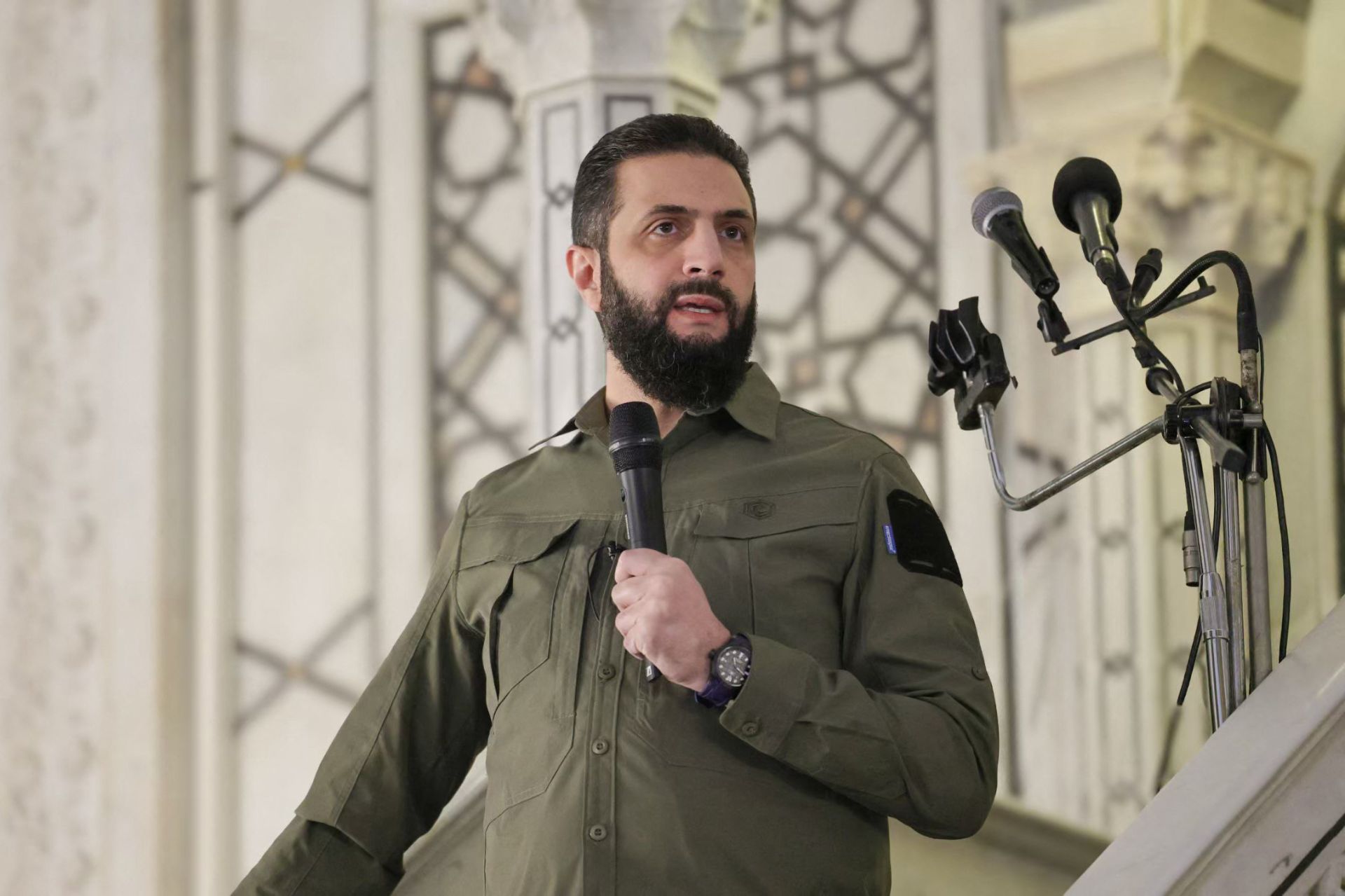
Cette photo diffusée par l’Agence syrienne officielle SANA le 8 décembre 2025 montre le président syrien Ahmed al-Charaa prenant la parole lors de prières à la mosquée des Omeyyades à Damas, à l’occasion de l’anniversaire de la chute du dirigeant de longue date, Bachar al-Assad. ©Handout / SANA / AFP
Syrian President Ahmed al-Sharaa issued a decree on Friday declaring Kurdish a "national language", in an apparent gesture of good will towards the minority following clashes in past days.
The move came as the Syrian army warned of new strikes east of Aleppo, despite a meeting between the US-led coalition and Kurdish forces seeking to ease tensions between the two sides.
After driving Kurdish forces from Aleppo city last week, the Syrian army had deployed reinforcements near the Kurdish-controlled Deir Hafer, some 50 kilometres (30 miles) east of the city, ordering Kurdish fighters to leave the area.
On Friday, it issued warnings ahead of strikes on Deir Hafer, saying it would target areas that Kurdish forces were using "as a launching point for their terrorist operations towards the city of Aleppo and its eastern countryside".
In addition to decreeing Kurdish a national language, Sharaa granted the minority national rights and made the Kurdish new year, Nowruz, a national holiday.
The decree also grants nationality to Kurds, as 20 percent of them had been stripped of it under a controversial 1962 census.
The apparent olive branch marks a momentous step in the country where teaching and publishing or broadcasting in Kurdish were effectively prohibited for decades under Assad rule.
Deescalation drive
The Syrian government has been seeking to extend its authority nationwide following the ousting of longtime leader Bashar al-Assad in December 2024.
Under a March deal, the Kurdish de facto autonomous administration in the north and its forces were to be integrated into the state.
But disagreements have stalled its implementation, with fighting repeatedly breaking out and the Kurds calling for a decentralised federal system, which Damascus rejects.
Earlier on Friday, Farhad Shami, spokesman for the US-backed, Kurdish-led Syrian Democratic Forces, had told AFP that the US-led anti-jihadist coalition had met with them in Deir Hafer on Friday.
Following the meeting, a Syrian military source said that "a delegation from the Syrian defence ministry entered the Deir Hafer area to negotiate with SDF leaders".
The US envoy for Syria, Tom Barrack, posted on X that he was working "around the clock" to prevent any escalation between Kurdish fighters and government forces, both of which have US backing.
The SDF controls swathes of Syria's oil-rich north and northeast, much of which it captured during the country's civil war and the fight against the Islamic State group over the past decade.
Civilians fleeing
Quoting local authorities in Deir Hafer, Syrian state television reported that "more than 4,000 civilians" had left the Kurdish-controlled region.
AFP correspondents saw some using a rickety bridge to cross a branch of the Euphrates River.
The military had used the same tactic in the city of Aleppo last week, telling civilians to depart before shelling Kurdish-held districts.
"The SDF stopped us from leaving -- that's why we used an agricultural back road and then crossed the bridge," said 60-year-old Abu Mohammad, who was accompanied by relatives.
Civilians have been fleeing the area on back roads since Thursday.
Syrian authorities had extended the deadline to flee until Friday, accusing the SDF of preventing civilians from leaving, a claim the group dismissed as "unfounded".
- 'Hurry and defect' -
Syria's military called on members of the SDF on Friday to "hurry and defect from this organisation and return to your country and your people".
The SDF in a statement said it believed these calls were intended to "create discord among the region's communities".
On Sunday, government troops took full control of Aleppo city after capturing two Kurdish-majority neighbourhoods.
Nanar Hawach, senior Syria analyst at the International Crisis Group, said that capture of Aleppo's Kurdish-held areas "doesn't change the military balance" but shows that Damascus "can impose costs when negotiations stall".
While Syria's government "cannot replicate" this scenario in the northeast, "it can apply sustained pressure along contact lines" like Deir Hafer.
AFP
Read more
Comments