- Home
- Middle East
- The Iranian Diaspora: A Key Force in a Globalized Protest
- 14
- Jan.
- 2026

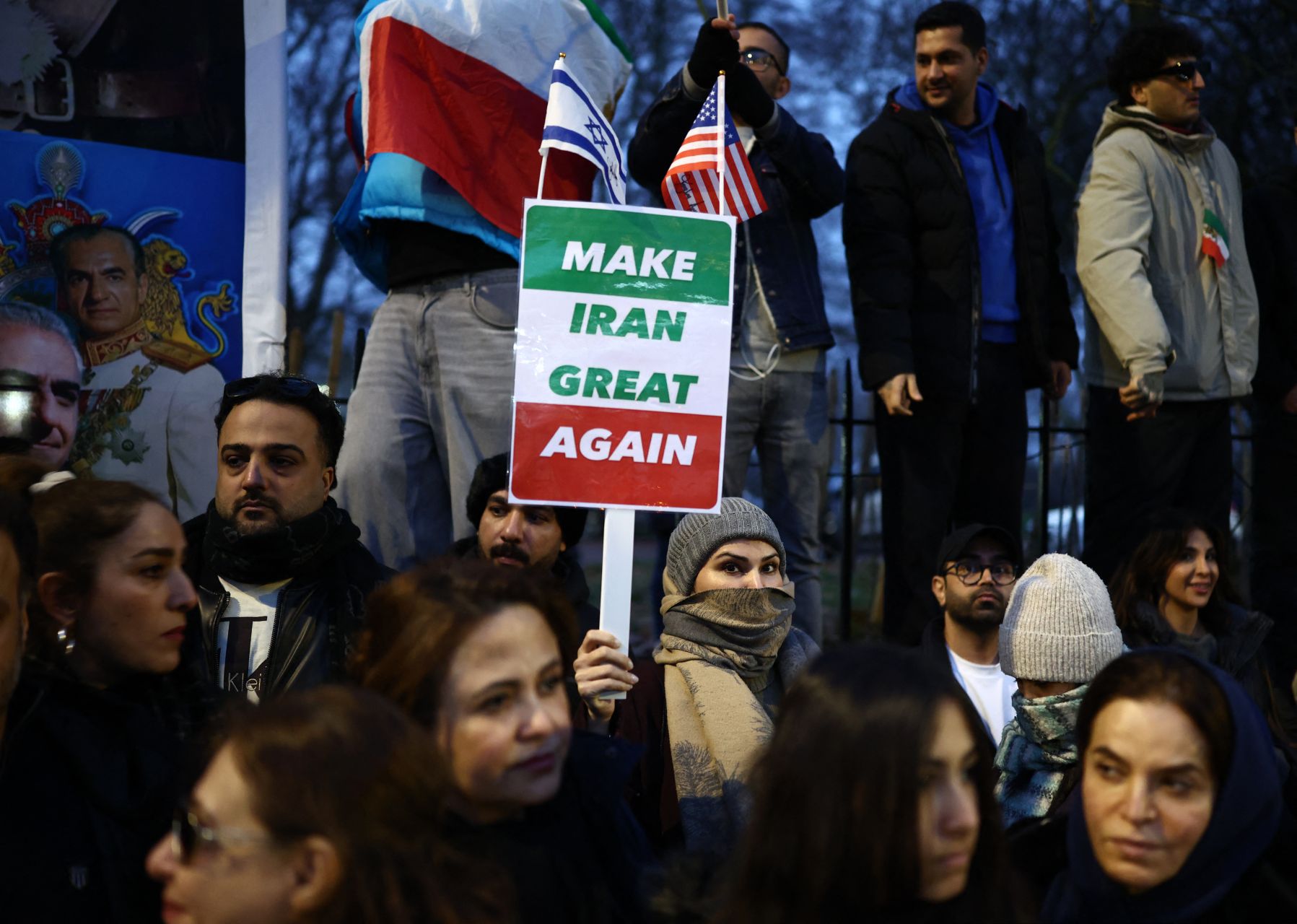
Des manifestants opposés au régime iranien brandissent des drapeaux iraniens lors d'un rassemblement devant l'ambassade d'Iran, dans le centre de Londres, le 12 janvier 2026. ©Henry NICHOLLS / AFP
As Iran’s authorities scramble to repress a growing uprising through violence and information blackouts, the country’s diaspora has emerged as a crucial front in the confrontation with the regime, combining media outreach, international lobbying, and economic leverage.
Since December 28, 2025, Iran has been gripped by a wave of protests of unprecedented scale. Yet the challenge to the authorities is not confined to Tehran, Isfahan, or Shiraz. It extends far beyond the country, carried by a diaspora now estimated at around 4.5 million people, primarily in North America and Europe.
The Iranian diaspora community is a structured social, political, and economic force, with a role deeply rooted in the country’s history. This is Beirut examines how exile has become an arena for contesting Iran’s political future.
From Historical Roots to New Fronts
The Iranian diaspora dates to the 1979 Islamic Revolution, which triggered an initial wave of political exile that uprooted administrative, military, academic, and economic elites linked to the former imperial regime. The 1980s, marked by the Iran-Iraq war and the consolidation of the new authoritarian government, only accelerated these departures.
From the 1990s onward, and especially after the 2009 Green Movement, the 2019 fuel price protests, and the 2022 demonstrations following Mahsa Amini’s death in police custody, Iran’s exile community began to change. Politically-exiled emigres were joined by a younger generation fleeing economic hardship, repression, and limited prospects in Iran.
Iran’s diaspora is distinguished by a high level of education and a strong presence in the research, medicine, engineering, technology, and finance fields. According to the Organization for Economic Co-operation and Development (OECD), Iran has ranked for more than a decade among the countries with the highest brain drain in the Middle East.
Estimates of the Iranian diaspora’s size vary depending on the source. In 2021, the Iranian Ministry of Foreign Affairs recorded 4,037,258 Iranians living abroad, while the United Nations estimates the diaspora at between 4.1 and 4.5 million.
Nearly 40% of Iranians living abroad reside in North America, according to the United Nations Department of Economic and Social Affairs (UN DESA). The United States is the main hub of the community, with 1.5 to 2 million people of Iranian origin, followed by Canada, which hosts around 400,000, concentrated in major urban centers such as Los Angeles—nicknamed “Tehrangeles”—and Toronto.
Europe is home to between 1.2 and 1.4 million Iranians, primarily in Germany, the United Kingdom, and France, but also in Sweden, the Netherlands, and Italy, with long-established communities in London, Paris, and Berlin.
Alongside these traditional hubs, Turkey has recently emerged as a major destination, reflecting shifting migration patterns. According to the International Organization for Migration and Turkish authorities, Iranians have ranked among the top foreign investors in real estate since 2020. In a single year, they established more than 1,600 companies, attracted by geographic proximity, ease of settlement, and indirect access to international markets.
Exile and Transnational Activism: Media, Networks, and Political Alliances
The protests that erupted in Iran on December 28, 2025 quickly reverberated abroad. As repression intensified and communication channels were blocked, transnational mobilization grew, combining digital campaigns with political advocacy. Solidarity gatherings abroad followed, including in Paris, London, Vienna, and Istanbul.
This dynamic intensified with the information blackout implemented by Iranian authorities. Access to the Internet and telephone networks has been almost completely cut off since January 8, 2026, according to Iran Human Rights, making communication with the outside world extremely difficult. In response, members of the diaspora have sought to provide workarounds for protesters in Iran, including foreign SIM cards, connections via border areas, and the occasional use of the Starlink satellite network.
Since the 2000s, the Iranian diaspora has evolved into a permanent information network, responsible for collecting, verifying, translating, and disseminating content from inside Iran. Foreign-based NGOs, including Iran Human Rights, Amnesty International, and Human Rights Watch, rely heavily on these networks to document human rights violations, compile casualty reports, and alert international media.
At the same time, numerous Persian-language opposition media outlets operating from abroad, primarily online or via satellite, play a key role in shaping a counter-narrative to official propaganda.
This organizational capacity is also evident in efforts to restructure the Iranian opposition in exile, long characterized by fragmentation. Reza Pahlavi, the son of Iran’s deposed Shah, has sought to serve as a symbolic catalyst, launching multiple initiatives aimed at bringing together ideologically diverse groups — monarchists, republicans, and human rights activists — around a discourse focused on democratic transition.
Yet Pahlavi represents only one part of the diaspora opposition. More collective dynamics have emerged over successive crises. Networks that emerged from the “Women, Life, Freedom” movement, which arose after Mahsa Amini’s death in 2022, continue to coordinate international campaigns that combine protests, symbolic actions, and advocacy with Western institutions. Meanwhile, transnational groups of lawyers, journalists, and human rights activists based in Europe and North America work to document regime crimes, collaborating with UN mechanisms and national courts.
Economic Leverage Amid Constraints
The Iranian diaspora wields economic influence, though that leverage is curtailed by Iran’s domestic restrictions and controls. According to World Bank estimates, financial transfers to Iran exceed one billion dollars per year, despite international sanctions and banking restrictions. Often informal or indirect, these flows provide a vital source of livelihood for millions of families in a country plagued by inflation, currency depreciation, and declining purchasing power.
Yet this crucial support operates within an economic system largely controlled by the state and the Islamic Revolutionary Guard Corps (IRGC). The International Monetary Fund (IMF) notes that these structures dominate entire sectors — such as energy, infrastructure, and telecommunications — and capture a significant share of the financial flows circulating in the country. As a result, diaspora transfers, even when intended for private use, indirectly feed an economy under political control through mechanisms such as state-imposed exchange restrictions, implicit taxation, and parallel financial channels.
International restrictions add another layer of constraint. While officially aimed at weakening the regime’s financial capacity, they also weigh heavily on the civilian population. IMF analyses indicate that these restrictions have increased reliance on informal channels, making financial flows more opaque and difficult to regulate.
The ambivalence extends to investment potential. Although some members of the diaspora possess significant economic capital, much of it remains abroad due to the lack of legal guarantees and political stability in Iran.
Within the diaspora, these contradictions fuel ongoing debates, turning the economy into a sphere of political struggle and highlighting the moral dilemmas that shape Iranian exile.
In today’s context, the Iranian diaspora stands out as one of the arenas where the country’s political future is being shaped. Whether this global mobilization can evolve beyond protest into a shared vision capable of guiding a potential post-regime transition remains to be seen.
Read more

Comments