- Home
- Middle East
- Iran Signals Fast Trials for Protesters Amid Trump’s Warnings
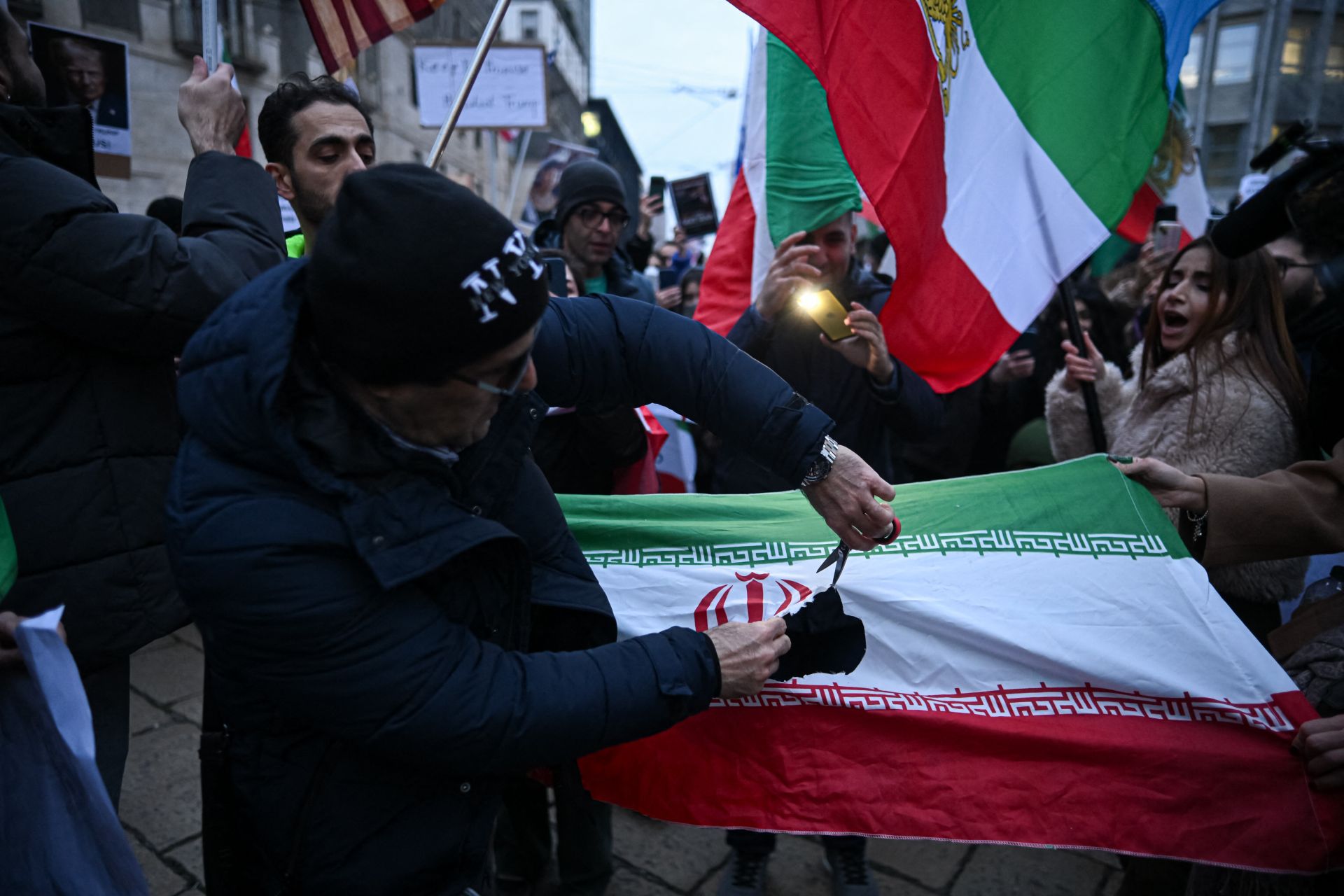
Un manifestant opposé au régime iranien découpe le drapeau national de la République islamique d’Iran lors d’un rassemblement devant le consulat des États-Unis à Milan, le 13 janvier 2026. © Piero Cruciatti / AFP
Iran’s judiciary chief said Wednesday authorities would pursue fast-track trials for suspects arrested during nationwide protests, signaling a further escalation in the state’s response as unrest continues across the country.
U.S. President Donald Trump warned that Washington would take “very strong action” if Iranian authorities proceed with hanging protesters, sharpening his rhetoric as reports emerge of possible executions.
France also intensified its criticism of Tehran’s response. French Foreign Minister Jean-Noël Barrot said Paris suspects the crackdown may be the most violent repression in Iran’s contemporary history.
“What we suspect is that this is the most violent repression in Iran’s contemporary history and that it must absolutely stop,” Barrot told AFP.
Meanwhile, NBC News reported that Israeli officials urged the U.S. administration to delay any direct military strike on Iran, arguing that pressure on the regime should first be intensified through non-military means. According to the report, Israeli officials said they support the fall of the Islamic Republic but believe internal pressure and international isolation should be prioritized.
Trump warns Iran over threatened executions
Speaking earlier in a CBS News interview, Trump said the U.S. would act if Iran begins hanging protesters.
“We will take very strong action if they do such a thing,” Trump said, warning Tehran against carrying out executions.
Tehran prosecutors have said Iranian authorities would pursue capital charges of “moharebeh”, or “waging war against God”, against some suspects arrested during the protests.
The U.S. State Department said on its Farsi-language X account that 26-year-old Erfan Soltani had been sentenced to be executed on Wednesday, adding that more than 10,600 people have been arrested.
Rights group Amnesty International called on Iran to immediately halt all executions, including Soltani’s.
Deadly crackdown and mounting evidence
International outrage has grown over Iran’s response to protests that rights groups say have likely killed hundreds, and possibly thousands, in what is described as one of the most serious challenges yet to Iran’s clerical leadership.
The U.S.-based Human Rights Activists News Agency (HRANA) reported that it had so far confirmed the killing of 1,850 protesters, 135 people affiliated with the government and nine uninvolved civilians as well as nine children over the last 17 days.
Videos verified by AFP News showed bodies lined up at the Kahrizak morgue near Tehran, with relatives searching for missing family members. Authorities are accused of obscuring the scale of the crackdown through an internet blackout that has now lasted more than five days.
Iranian state media has reported dozens of security personnel killed, while authorities announced a mass funeral in Tehran for what they described as the “martyrs” of recent days.
A Serious threat
The government on Monday sought to regain control of the streets with mass nationwide rallies that supreme leader Ayatollah Ali Khamenei hailed as proof that the protest movement was defeated, calling them a “warning” to the U.S.
In power since 1989 and now aged 86, Khamenei has faced significant challenges, most recently the 12-day war in June against Israel, which forced him to go into hiding.
Analysts have cautioned that it is premature to predict the immediate demise of the theocratic system, pointing to the repressive levers the leadership controls, including the Revolutionary Guard Corps, which is charged with safeguarding the Islamic revolution.
Nicole Grajewski, professor at the Sciences Po Centre for International Studies, told AFP News the protests represented a “serious challenge” to the Islamic republic, but it was unclear if they would unseat the leadership, pointing to “the sheer depth and resilience of Iran’s repressive apparatus”.
Unlike previous protest movements, the current unrest has combined economic grievances with direct political defiance, openly challenging the clerical leadership and security apparatus. Analysts say the scale, geographic spread, and persistence of the demonstrations mark a significant departure from earlier episodes of dissent, raising questions about the regime’s long-term stability and capacity to restore control through repression alone.
As pressure mounts at home, the crisis also raises broader questions about how Iran can sustain its external posture, including relations with the international community and continued support for regional allies and proxies such as Hamas and Hezbollah, while confronting its most serious internal challenge in years.
Read more
Comments