- 01
- Dec.
- 2025

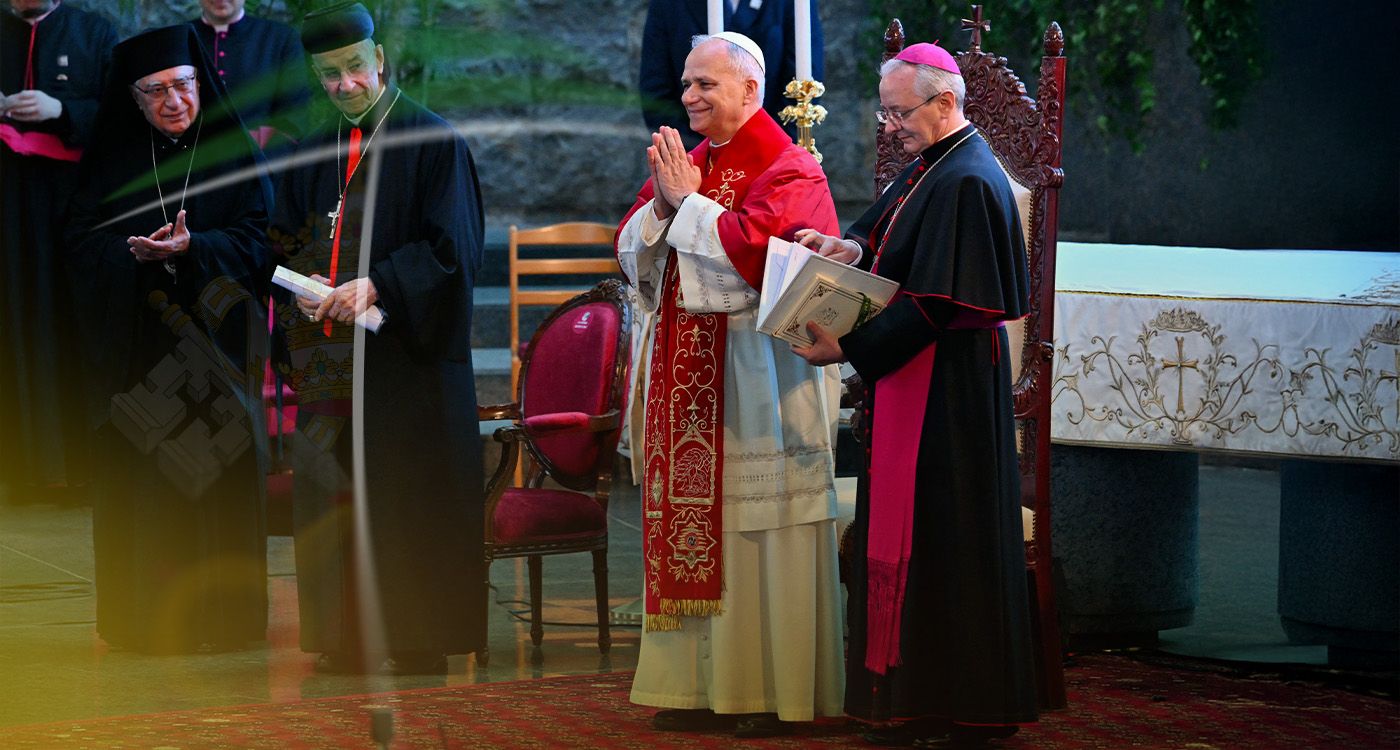
Lebanon epitomizes the enduring legacy of a waning Middle Eastern Christianity, its resistance to cultural and political Islamization, and its striving to engage in political modernization.
Pope Leo XIV’s first foreign trip is striking and prompts a closer look at what motivated his choice of destinations. To those versed in Church history, his decision to travel first to Turkey and Lebanon may appear obvious, but it remains thrilling.
Contemporary Turkey harbors the most important venues of paleo-Christian history. Turkey represents the historical landmark of the Christian divide between the Eastern and Western aisles of the Church in 1054. The country is the most emblematic site of the geopolitical divides that set the Muslim world apart from Europe and its Christian roots. Turkey is also the venue of the first genocide that eradicated Armenian, Greek, and Syriac Christianity. Finally, it is the seat of the imperial legacy of a conquering Islamic caliphate and the witness to its demise in 1922.
How difficult it is for Vatican diplomacy to sift through the different layers of this complex history and its multiple sedimentations. None of these aspects is likely to be overlooked or set aside if Pope Leo’s journey is to bear fruit despite the cultural, political, and epistemological differences that will frame its narratives
The visit to Lebanon does not compare with the Turkish journey because of their geopolitical mismatch. One is an erstwhile caliphate and imperial power, while the other is a small political entity that emerged as a territorial state after its unraveling. Yet, Lebanon epitomizes the enduring legacy of a waning Middle Eastern Christianity, its resistance to cultural and political Islamization, and its striving to engage in political modernization based on cultural and political pluralism, constitutional statehood, and civil equality.
This legacy owes much to Maronite religious irredentism, its deep roots in the Syriac and Antiochian traditions, and a firm sense of Christian inclusiveness that transcends denominational divisions while maintaining resistance to Islamic cultural and political dominance. It also owes to the quixotic and paradoxical conflation between the tradition of otherworldly asceticism and the historical trajectory of religious, cultural, social, and political emancipation. This is reflected throughout Lebanon’s history, including the formation of the Maronite Patriarchate in 687, its union with the Vatican in 1182, the cultural renaissance in Lebanon triggered by the founding of the Maronite College in Rome in 1584, the political and linear dynamic that ushered in the proto-national medieval emirate from 1523 to 1842 and its political derivatives—the double Maqamiyya from 1843 to 1861 and the Mutasarrifiyya from 1861 to 1918—and the ultimate creation of Greater Lebanon in statehood in 1920.
Lebanon’s predicament recapitulates the lofty promises of the Arab region’s unique liberal democracy and its tragic defeat at the hands of the totalitarian narratives of Arabism and Islamism. Lebanon has become the federating homeland of the retreating Christian Churches in the Middle East, which are struggling to regain their spiritual and moral autonomy and rebuild their historical agency. It is no coincidence that ecclesial federating structures, theological academies, social and educational ministries, and patriarchal sees have relocated to Lebanon at a time when migration is taking its toll.
Lebanon’s demise marks the twilight of a dissipating Oriental Christianity, while rampant Islamization is overhauling what remains of religious and cultural pluralism in the contemporary Middle East, and the crises of Islamic modernity are at their peak. The Church of Rome is navigating its way through this tidal change and attempting to map its new coordinates, with Lebanon at the center of this endeavor. Intellectual and operational ministries have been navigating a new era and its manifold challenges for the last century, with uneven fortunes.
The visit to Turkey was prompted by the 1700th anniversary of the Council of Nicaea in 325, the first ecumenical council, which settled the Christological controversies, established the basis of ecumenical theology, promulgated early canon law, and mandated the uniform observance of Easter’s date. It provided an opportunity to celebrate the first model of working ecumenism, which continues to serve as a paradigm for contemporary ecumenical efforts and achievements. The Nicene Creed remains the enduring cornerstone of ecumenism and the pivotal narrative of Christian unity.
The open-air museum of Cappadocia, with its hundreds of cave churches dating back to the 4th century, testifies to Turkey’s centrality in early Christian history and its rootedness in the theology and ecclesiology of the first centuries, which played a formative role in the formalization of the Kerygma and the theological traditions of the early churches. The same is true of the Syriac and Antiochian Churches and the Turoyo mountains with their monasteries, the systematic obliteration of the Armenian religious legacy culminating in the genocide, and the destruction of the Hellenic Church and its Byzantine formative heritage.
Throughout the twentieth century, popes continued visiting Turkey to uphold its historical Christian legacy and to emphasize the ecumenical role of the Phanar Patriarchate, its federating function within the Orthodox Churches, and the importance of sustaining ecumenical engagement. Nonetheless, the lingering presence of Ottoman Islamism and its inherent negationism weighs heavily on diplomatic efforts and distorts the very meaning of interreligious and intercultural dialogue, particularly given the semantic discrepancies at the intellectual, political, or religious level. It should not be forgotten that the Turkish legacy encapsulates Islamic imperialism and religious supersessionism in its various forms, as well as its impact on a truncated modernity and its connection to the bloody and destructive legacy of Ottoman imperialism.
Unfortunately, the absence of intellectual and epistemological premises for a working dialogue does little to support a diplomacy of peace-making and restorative justice. The Islamist regime in Turkey is reinvesting itself in subversive Islamism, challenging European continental peace, the foundational principles of European democracy, and the systemic equilibria of European security and its strategic anchors. Moreover, the regime openly discriminates against its substantive religious and ethnic minorities. As a result, the message of constructive dialogue and ecumenical spirituality is unlikely to resonate in Islamist Turkey and would mostly be instrumentalized to serve shifting political goals, where moral considerations are entirely absent.
The visit to Lebanon comes at a critical juncture, as the country has lost its bearings and struggles to regain political normalization and implement institutional reforms. Regional peace is fragile, civil stability is at risk, and Iranian power politics fuel a steady stream of Shiite extremism and subversive strategies of domination. The extraterritoriality of Shiite politics is closely tied to Iranian power politics and serves to challenge both regional stability and civil peace in Lebanon.
The Lebanese national and civil narratives that have shaped political life are disputed unequivocally by the Shiite political mainstream at a time when Hezbollah’s war of choice has dragged the country into an open-ended cycle of wars and its highly destructive outcomes. The Pope’s spiritual and moral authority, along with the peacekeeping diplomacy of the Apostolic See, appears to have little impact on a political scene where concepts such as interreligious and political dialogue, peace-making and rational conflict resolution have no resonance in an environment impervious to these norms and their influence on the actual course of politics.
The unsettled strategic issues, the revanchism of the Islamic regime in Tehran, and the ideological panopticon that shapes the Shiite political narrative make peace-making difficult, whether within the bounds of international diplomacy or track-two diplomacy and its civil society actors. The Shiite opposition, far from being absent, is still cowed by the extremists and their will to foreclose the public space. The spiritual, charitable, and peacemaking dimensions of Pope Leo’s visit, along with his close attention to ecumenical, peaceful, and reform-oriented Lebanon, are at the top of his agenda, alongside the highly compromised future of the Christian presence in Lebanon.
However fraught with imponderables, Pope Leo’s missionary zeal and his experience with tremendous hardships as the general superior of the Augustinian Order worldwide have prepared him to navigate the troubled waters of an unstructured and conflict-prone postmodernity and to confront the challenges of cultural, political, and societal transitions. Like all his predecessors, he is also adept at channeling spiritual resources to promote the ‘ministry of reconciliation’ (2 Corinthians 5:11–21) and peace-making. The contemporary papacy continues its odyssey in a transforming world.
Comments