- 12:01


In a statement issued on the centennial of the Lebanese Constitution, Hezbollah presented itself Monday as a defender of constitutional legitimacy, national unity, and Lebanese sovereignty, while simultaneously reaffirming that armed “resistance” remains a protected and legitimate right beyond any governmental decision.
The statement repeatedly called for adherence to the Constitution “more than ever,” while rejecting “foreign tutelage,” federalism, and “disguised separation projects.” This rhetoric comes at a moment of renewed debate over Hezbollah’s weapons, state sovereignty, and the implementation of the Taif Agreement.
But legal expert and former head of the State Council Choukri Sader told This is Beirut that Hezbollah’s interpretation of the Constitution fundamentally contradicts the constitutional framework governing the Lebanese state itself.
Sader argued that under the Lebanese Constitution, exclusive authority over decisions of war and peace rests solely with the Council of Ministers. “No armed group has the right to independently declare war on a foreign state.”
Moreover, the statement’s repeated references to constitutional legitimacy and the rule of law raise broader questions surrounding Hezbollah’s own legal status within the Lebanese state framework. While the party has been politically represented in parliament and successive governments for decades, Hezbollah did not emerge through the conventional state licensing framework traditionally used for Lebanese political parties.
The contradiction is particularly striking as the party invokes the Constitution and state sovereignty while continuing to maintain an armed structure operating outside the Lebanese state’s exclusive authority over military force and decisions of war and peace.
Commitment to the Constitution
In its statement, Hezbollah argued that Lebanon is facing a highly sensitive internal and regional moment that “requires, more than ever, adherence to the Lebanese Constitution.” The party also called for “leaving behind the era of mandates, high commissioners, and foreign tutelage.”
Yet for Sader, moments of regional escalation require stronger adherence to the state, not parallel military decision-making outside its institutions. Sader argued that amid heightened internal and regional tensions, all Lebanese parties should rally around the Constitution and state institutions.
Sader argued that Hezbollah is using constitutional rhetoric to justify maintaining an armed structure outside state institutions, warning that allowing any group to independently decide war would undermine the existence of the Lebanese state itself.
War and Peace
Much of Hezbollah’s statement focused on defending what it described as the Lebanese people’s “full right” to defend their land and sovereignty against Israel.
The party argued that armed “resistance” against occupation and aggression remains constitutionally legitimate and that no political or governmental authority can revoke what it described as the Lebanese people’s right to defend their land.
Sader rejected that argument, stating that “when there is a state, that state possesses exclusive privileges, first and foremost the monopoly over weapons,” he said.
Article 65 of the Lebanese Constitution states that executive authority is vested in the Council of Ministers, which also exercises authority over the armed forces. The same article classifies “war and peace” among the fundamental national issues decided by the Cabinet.
For Sader, this leaves little room for Hezbollah’s constitutional interpretation. “No right supersedes the state’s right to decide war and peace,” he said. “Any military action outside the framework of the state and outside the Constitution cannot be legally justified.”
‘A Final Homeland’
Lebanon was characterized as “a final homeland for all its citizens” in the statement, describing the country as “one land, one people, and one set of institutions.”
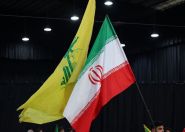
However, Sader argued that Hezbollah’s military structure itself undermines the concept of a unified state. “The moment a group independently declares war outside the framework of the state, especially in support of a foreign power, it places itself outside the constitutional order,” he said, in an apparent reference to Hezbollah’s alignment with Iran and its regional military role.
The contradiction runs through much of Hezbollah’s statement: a repeated call for full implementation of the Constitution alongside a defense of an armed structure operating independently from the institutions constitutionally tasked with military authority.
Taif, Sectarianism, and State Authority
Hezbollah additionally argued that Lebanon’s sectarian political system “is no longer capable of producing a fair, effective, and stable state,” calling for the implementation of all constitutional reforms outlined in the Taif Agreement, particularly the abolition of political sectarianism.
While the militant group presented itself as advocating for a more equitable and less sectarian state, Hezbollah itself was founded as an Islamist Shiite movement built around a distinct religious and ideological identity tied to the doctrine of Iran’s Islamic Revolution and Wilayat al-Faqih. And like much of Lebanon’s ruling class, it continues to operate within, and benefit from, the country’s sectarian power-sharing structure, despite publicly calling for reforms to transcend it.
Sader agreed that Lebanon failed to fully implement the post-war constitutional framework but argued that the responsibility lies with the entire political class, including Hezbollah itself. “We never truly implemented the Constitution,” he said. “Instead, everyone interpreted it according to their own interests.”
The Taif Agreement, which amended Lebanon’s Constitution after the civil war, explicitly called for extending state authority over all Lebanese territory and limiting military authority to state institutions. Critics of Hezbollah have long argued that the party’s military wing exists outside that framework despite its political integration into the Lebanese system.
Hezbollah’s constitutional centennial statement repeatedly invoked the language of state sovereignty, constitutional legitimacy, and institutional authority while defending the legitimacy of armed resistance beyond the state itself.
“You do not open a state of your own and independently decide war and peace,” he said.


Comments