- Home
- Middle East
- Trump: ‘Decimation’ of Iran 'To Be Continued' After Talks With Xi
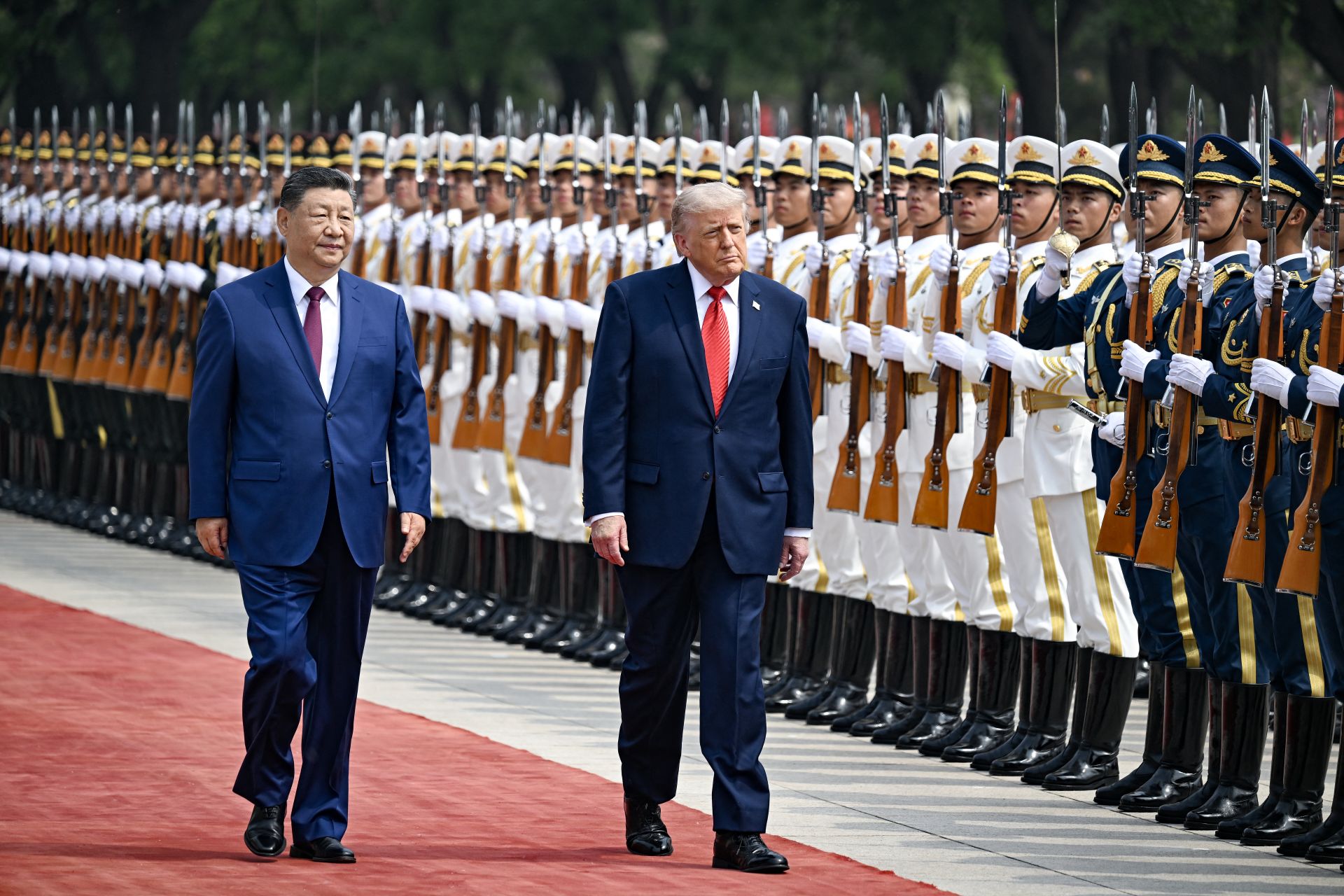
U.S. President Donald Trump (R) and China's President Xi Jinping inspect a guard of honour during a welcome ceremony at the Great Hall of the People in Beijing on May 14, 2026. ©KENNY HOLSTON / POOL / AFP
U.S. President Donald Trump signaled Thursday that Washington could resume military operations against Iran despite the fragile ceasefire currently in place, while simultaneously seeking Chinese support to reopen the Strait of Hormuz and contain the regional crisis threatening global energy markets.
The remarks came after Trump met Chinese President Xi Jinping in Beijing in talks heavily dominated by the Iran war, maritime tensions in the Gulf, and the future of negotiations with Tehran.
In a post published on Truth Social following the meeting, Trump cited what he described as the “military decimation of Iran” among his administration’s achievements before adding: “To be continued.”
“I am not going to be much more patient,” Trump later said during an interview aired Thursday night on Fox News’ Hannity program. “They should make a deal.”
Trump-Xi talks focus on Hormuz and Iran
According to the White House, Trump and Xi agreed during Thursday’s discussions that the Strait of Hormuz must remain open and free from militarization or toll systems. The meeting comes as the strategic waterway remains partially paralyzed following months of confrontation between Iran, the United States, and Israel.
Before the war erupted in late February, roughly one fifth of global oil and liquefied natural gas supplies transited through the strait.
Trump claimed Xi pledged that Beijing would not provide military equipment to Iran and expressed willingness to help restore maritime navigation through Hormuz. “He said he’s not going to give military equipment,” Trump told Fox News. “He’d like to see the Hormuz Strait open.”
The White House also stated that Xi expressed opposition to any military control over the strait and indicated interest in purchasing additional American oil in order to reduce China’s future dependence on the Hormuz.
U.S. Trade Representative Jamieson Greer later confirmed that Chinese officials had emphasized their desire to see the waterway reopened without restrictions. “It’s really important for China to have the Strait of Hormuz open, no tolling, no military control,” Greer told Bloomberg from Beijing.
Trump raises prospect of new strikes
Despite ongoing diplomatic efforts, Trump’s rhetoric suggested that military options remain under consideration. During the Hannity interview, the U.S. president warned that Washington could strike Iran again if negotiations fail.
“The other thing we could do is bomb it again,” Trump said.
He also commented on Iran’s enriched uranium stockpile, suggesting its symbolic and political value now outweighed its military significance. “I just feel better if I get it,” he said. “I think it’s more for public relations than anything else.”
Meanwhile, Admiral Brad Cooper, head of U.S. Central Command (CENTCOM), testified before a Senate committee that although Iran’s military capabilities had been significantly degraded during the war, Tehran still retains the ability to launch attacks.
Netanyahu says Iran weaker than ever
Israeli Prime Minister Benjamin Netanyahu also intensified pressure on Tehran Thursday, declaring during Jerusalem Day ceremonies that “the regime of terror in Iran is weaker than ever.”
Netanyahu praised Israeli military operations against Iran and its regional allies, including Hezbollah and Hamas, arguing that Israel’s actions alongside close coordination with the Trump administration had “transformed the face of the Middle East.”
He reiterated that Israel remains committed to preventing Iran from obtaining nuclear weapons and vowed continued operations against what he described as threats posed by “radical Islam.”
Read more



Comments