- Home
- Middle East
- President Trump Vows ‘Complete Victory’ Over Iran as Diplomatic Deadlock Deepens
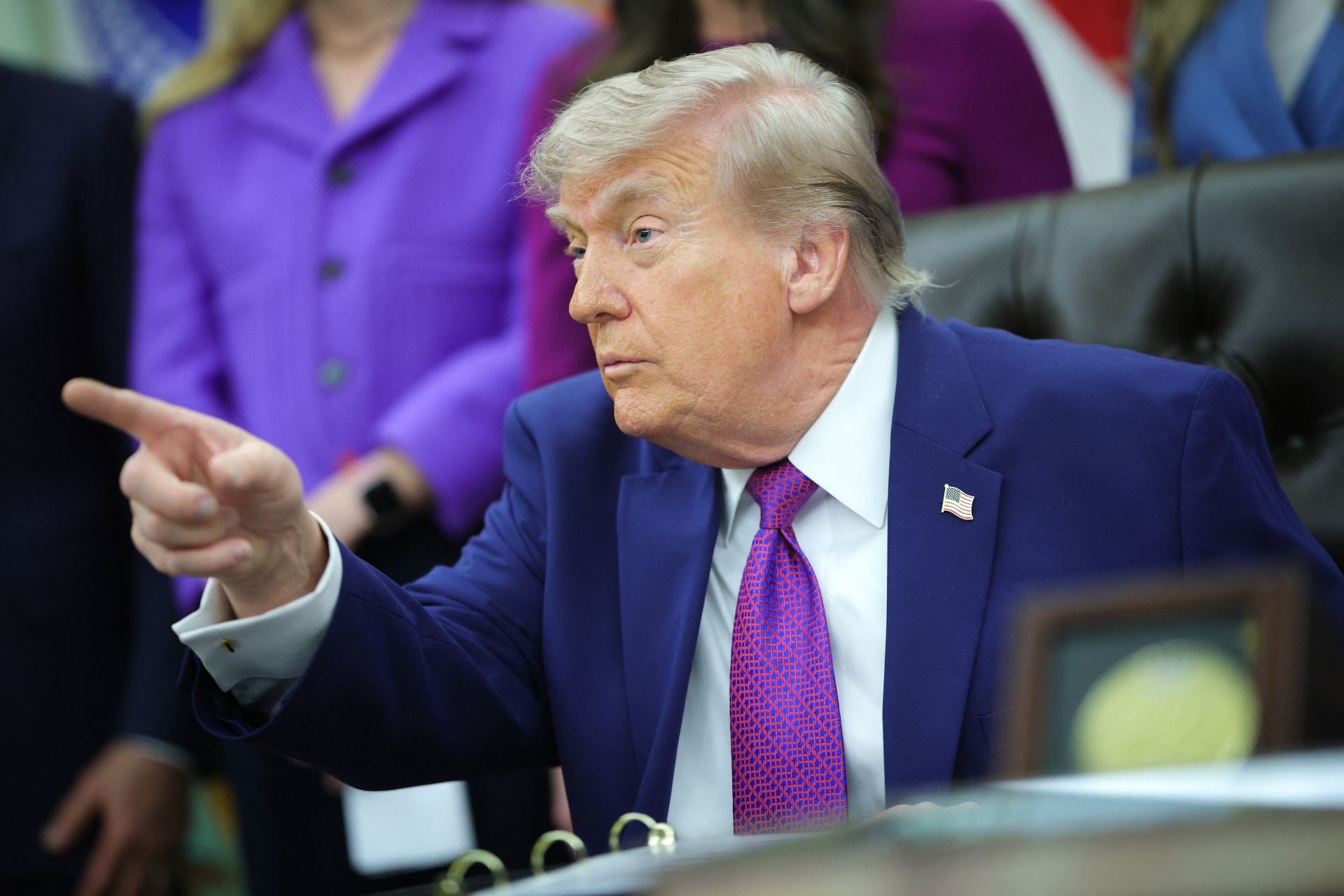
U.S. President Donald Trump answers a question from a reporter during an event on maternal healthcare in the Oval Office of the White House on May 11, 2026 in Washington, DC. The Trump administration recently launched Moms.gov, a website to help provide resources to expecting women and their families. ©KEVIN DIETSCH / GETTY IMAGES NORTH AMERICA / GETTY IMAGES VIA AFP
U.S. President Donald Trump declared Monday that Washington remains determined to achieve “complete victory” over Iran, signaling a sharp hardening of the American position as negotiations with Tehran appear increasingly deadlocked and the fragile regional ceasefire edges closer to collapse.
“We’re going to have a complete victory,” Trump told reporters at the White House, dismissing suggestions that mounting economic and geopolitical pressure could force Washington to compromise.
“Iran thinks I’ll get tired of this. I’ll get bored, or I’ll have some pressure. But there’s no pressure,” he said.
The remarks came only hours after Trump publicly rejected Iran’s latest counterproposal to a U.S.-backed ceasefire framework, describing Tehran’s demands as “totally unacceptable.”
Ceasefire on ‘life support’
Trump warned that the ceasefire that has largely halted direct fighting in the Gulf since April is now barely surviving.
“The ceasefire is on massive life support,” Trump said. “Where the doctor walks in and says, ‘Sir, your loved one has approximately a one percent chance of living.’”
The comments triggered immediate shockwaves across global energy markets already destabilized by months of war, overlapping naval blockades, and disruptions to maritime traffic through the Strait of Hormuz.
Oil prices surged sharply Monday following Trump’s rejection of the Iranian proposal before slightly retreating later in the day.
The latest diplomatic breakdown also deepened fears that commercial navigation through Hormuz — one of the world’s most critical energy corridors — could remain severely disrupted for months.
Iran demands sanctions relief and end to blockade
According to Iranian media, Tehran’s latest proposal included demands for an end to the U.S. naval blockade, the release of frozen Iranian assets, guarantees against future attacks, sanctions relief, and broader regional de-escalation, including in Lebanon.
Iranian Foreign Ministry spokesman Esmaeil Baghaei defended the proposal Monday, insisting Tehran had merely requested its “legitimate rights.”
“We did not demand concessions,” Baghaei said. “The only thing we demanded was Iran’s legitimate rights.”
Iran also demanded secure navigation through the Strait of Hormuz and the release of Iranian assets frozen abroad for years.
The demands were viewed in Washington as an attempt by Tehran to transform the negotiations into a broader strategic victory rather than a narrow ceasefire arrangement.
Trump weighs broader military operation
Trump also confirmed that he is considering relaunching “Project Freedom,” the short-lived U.S.-led naval initiative designed to escort commercial vessels through the Strait of Hormuz.
Speaking to Fox News, the president said any renewed operation would likely become part of a broader military campaign.
“If I decide to renew Project Freedom, it would only be a piece of something larger,” Trump said.
The original operation was suspended only days after its launch amid diplomatic efforts and reported Gulf concerns that the mission risked escalating the conflict further.
Meanwhile, U.S. officials continue enforcing a full maritime blockade on Iranian ports while Iran maintains severe restrictions on shipping through Hormuz.
Netanyahu says war ‘not over’
Israeli Prime Minister Benjamin Netanyahu reinforced the increasingly confrontational tone, insisting the conflict cannot end while Iran retains highly enriched uranium and operational nuclear infrastructure.
“It’s not over,” Netanyahu told CBS’s 60 Minutes. “There’s still nuclear material that has to be taken out of Iran.”
He added that Iranian enrichment facilities still need to be dismantled.
According to reports cited by The Wall Street Journal, Iran’s counterproposal may include diluting part of its highly enriched uranium stockpile while transferring the remainder to a third country under specific guarantees.
Hormuz crisis raises global alarm
The diplomatic crisis is unfolding alongside mounting international concern over the future of the Strait of Hormuz.
Saudi Aramco CEO Amin Nasser warned Monday that the world is facing the largest energy supply shock in modern history.
“If the Strait of Hormuz opens today, it will still take months for the market to rebalance,” he said, warning that prolonged disruption could extend instability into 2027.
UN officials also warned that the crisis is no longer limited to energy markets.
Jorge Moreira da Silva, head of the United Nations Office for Project Services (UNOPS), said fertilizer shortages linked to Gulf shipping disruptions could trigger a major global humanitarian crisis.
“We may witness a crisis that will force 45 million more people into hunger and starvation,” he warned.
International military preparations intensify
As tensions escalate, Britain and France announced plans to host a multinational meeting involving more than 40 defense ministers to coordinate maritime security operations around Hormuz.
France has already deployed the nuclear-powered aircraft carrier Charles de Gaulle to the region, while Britain confirmed the deployment of the destroyer HMS Dragon.
Iran, meanwhile, warned European states against joining military operations in the Gulf.
“Our restraint is over as of today,” said Iranian parliament national security commission spokesman Ebrahim Rezaei.
He warned that any attack on Iranian vessels would trigger a “strong and decisive response” against American ships and military bases.
Diplomacy narrowing as military pressure rises
Despite ongoing diplomatic contacts through intermediaries, including Pakistan, Turkey, and Gulf states, both Washington and Tehran now appear increasingly positioned for prolonged confrontation rather than imminent compromise.
Trump is expected to discuss Iran extensively during his upcoming summit with Xi Jinping in Beijing this week, as Washington pressures Beijing to use its influence over Tehran.
Read more
Comments