- Home
- Middle East
- Arrival of Third U.S. Carrier Marks First Triple Deployment in Middle East Since 2003
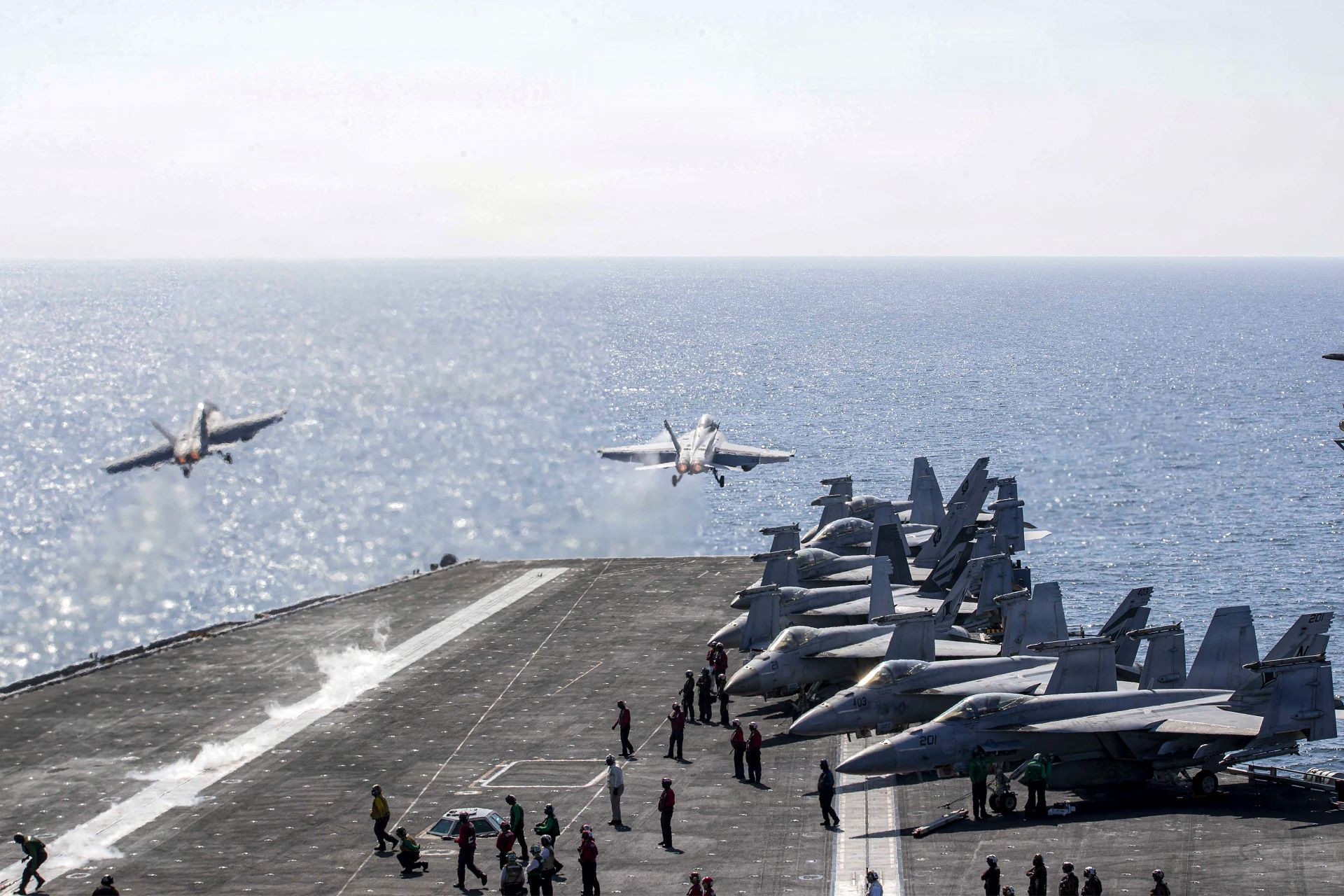
This US Navy handout photo released by US Central Command public affairs shows two F/A-18 Super Hornets launching from the flight deck of Nimitz-class aircraft carrier USS Abraham Lincoln (CVN 72) in support of Operation Epic Fury on March 3, 2026. © US NAVY / AFP
For the first time since the 2003 Iraq War, the United States has deployed three aircraft carrier strike groups simultaneously to the Middle East, marking a major escalation in its military posture in the region, according to the United States Central Command.
The latest deployment follows the arrival of the USS George H. W. Bush strike group, which joined the USS Gerald R. Ford and USS Abraham Lincoln in recent days. CENTCOM said the buildup supports Operation Epic Fury, with more than 15,000 sailors and Marines and over 200 aircraft now deployed across the three strike groups.
Carrier Strike Group 3 — USS Abraham Lincoln
Operating in the Arabian Sea within the United States Central Command area of responsibility, the USS Abraham Lincoln (CVN-72) leads one of the United States’ primary naval formations in the region.
The carrier is at the center of Carrier Strike Group 3 and is supported by Carrier Air Wing 9, alongside a screen of guided-missile destroyers.
The USS Abraham Lincoln carries a robust and flexible air wing, with a capacity of roughly 70 to 90 aircraft depending on operational configuration. This includes F/A-18 Super Hornets for strike missions, F-35C Lightning II stealth fighters, EA-18G Growler aircraft for electronic warfare, and E-2D Hawkeye planes that provide airborne early warning and command-and-control capabilities.
Carrier Strike Group 12 — USS Gerald R. Ford
Operating between the Red Sea and the Eastern Mediterranean, the USS Gerald R. Ford (CVN-78) is positioned along a strategic transition zone that allows rapid access to multiple theaters across the Middle East.
As the flagship of its strike group, the carrier is embarked with Carrier Air Wing 8 and supported by a screen of escort vessels, primarily guided-missile destroyers.
The USS Gerald R. Ford, the most advanced aircraft carrier in the U.S. Navy, carries a powerful air wing typically exceeding 75 aircraft. This provides a high-tempo strike capability, enhanced sortie generation rates, and broad operational flexibility across air, sea, and electronic warfare domains.
Carrier Strike Group 10 — USS George H. W. Bush
Operating in waters near Iran within the broader United States Central Command area of responsibility, the USS George H.W. Bush (CVN-77) Carrier Strike Group has recently entered the Middle East as part of a wider naval buildup that now includes three U.S. carrier groups in the region.
The strike group reached CENTCOM waters in late April 2026 after transiting around Africa, joining the USS Gerald R. Ford and USS Abraham Lincoln already on station in nearby theaters. Its arrival completed the rare concentration of three U.S. aircraft carriers in the Middle East, the first such deployment since 2003.
The USS George H.W. Bush operates alongside Carrier Air Wing 7 and a standard escort screen of guided-missile destroyers, including the USS Donald Cook, USS Ross, and USS Mason. These destroyers form the protective and missile-defense perimeter of the strike group, enabling sustained operations in contested waters.
The carrier’s embarked air wing typically fields around 60 to 70 aircraft, providing a mix of strike, reconnaissance, and electronic warfare capabilities.
Read more


Comments