- Home
- Middle East
- Hezbollah-Linked Suspect Extradited to Panama in Long-Running Terror Investigation
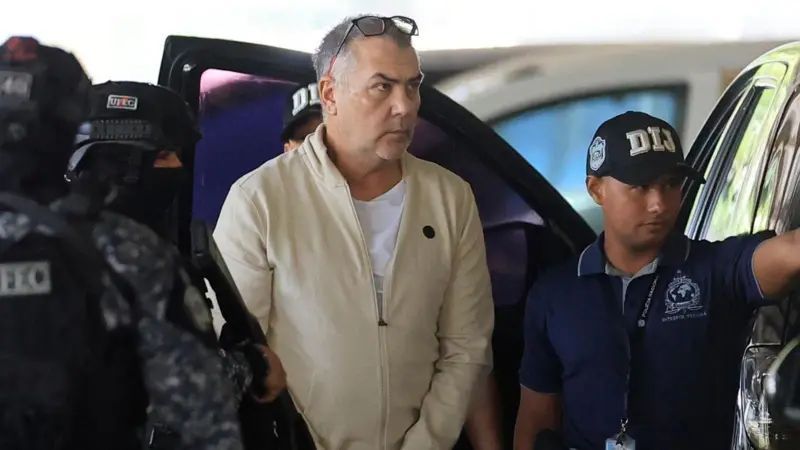
Ali Zaki Hage Jalil extradiated under heavy security ©EPA
The U.S. Embassy in Panama announced a major breakthrough in the decades-long investigation into the 1994 bombing of Alas Chiricanas Flight 901, stating that suspected Hezbollah-linked operative Ali Zaki Hage Jalil has been extradited to Panama to face trial.
The announcement described the move as the result of coordinated efforts between the United States, Panama, and Venezuela’s interim authorities, following a long-standing extradition request. According to the statement, the suspect will now stand trial for the attack, which killed 20 people, including American and Panamanian citizens. Twelve of the victims were members of Panama’s Jewish community.
The Embassy said the extradition marks “a major victory in the 30-year pursuit of justice” and highlighted what it called sustained diplomatic and operational coordination between the three parties involved.
U.S. Ambassador to Panama Kevin Marino Cabrera said the case demonstrates that the United States “has a long memory and an even longer reach,” adding that those who target Americans or U.S. allies “will be found and held accountable.”
The U.S. Federal Bureau of Investigation provided intelligence and technical support to Panamanian authorities during the investigation, according to the statement.
The case dates back to 19 July 1994, when Flight 901 exploded shortly after takeoff from Colón, killing all 21 people on board. The attack, which also occurred one day after the AMIA bombing in Buenos Aires, has long been attributed by U.S. and Israeli intelligence to Hezbollah-linked operatives.
In 2024, the United States offered a $5 million reward for information on those responsible for the bombing.
Broader regional Hezbollah activity
The extradition comes amid a broader U.S. push to dismantle what it describes as Hezbollah’s global networks, particularly in the Western Hemisphere. In recent months, U.S. officials have signaled a shift toward aggressive counter-network operations across Latin America.
Following the reported capture of former Venezuelan leader Nicolás Maduro by U.S. special forces, Secretary of State Marco Rubio stated that Hezbollah would no longer be allowed to operate in Venezuela, declaring that “no more Iran/Hezbollah presence” would be tolerated in the region. He also emphasized that the Trump administration aimed to prevent Venezuela from becoming a “crossroads for Hezbollah, Iran and other malign influences” in the Western Hemisphere.
These remarks reflect a broader U.S. strategic assessment of Hezbollah as not only a Middle Eastern militant group, but also a transnational organization operating through extensive financial, logistical, and criminal networks across Latin America, Africa, and Europe, according to U.S. government analyses, U.S. Department of the Treasury sanction designations, and congressional testimonies.
Panamanian and U.S. officials have described the recent move as a step toward long-delayed accountability for victims’ families, while also underscoring the continued geopolitical relevance of historical terrorist cases in shaping current U.S. policy toward Iran-linked networks in the Americas.
Read more


Comments