- Home
- Middle East
- B‑52 Operations Over Iran Suggest Broader U.S. Control of Skies
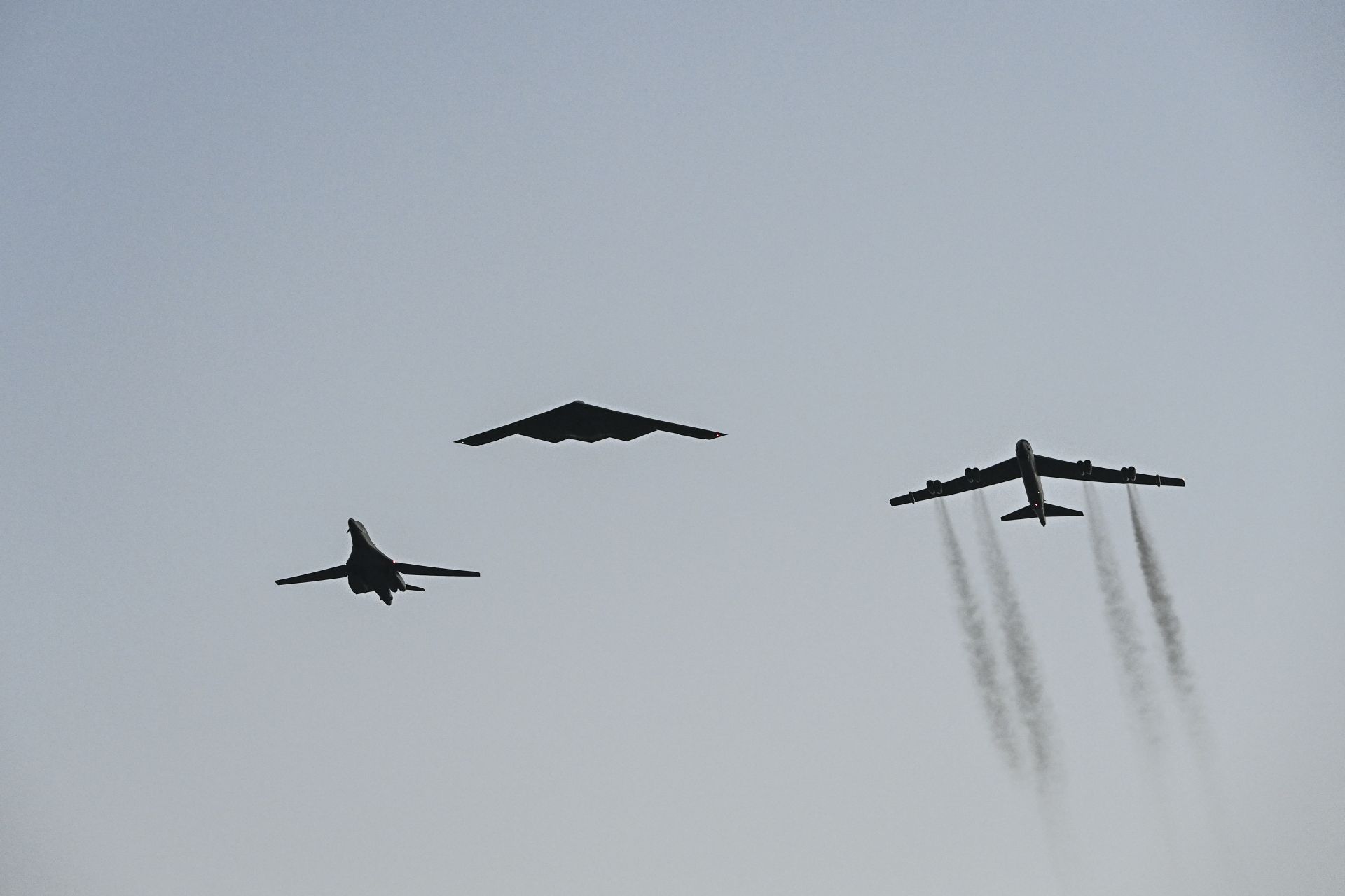
US Air Force strategic bombers (from R) B-52H Stratofortress, B-2 Spirit and B-1B Lancer flyover prior to Super Bowl LV when the Tampa Bay Buccaneers will take on the Kansas City Chiefs at Raymond James Stadium on February 7, 2021 in Tampa, Florida. ©Chandan Khanna / AFP
The United States Armed Forces has begun deploying B-52 Stratofortress bombers over Iran, signaling a major escalation in its ongoing military campaign and a growing level of control over Iranian airspace, according to a report by Fox News.
Chairman of the Joint Chiefs of Staff Dan Caine stated that the missions were initiated following an “increase in air superiority,” enabling U.S. forces to operate more freely inside Iran and expand the scope of their strikes.
U.S. President Donald Trump said that Iran’s air defense systems had been “annihilated,” adding that the country is “no longer a threat” after more than a month of sustained military operations.
Transition to Sustained Strike Operations
According to Fox News, the use of B-52 bombers marks a shift in the campaign from initial efforts to weaken Iran’s air defenses to a more sustained and flexible phase of operations. Unlike earlier stand-off strikes, these bombers are capable of remaining over the battlefield and targeting multiple positions, including mobile and fortified positions.
Retired U.S. Air Force Colonel Mark Gunzinger told Fox News that the presence of B-52s over Iran suggests not only air superiority but potentially air dominance in certain areas. This allows U.S. forces to strike targets dynamically rather than relying solely on pre-planned operations.
Ongoing Threats and Escalation
Despite increased U.S. control of Iranian airspace, Fox News reports that Iran continues to rely on missile and drone capabilities, maintaining a level of threat through asymmetric warfare tactics.
Earlier in the campaign, stealth aircraft such as the B-2 Spirit were used to target heavily fortified nuclear sites, including the Fordow Fuel Enrichment Plant and the Natanz Nuclear Facility. The introduction of B-52 bombers now points to a broader and more sustained phase of strikes.
Fox News also reports that the U.S. is using a significant portion of its combat-ready bomber fleet to maintain the campaign, highlighting the scale and intensity of ongoing operations.
Chairman of the Joint Chiefs of Staff Dan Caine stated on March 4: “This progress has allowed CENTCOM to establish localized air superiority across the southern flank of the Iranian coast and penetrate their defenses with overwhelming precision and firepower. We will now begin to expand inland, striking progressively deeper into Iranian territory and creating additional freedom of maneuver for U.S. forces.”
The statement indicates that U.S. forces had already gained a significant level of control over Iranian airspace in the early stages of the operation, particularly along the southern coastline.
Fox News reports that the U.S. has moved beyond the initial phase of degrading Iran’s air defenses, now operating more freely within Iranian airspace. This expanded capability allows for sustained, higher-volume strikes as the campaign enters a potentially more intense stage. President Donald Trump has described this as the “final phase” of operations, with U.S. officials signaling that strikes could escalate in the coming weeks.
Fighter Downed
Complicating the picture, U.S. officials confirmed the downing of an American fighter jet in south-west Iran today, according to Reuters. It is the first incident of a U.S. jet being downed by enemy fire in the current war. A search is ongoing for the two American crewmembers.
Read more



Comments