- Home
- War in the Middle East
- Israel Strikes Litani Bridges to Pressure Lebanese Government

The destroyed Qasmiye Bridge built over the Litani River, following an Israeli airstrike, in Qasmiye on March 18, 2026. (Photo by KAWNAT HAJU / AFP) ©(Photo by KAWNAT HAJU / AFP)
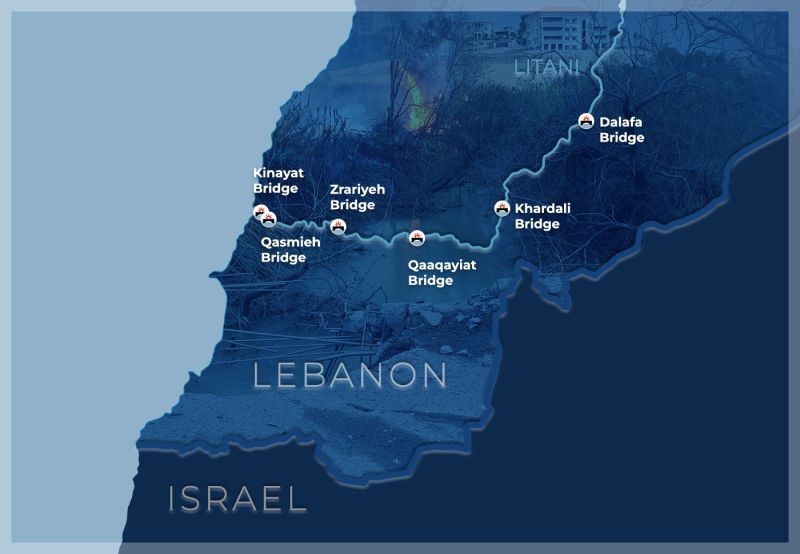
As Israel presses its ground invasion of south Lebanon, it has destroyed several bridges spanning the Litani River, saying Hezbollah was using the crossings for military purposes. Analysts told This Is Beirut that the strikes also form part of a broader pressure campaign on the Lebanese state.
Israeli Defense Minister Israel Katz said the bridges had been used by Hezbollah to move weapons and fighters to the theater of operations along the border. He announced the IDF’s plan to “control the remaining bridges and [implement] a security zone up to the Litani,” during a security assessment with senior military officials on March 24.
On March 13, the IDF struck the Zrariyeh bridge in the western Litani, a marked escalation and the first time Israel acknowledged hitting state infrastructure in the current conflict.
Since then, Israeli strikes have destroyed or severely damaged at least six other bridges in southern Lebanon, five of which lie directly on the Litani. The most consequential strikes severed the coastal highway between Sidon to Tyre and the main transit axis between the Beqaa Valley and southern Lebanon.
“Pressure Points”
Israel’s strikes on the bridges can be understood as a threat to occupy southern Lebanon up to the Litani River, former US Assistant Secretary for Near Eastern Affairs David Schenker told This is Beirut.
Schenker, a fellow at the Washington Institute, said Israel likely could have disrupted Hezbollah’s logistics to the border zone through other means, pointing to the IDF’s real-time intelligence capabilities and targeted unmanned aerial vehicle (UAV) strikes.
The “heavy-handed approach” to destroy the bridges, according to Schenker, strengthens Israel’s “leverage to compel the Lebanese army to do more on disarming Hezbollah.”
“The government is in a very difficult situation,” he said, “they can oppose Hezbollah, or Israel can continue indefinitely in its own operations.”
Hours after Hezbollah opened a military front against Israel on March 2, Lebanon’s cabinet banned the group’s military activities and tasked the Lebanese Armed Forces (LAF) with moving forward on its disarmament. LAF leadership, however, has balked at the order, citing concerns over domestic stability, while the US and Israel have grown skeptical over Beirut’s willingness to disarm Hezbollah.
Retired LAF general Khalil Gemayel, who commanded the South Litani sector, said Israel’s destruction of the Litani bridges sought to exploit “pressure points” of the Lebanese state.
Strikes on transit infrastructure mean that southern cities such as Tyre and Bint Jbeil will “quickly suffer from the humanitarian costs of isolation,” even if neither is formally occupied, leaving Beirut eager to connect them to the mainland, Gemayel told This is Beirut.
Khaled Hamadeh, a retired LAF general, said the destruction of the bridges prolongs “the return of displaced populations, thereby deepening the humanitarian crisis and increasing pressure on the Lebanese state.”
As of March 26, about 150,000 civilians remain south of the Litani, “out of reach for humanitarian convoys seeking to deliver essential aid,” according to UNHCR. Meanwhile, a fifth of Lebanon’s population is displaced, according to the UN’s International Organization for Migration, straining public infrastructure and spurring tensions in host communities throughout the country.
Implications for Broader Israeli Strategy
The scale of Israel’s current military operation invites comparisons with its 1982 invasion of Lebanon, when IDF forces advanced to Beirut and forced thousands of PLO fighters to evacuate by sea. According to Hamadeh, however, the current trajectory suggests a fundamentally different strategy.
“Unlike in 1982,” the retired LAF general told This is Beirut, “achieving [Israeli] objectives does not necessarily require large-scale territorial occupation or sustained ground deployment. Advances in military technology have enabled alternative forms of control and coercion.”
In this context, Israel’s isolation of the south represents a strategy “not to hold territory indefinitely, but to reshape political behavior” within Lebanon, according to Hamadeh.
However, Schenker said that the Israelis likely do not believe Beirut will act forcefully on Hezbollah disarmament, citing internal obstacles and the 16 months of relative inaction that followed the end of the last major conflict in November 2024.
The resulting landscape would see Hezbollah retrench in the Lebanese heartland, either prompting confrontation with state authorities or leaving them to bide time until the next Israeli offensive.
Schenker explained that the Israelis “want to get to a situation that is acceptable to them, which is Hezbollah not being present within 30 miles of their border.”
“To get there,” he said, “Israel seems prepared to maintain ongoing operations at a higher tempo as the new normal.”
Read more


Comments