- Home
- Middle East
- Drone, Rocket Attack Targets U.S. Embassy in Baghdad
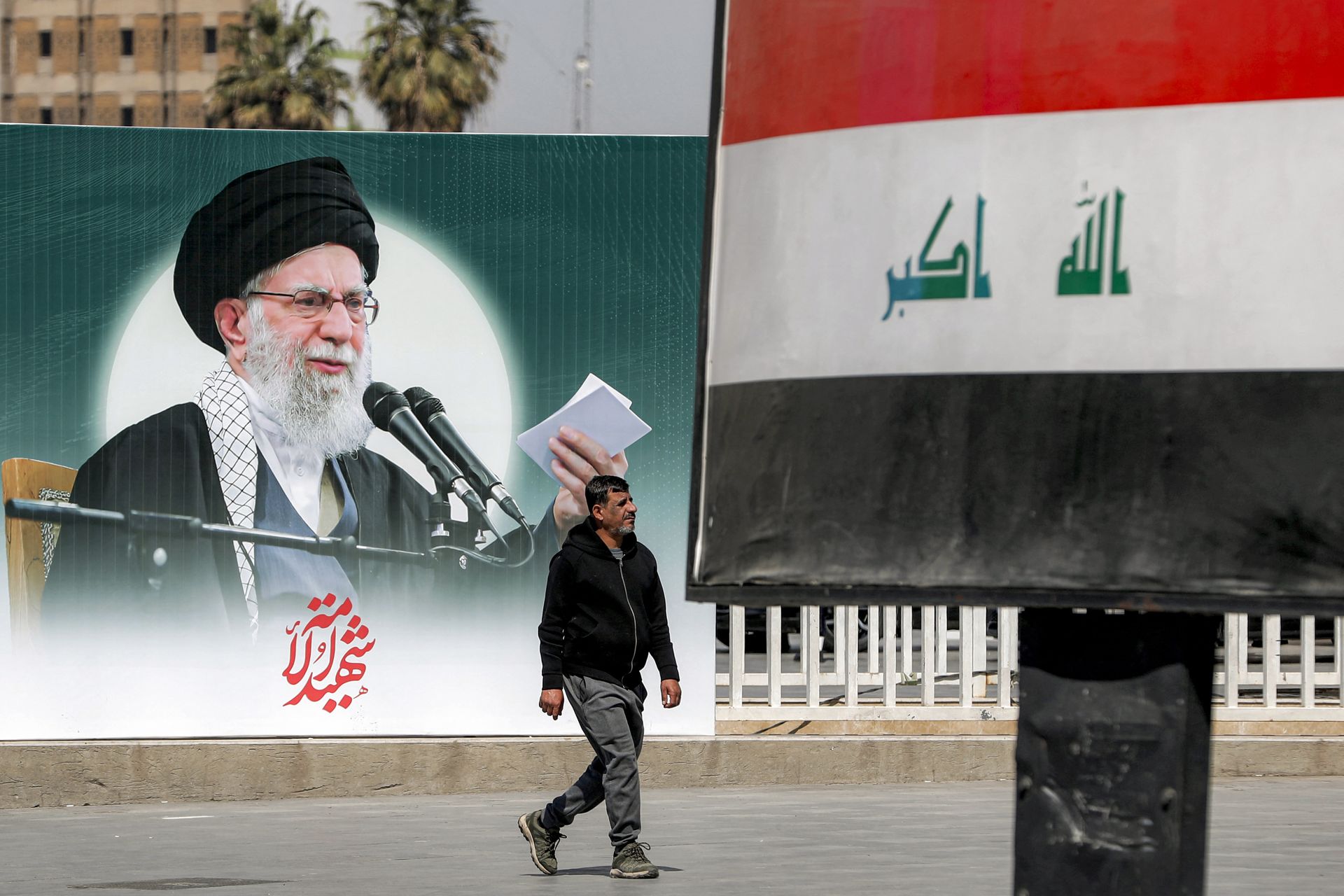
A man walks past a banner depicting Ayatollah Ali Khamenei, Iran's late supreme leader who was killed on February 28 in a US-Israeli strike in Tehran, displayed at Baghdad's central Tahrir Square on March 9, 2026. ©Photo by AHMAD AL-RUBAYE / AFP
A drone and rocket attack targeted the US embassy in Baghdad early Tuesday, while a strike killed four people at a house reportedly hosting Iranian advisors, security officials said, pulling Iraq deeper into the Middle East war.
An AFP journalist reported seeing black smoke rising after an explosion in the embassy complex, as well as air defences intercepting another drone.
The strikes came hours after air defences thwarted a rocket attack at the embassy and a drone sparked a fire at a luxury hotel frequented by foreign diplomats in Baghdad's fortified Green Zone.
Iraq was drawn into the Middle East war after having long been a proxy battleground between the United States and Iran, with strikes targeting Iran-backed groups that have claimed daily attacks on US interests in Iraq and across the region.
Meanwhile, a strike on a house in Baghdad killed four people early Tuesday, with initial reports suggesting that two of the dead were "Iranian advisors" to Tehran-backed groups, a security source told AFP.
Another source from an Iran-backed faction confirmed that four people were killed in the strike on a house hosting Iranian advisors in al-Jadiriyah neighbourhood.
The attacks came shortly after the powerful Tehran-backed Kataeb Hezbollah group announced that its senior security commander Abu Ali al-Askari had been killed, without providing details on the circumstances of his death.
Iraq's interior ministry initially said that a "projectile" fell on the roof of the luxury al-Rasheed Hotel in Baghdad's heavily fortified Green Zone, before clarifying that it was a drone. It did not specify whether the building itself was the target.
"The incident caused no casualties or material damage," it added.
A street leading to the hotel, which hosts diplomatic missions including the US embassy, was blocked by a large security deployment, with firefighters and ambulances present, according to an AFP correspondent.
Witnesses saw a fire break out on the roof of the hotel.
Shortly after the hotel incident, a loud blast was heard in Baghdad, as air defences were seen intercepting an attack over the US embassy, an AFP journalist said.
A security official told AFP "air defences thwarted an attack with four rockets" on the embassy.
Prime Minister Mohammed Shia al-Sudani, head of the armed forces, denounced the attacks -- including a strike on a southern oil field -- calling them threats to his country's "security and stability".
He promised security services would "hunt down the perpetrators of these acts and bring them to justice immediately", according to a statement from his spokesman, Sabah al-Numan.
"These criminal acts have serious repercussions for our country and undermine the government's efforts toward reconstruction and prosperity."
- Fighters killed, oil attack -
Kataeb Hezbollah announced Monday "the martyrdom of Haj Abu Ali al-Askari", without providing any details on how and when he was killed.
A security official told AFP that "Abu Ali al-Askari is Abu Ali al-Amiri, the commander who was killed in a strike on Baghdad on Saturday".
Kataeb Hezbollah referred to Askari as the group's security chief. He was also the spokesperson in charge of issuing all key statements in the group's name.
Drone and rocket attacks have also targeted oil fields and facilities.
Earlier Monday, two drones targeted the southern Majnoon oil field -- which had already paused production -- with the oil ministry spokesperson saying that one of the drones had hit a telecommunications tower.
A security official said a second drone had targeted the offices of a US firm, operating at the site.
In a separate incident in the west, eight Iraqi fighters from a former paramilitary coalition were also killed in strikes near the country's border with Syria.
The fighters belonged to the Hashed al-Shaabi, also known as the Popular Mobilisation Forces (PMF), which are now part of Iraq's regular army.
Read more
Comments