- Home
- Middle East
- Hormuz Alternative Oil Routes Inadequate to Cope with Demand
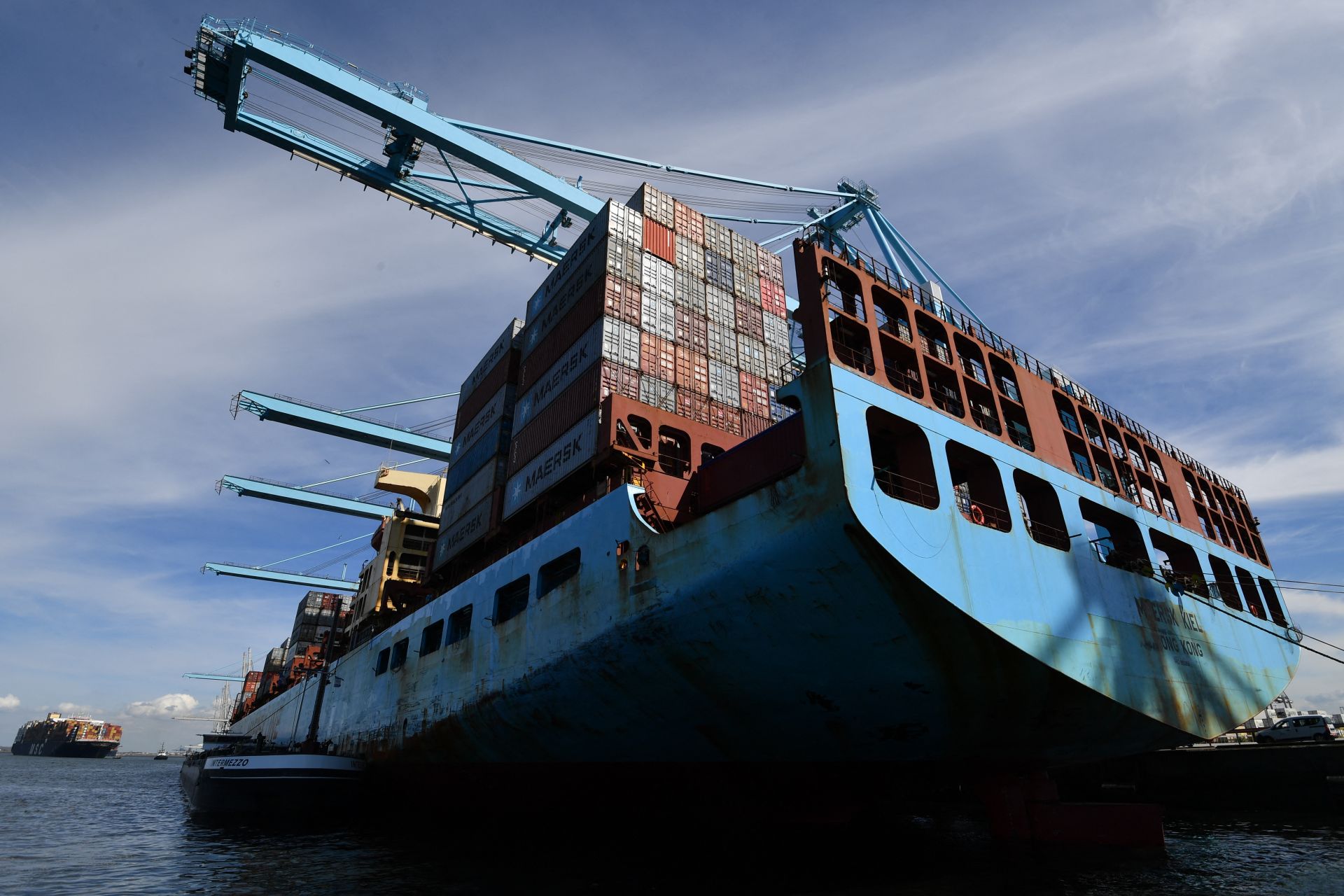
A container ship arrives at the Delta terminal of ECT (Europe Container Terminals) in the port of Rotterdam, August 1, 2022. ©John Thys / AFP
Iran's threats against oil tankers transiting the Strait of Hormuz -- a chokepoint through which some 20 percent of global exports pass in peacetime -- has forced countries in the region to seek alternative routes.
But analysts warn those routes are not yet sufficient to deal fully with global oil demand.
"Saudi Arabia and the UAE can reroute some crude output to terminals outside the Gulf," the International Energy Agency stated in its latest monthly oil report, saying that this can "help offset lost crude flows via Hormuz."
But data intelligence firm Kpler warns that alternative export routes "remain insufficient, with record loadings from Fujairah (UAE) and Yanbu (Saudi Arabia) still leaving effective Middle Eastern exports at only about one-third of normal levels."
Kpler says Asian refiners are expected to step up purchases of long-haul cargoes from the Atlantic Basin with no quick reopening of Strait of Hormuz traffic likely.
Almost 20 million barrels per day (mb/d), or about 20 percent of global oil consumption, typically pass through the Strait of Hormuz, mostly bound for China, India, South Korea and Japan.
According to the IEA, some 350 oil tankers, some loaded and some empty, are currently stranded in the area.
Iran views those belonging to the United States and its allies as "legitimate targets."
Only some 80 ships have been able to pass through the strait since the start of the war on February 28.
Partial Strait Bypass
In a study published on March 9 the Standard Chartered bank indicated that Bahrain, Iraq, Kuwait and Qatar must export almost the entirety of their crude through the Strait of Hormuz whereas Saudi Arabia and the United Arab Emirates can partially offset the blockage via alternative pipelines.
Saudi Arabia's East-West pipeline connects Abqaiq, near the Gulf, to the port of Yanbu on the Red Sea.
On March 9, the Saudis set a record for daily exports from its western ports of 5.9 mb/d, compared to an average of just 1.7 in 2025, according to the IEA.
This pipeline will reach full capacity of 7 mb/d "in the coming days," Amin Nasser, CEO of Saudi Aramco, promised on March 10.
The UAE, meanwhile, is shipping crude through its port of Fujairah on the Gulf of Oman to avoid the Strait of Hormuz, albeit with modest volumes.
"Usually 1.5 mb/d, they can be increased to 1.8 mb/d," according to the IEA.
Together, Saudi Arabia and the UAE have additional crude transport capacity of up to 5.5 million mb/d, according to the IEA.
Yet "despite record shipments from Fujairah and Yanbu, actual exports from the Middle East still account for only about a third of their normal level," according to Kpler.
Iranian drone and missile attacks pose a constant threat to these sites as well.
Other routes are possible, such as an Iraq-Turkey pipeline, but it has been out of service for years.
Elsewhere, in Kazakhstan and Azerbaijan, capacity is constrained, while Iran targeted the Baku-Tbilisi-Ceyhan pipeline, which terminates in Turkey, at the start of the conflict.
Long Distances
Russia's oil export infrastructure is regularly targeted by Ukraine, and volumes remain insufficient to meet global demand despite the partial lifting of sanctions by the United States.
Although demand for Russian oil may increase owing to major supply disruptions in the Middle East, the IEA says its forecasts for the country remain unchanged for the time being with average production of 9.3 mb/d through to the end of 2026.
Alternative routes for oil from the United States, West Africa and Latin America are longer and the global tanker market is already tight. Furthermore, those countries' ability to quickly jack up production does not exceed a few hundred thousand additional barrels per day.
The Middle East war is bringing severe strain to the entire energy system, according to the think tank Rystad Energy.
"Under the pre-war scenario, we had expected Brent to average $60 per barrel in 2026, as the market faced a substantial surplus of 2.6 million barrels per day," says Rystad.
Since the conflict began the price of black gold has fluctuated between $80 and $120 and Monday was floating around the $100 mark.
AFP
Read more


Comments