- Home
- Middle East
- Trump Urges Other Nations' Warships to Protect Gulf Oil Route
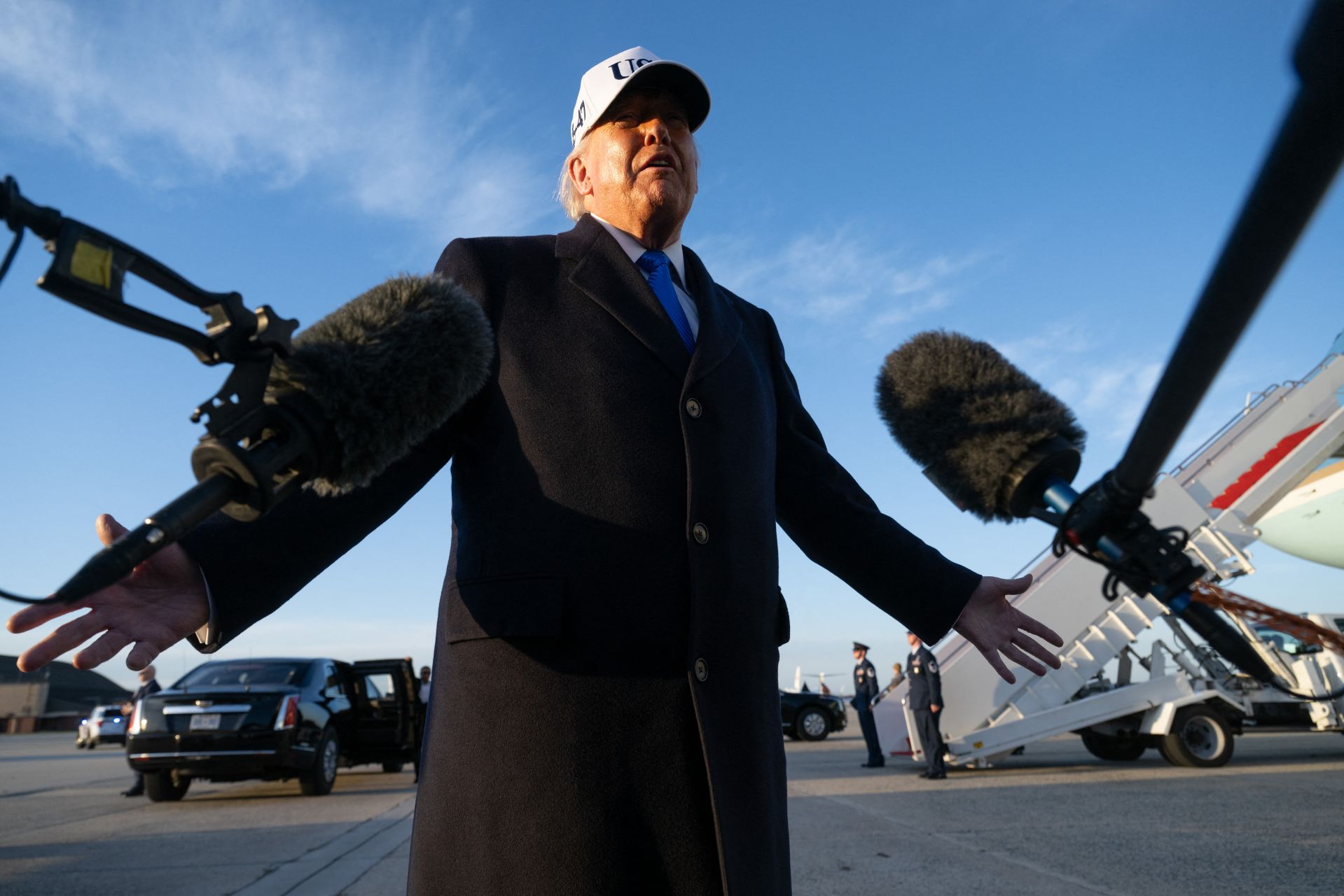
US President Donald Trump speaks to reporters before boarding Air Force One as he departs Joint Base Andrews in Maryland on March 13, 2026. ©SAUL LOEB / AFP
U.S. President Donald Trump called for other nations' warships to help safeguard world oil supplies passing through the Strait of Hormuz, a route which is virtually blocked as of Sunday by the threat of Iranian attacks.
Despite sustaining heavy bombardments since U.S.-Israeli forces launched a war against Iran on February 28, Tehran has defied Trump's assertion that its military capability has been "completely" destroyed.
Escalating Energy Crisis
Over the last two weeks, Iran’s military has launched drones and missile attacks against Israel, Gulf energy facilities, and other targets across the Middle East.
Clouds of black smoke rose over the UAE port of Fujairah, home to a major Emirati oil storage and export terminal, shortly after Iran's military warned UAE civilians to avoid port areas.
Iran's escalatory actions have nearly halted shipping in the Strait of Hormuz, a vital trade route which ordinarily hosts one-fifth of world oil supplies. Petroleum prices have risen by 40 percent, roiling the global economy.
Trump Threatens to Assemble Coalition
"Many countries, especially those who are affected by Iran's attempted closure of the Hormuz Strait, will be sending warships, in conjunction with the United States of America, to keep the strait open and safe," Trump posted on social media Saturday.
"Hopefully China, France, Japan, South Korea, the UK, and others that are affected by this artificial constraint will send ships to the area," he added.
"In the meantime, the United States will be bombing the hell out of the shoreline and continually shooting Iranian boats and ships out of the water."
Attacks on Kharg Island
U.S. forces struck Iran's Kharg Island on Friday, from which nearly all of the country's oil exports flow. Trump posted on Truth Social that they had "obliterated every MILITARY target" on the island while sparing energy facilities.
Iran had previously threatened U.S.-linked oil and energy firms would be "turned into a pile of ashes" if its oil facilities were hit.
U.S. media reported that the Pentagon has dispatched the amphibious assault ship USS Tripoli and around 2,500 Marines to the region.
The Pentagon said more than 15,000 targets in Iran have been hit by U.S. and Israeli forces.
‘Leave Now’
Tehran has also shown a capacity to strike at Israel and across the region, firing missiles and dispatching drones in a string of attacks over the weekend.
AFP journalists heard blasts over Jerusalem after the military detected missiles launched from Iran, while the UAE, Kuwait, and Saudi Arabia reported new missile or drone interceptions.
Washington's embassy in Iraq was hit by a drone, security sources told AFP, the second such strike during the war, while the Emirati consulate in Iraqi Kurdistan was targeted for the second time in a week.
U.S. officials in Baghdad urged citizens to "leave now."
In Kuwait, a drone strike damaged the international airport's radar system but caused no injuries, the civil aviation authority said.
Qatar evacuated parts of downtown Doha and intercepted two missiles. Blasts were heard by AFP journalists.
Iran's Revolutionary Guards said they had launched missiles at US forces stationed at the Al-Kharj base in Saudi Arabia, a close U.S. ally that hosts a large number of American troops.
The kingdom did not confirm the attack but said earlier it had intercepted six ballistic missiles headed toward Al-Kharj.
The U.S. military has lost 13 personnel. They include six aboard a refueling aircraft that crashed in Iraq, an incident U.S. officials said was not the result of hostile or friendly fire.
Attacks Continue in Iran
Military strikes were reported by local media in several Iranian provinces, including one on an industrial site in Isfahan that killed 15 people, according to the Fars news agency. AFP could not verify the toll.
The UN refugee agency said up to 3.2 million people have been displaced in Iran, most of them fleeing the capital and other cities to seek safety.
In Iran, leaders appeared intent on projecting stability despite the killing of Supreme Leader Ali Khamenei on the war's opening day.
His son Mojtaba Khamenei was named the new supreme leader but has not appeared in public and is reportedly wounded. Iran said Saturday that "there is no problem with the new supreme leader."
Lebanon
Lebanon has also been drawn into the war after the Tehran-backed militant group Hezbollah attacked Israel following Khamenei's death.
Israel has responded with air and ground assaults, killing at least 826 people, according to the Lebanese authorities.
It has also issued evacuation orders covering hundreds of square kilometers of Lebanon, displacing hundreds of thousands of people and prompting warnings of a humanitarian disaster.
Hezbollah said it was engaged in "direct clashes" with Israeli forces in the southern Lebanese town of Khiam late on Saturday.
AFP
Read more
Comments