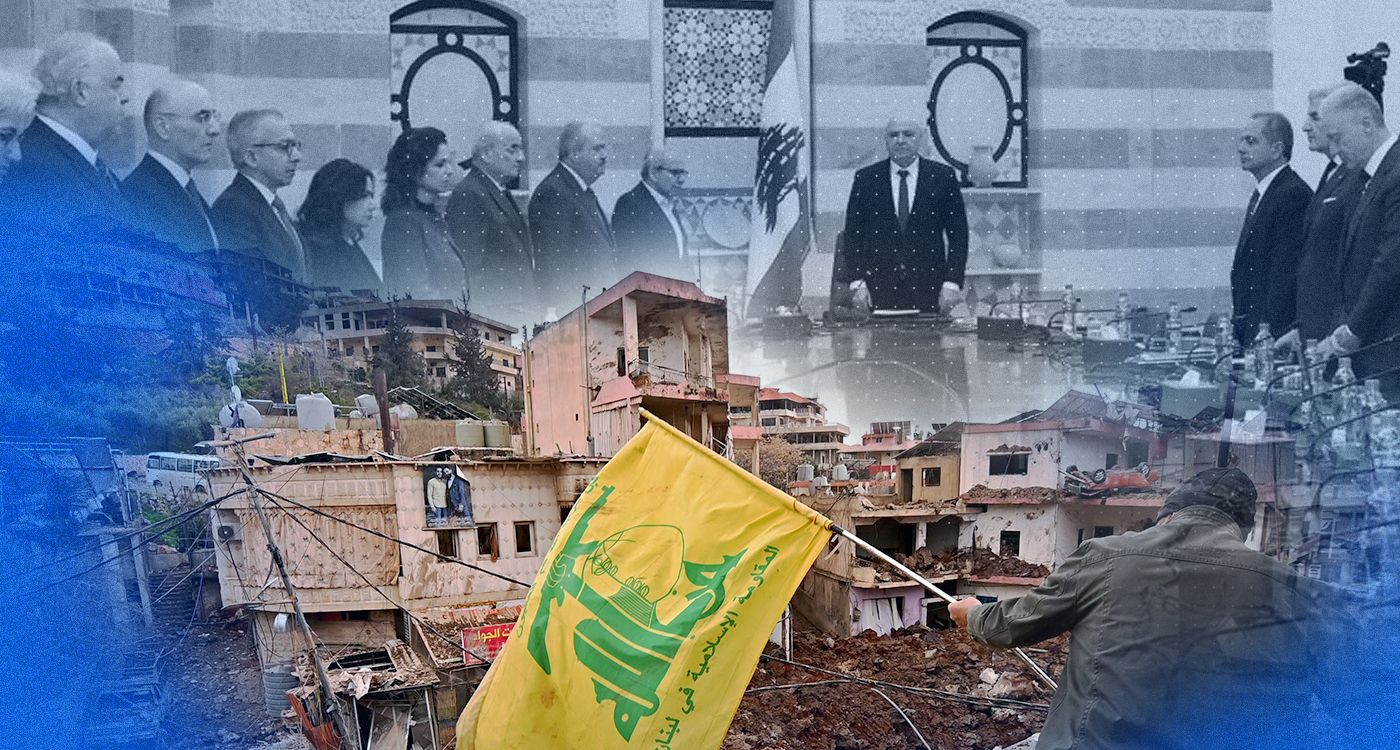
After Hezbollah once again turned Lebanon into a battlefield at the behest of the Iranian regime, all eyes turned to see whether the Lebanese state could undertake tangible measures to counter this existential risk.
Hours after Hezbollah lobbed rockets into Israel on March 2, the Lebanese government convened an emergency meeting at the Presidential Palace in Baabda overlooking Beirut. Following the session, Prime Minister Nawaf Salam announced the cabinet had banned Hezbollah’s military activities and ordered the Lebanese Armed Forces (LAF) to enforce the decision and immediately move forward with its plans to disarm the militia.
There was reason to believe this time might be different. After Hezbollah had drawn Lebanon into a conflict with potentially severe consequences for the country, expectations grew that the state would take its decisions more seriously than in the past and follow-up on its resolutions with concrete enforcement measures.
Since taking office after the last war, President Aoun and Prime Minister Salam have repeatedly promised the Lebanese people and foreign partners that Hezbollah would be disarmed by the end of 2025. Aoun publicly reiterated this commitment in several speeches, presenting it as a core objective for the first year of his presidency.
Yet these pledges have remained largely rhetorical and have not been translated into action on the ground. The government’s approach has instead been characterized by accommodation of Hezbollah, aimed at avoiding any direct confrontation with the militia and its insistence on retaining its arsenal and military role outside state authority.
Amid this hesitancy, broad swathes of Lebanese society grew frustrated as time passed without any concrete progress toward this goal. At the same time, regional and international warnings to the Lebanese state became more urgent. Foreign powers told the Lebanese state that it needed to concretely address the problem of Hezbollah’s arms, or Israel would undertake the task itself by military force.
Ultimately, the Lebanese cabinet’s decision to ban Hezbollah’s military activities came only after the group plunged the country into a regional conflict. The decision raises a fundamental question: is it even possible to distinguish between military and political wings within Hezbollah?
The party’s structure does not operate on such a dualistic model. Hezbollah’s various apparatuses function within a unified organizational framework that ultimately serves what is commonly described as its “military wing.”
Shortly after the government’s decision, Mohammad Raad, the head of Hezbollah’s parliamentary bloc and a senior figure of the party’s so-called “political wing,” issued a statement defending its “military wing.” He rejected the cabinet’s order, declaring it unacceptable. The following day, Hezbollah escalated its military activities and has shown no signs of stopping.
This raises another fundamental question. What has the government done in response to Hezbollah’s rejection of its decision? What concrete enforcement measures have been taken on the ground? Where are the mechanisms that would demonstrate that the ban on Hezbollah’s military activities is anything more than political declaration for public consumption?
Truth is found in action, not statements. Protecting the nation requires enforcing decisions. The Lebanese people are not asking for more speeches, but clear answers on how the state intends to assert its authority and enforce the ban.
What matters most is that the government enforces its ban on Hezbollah’s military actions in practice. Ultimately, this will test the government’s credibility and how seriously it takes its responsibility to spare Lebanon further devastation. So far, the signs are not encouraging. Hezbollah remains defiant and continues its attacks on Israel, while the Lebanese government watches from the sidelines.

Comments