- Home
- Middle East
- SDF Commander Says Integration With Syrian State Has Begun
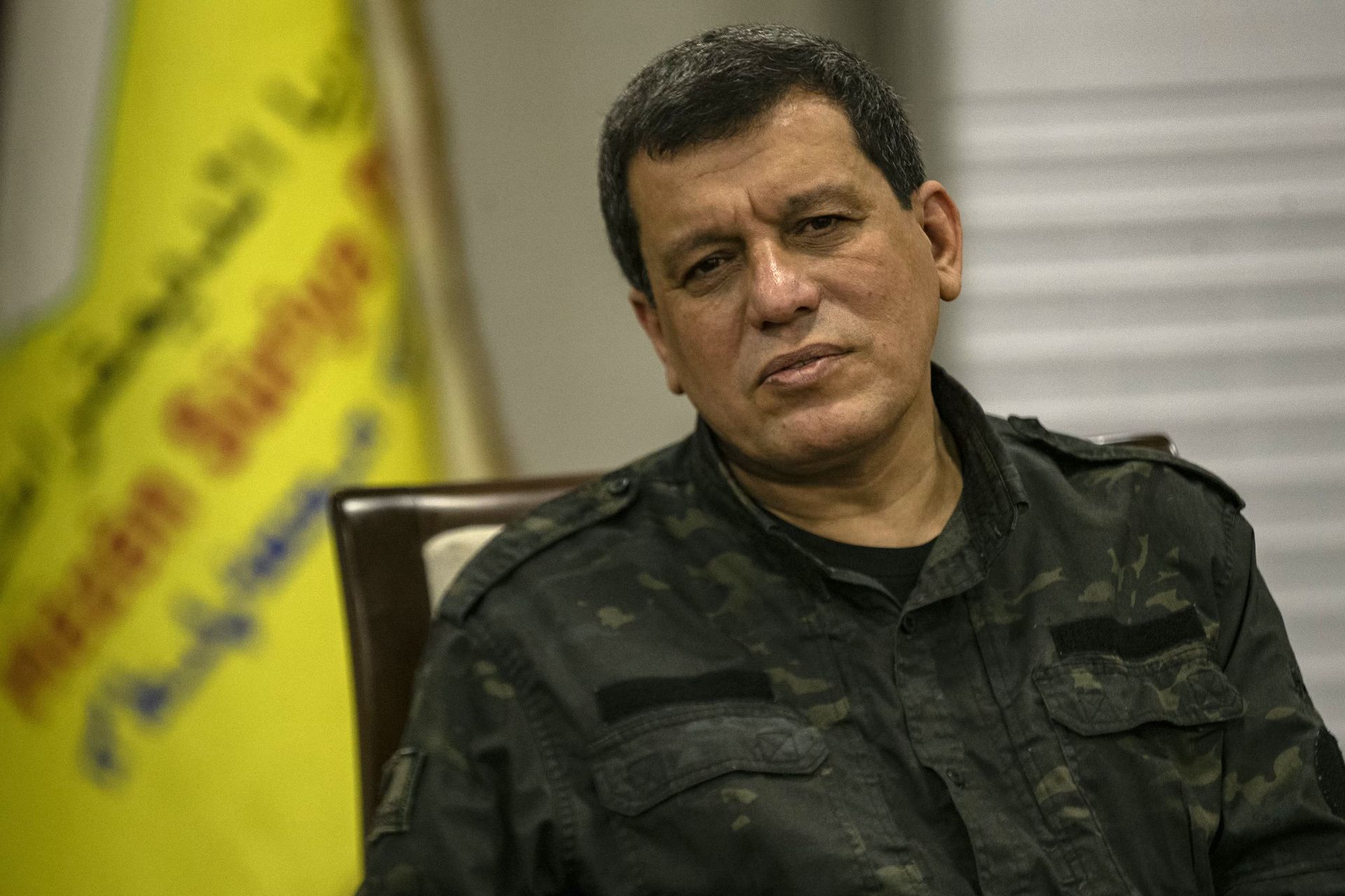
Syrian Democratic Forces commander-in-chief Mazloum Abdi speaks during an interview with AFP in Syria's northeastern city of Hasakeh on October 26, 2024. ©Delil Souleiman / AFP
The commander of the Syrian Democratic Forces (SDF), Mazloum Abdi, said Tuesday that the integration of the Kurdish-led Autonomous Administration and its security forces into Syria’s state institutions has formally begun, while cautioning that the process “may take some time” due to political and operational obstacles.
Speaking during a meeting of the Hasakah Notables Council in northeastern Syria, Abdi confirmed that implementation of the January agreement with Damascus is underway, describing it as a gradual transition rather than an immediate handover of authority.
He stressed that personnel from the SDF-affiliated Internal Security Forces (Asayish), including their commanders, must retain their positions within the structure of Syria’s Interior Ministry during the transition, a provision he said is already being applied on the ground.
Joint committees and phased transfer of authority
Abdi announced the formation of a senior joint leadership committee tasked with overseeing the integration process, alongside security teams arriving from Damascus to complete administrative procedures.
Despite what he acknowledged as “real obstacles,” Abdi said both sides remain confident the agreement will succeed. He added that a joint command structure is being finalized to manage security coordination and to counter what he described as incitement and attempts to derail the process.
On the civilian side, Abdi said institutions run by the Autonomous Administration for more than 12 years will be merged into Syrian state bodies, with current directors remaining in place during a transitional period to avoid administrative collapse.
“This is about continuity,” he said, arguing that preserving existing cadres is essential to prevent a governance vacuum in northeastern Syria.
Local autonomy within a centralized state
Addressing concerns among Kurdish communities, Abdi said the agreement recognizes the “specificity” of Kurdish-majority areas, allowing residents to administer their own regions within the framework of the Syrian state. He added that this approach also applies to Syriac-Assyrian communities in their towns and villages, pointing to a model of expanded local administration under centralized sovereignty.
He emphasized that the integration process is not limited to Kurdish institutions but applies to all governing bodies under the Autonomous Administration.
Military integration under Defense Ministry
On the military front, Abdi confirmed that SDF forces will be reorganized into brigades under Syria’s Defense Ministry while ensuring that fighters who participated in anti-terror operations retain their roles.
He also disclosed ongoing discussions over the appointment of a deputy defense minister in Damascus, an unresolved issue he said is still under negotiation.
Abdi added that recent meetings with Syria’s foreign minister and intelligence chief resulted in agreement to accelerate implementation and establish two high-level committees to supervise both military and administrative integration.
Warning against hate speech
Abdi also addressed rising social tensions, condemning what he called “strange and unfamiliar” hate rhetoric in areas historically known for coexistence, including parts of Jazira and Aleppo.
He urged communities to focus on stability and reconciliation, saying international stakeholders are closely watching implementation of the agreement, which aims to consolidate a ceasefire and move toward a permanent truce.
Background: January agreement with Damascus
The comments come amid efforts to operationalize a deal reached last January between the SDF and the Syrian government following shifts on the battlefield in northeastern Syria.
The agreement includes, a permanent ceasefire, integration of SDF forces into the Defense Ministry, restructuring security bodies under the Interior Ministry, merging civil institutions into the state while preserving local particularities, and the formation of joint oversight committees.
The deal followed clashes in parts of Raqqa, Hasakah countryside, and Deir Ezzor, after which Syrian government forces regained control of large territories, leaving SDF presence largely confined to Hasakah province and areas around Kobani.
A fragile transition
While officials say implementation has begun, timelines remain unclear, and key mechanisms are still under review. Abdi’s remarks underline an attempt to anchor existing security and administrative leadership within state structures, a strategy aimed at easing the transition but one that also raises questions about how power will ultimately be redistributed.
For now, both sides appear committed to gradual integration. Whether the process delivers lasting stability will depend on their ability to overcome technical disputes, political mistrust, and competing visions for governance in northeastern Syria.
Read more


Comments