- Home
- Middle East
- Anti-Khamenei Chants Erupt in Tehran as Iran Marks Revolution Anniversary
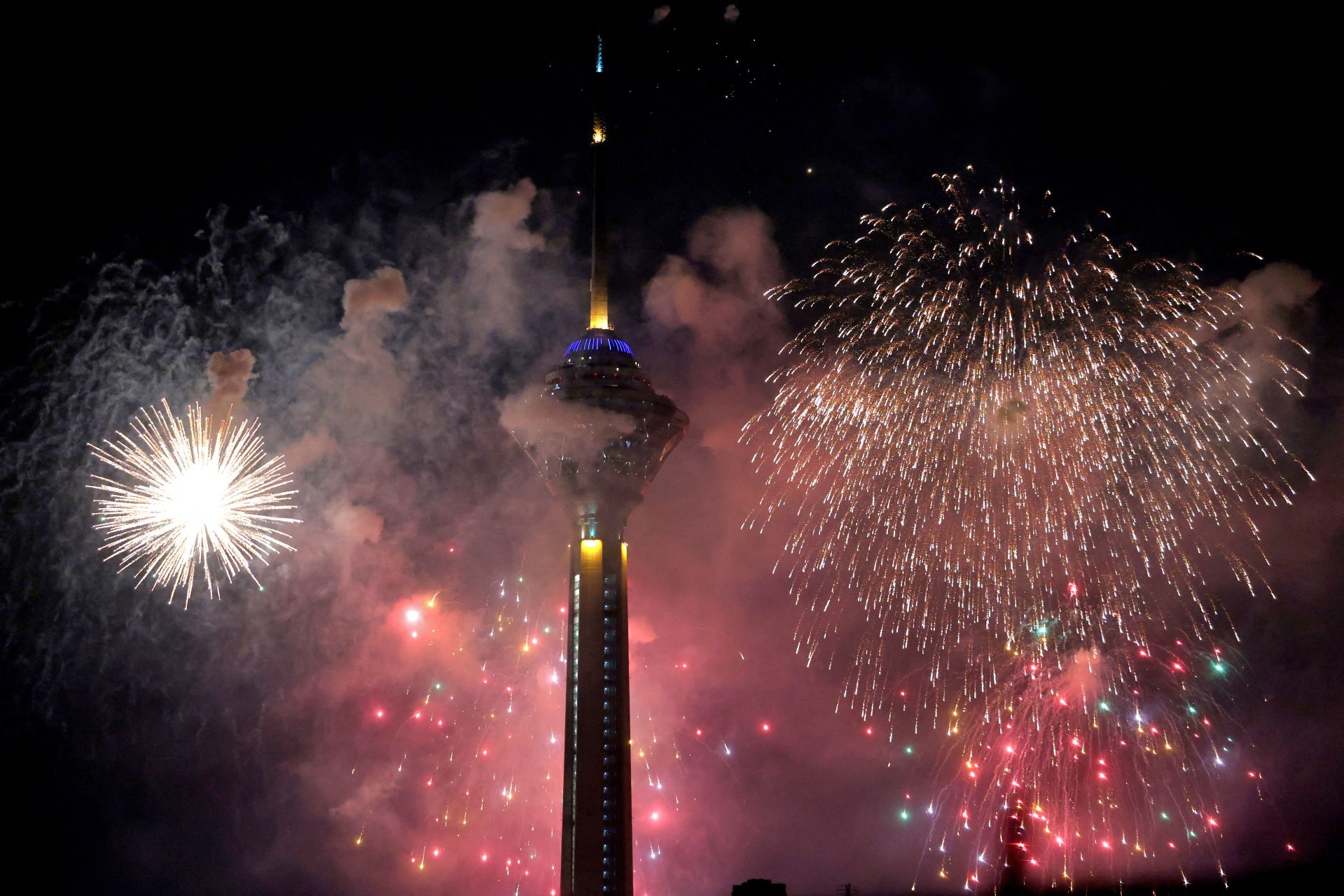
Fireworks light up the sky next to Milad Tower in Tehran to mark the 47th anniversary of the Iranian Revolution on February 10, 2026. ©ATTA KENARE / AFP
Residents in several neighborhoods of Tehran chanted slogans against Iran’s supreme leader, Ali Khamenei, late Tuesday, in a rare resurgence of public dissent on the eve of the Islamic Republic’s most symbolic national commemoration.
Videos circulating on social media showed voices ringing out from apartment balconies with chants including “death to Khamenei,” “death to the dictator,” and “death to the Islamic Republic.” The footage, shared by widely followed protest-monitoring accounts, could not be independently verified but appeared to capture coordinated nighttime protests in multiple residential areas of the capital.
The Renewed Unrest
The slogans emerged just hours before Bahman 22, the anniversary marking the 1979 collapse of the monarchy and the formal consolidation of power by revolutionary leader Ruhollah Khomeini, a date traditionally accompanied by state-organized celebrations and heavy security deployments.
Local activist channels reported that security forces were dispatched to some districts after residents began chanting, with pro-government slogans broadcast in response. Similar reports of balcony protests also surfaced from Isfahan and Shiraz, suggesting the demonstrations were not confined to Tehran.
The renewed unrest comes after weeks of relative quiet following a sweeping crackdown on nationwide protests that erupted in late December over rising living costs before morphing into broader anti-government demonstrations.
According to the U.S.-based Human Rights Activists News Agency, nearly 7,000 people were killed during the unrest, most of them protesters shot by security forces, and more than 52,000 were arrested, figures far exceeding official Iranian tallies, which acknowledge just over 3,000 deaths and attribute much of the violence to what authorities describe as “foreign-instigated riots.”
Iranian officials have consistently blamed the protests on outside interference, accusing the United States and Israel of fomenting instability.
A Digital Clampdown, and a Partial Release
Tuesday’s chants also coincided with the gradual easing of one of the government’s most powerful tools during the crackdown: a nationwide internet shutdown imposed on January 8, at the height of the demonstrations.
For more than a month, authorities sharply curtailed access to the global internet, blocking most virtual private networks (VPNs), disrupting satellite connections, and leaving only Iran’s internal intranet fully operational. Officials said the measures were necessary for security. Rights groups described them as a deliberate attempt to isolate protesters and suppress documentation of abuses.
While basic connectivity has since been restored, access remains heavily filtered. VPNs function intermittently, many international platforms remain blocked, and users report frequent disruptions.
Global internet monitor NetBlocks said Iran’s online environment continues to be defined by “whitelisting and intermittent connectivity,” limiting contact with the outside world.
The economic impact has been severe. Iran’s telecommunications ministry estimates daily losses of nearly $3 million to the digital economy alone, with broader economic damage reaching roughly $35 million per day. Small business owners, freelancers, and online educators told local media they were still struggling to recover weeks after the shutdown began to ease.
Digital rights advocates warn that prolonged restrictions risk deepening social alienation, accelerating capital flight, and further eroding public trust, especially among young Iranians, who formed the backbone of last month’s protests.
A Regime Under Dual Pressure
The reemergence of anti-government chants highlights the fragile calm inside Iran as authorities attempt to project control ahead of the revolution anniversary.
It also underscores a broader dilemma facing Tehran: how to contain domestic anger while navigating intensifying external pressure, including renewed nuclear negotiations with Washington and a visible U.S. military buildup in the region.
For many Iranians, the easing of internet restrictions has not translated into a return to normal life. Instead, it has reopened channels for dissent, even if only briefly and at night, offering a reminder that the grievances driving last month’s uprising remain unresolved.
As the Islamic Republic marks another year since its founding, the balcony protests signal that beneath the surface of official celebrations, a deeply polarized society is still searching for ways to be heard.
Read more

Comments