- Home
- Middle East
- Iran President Confirms Talks with US After Trump's Threats
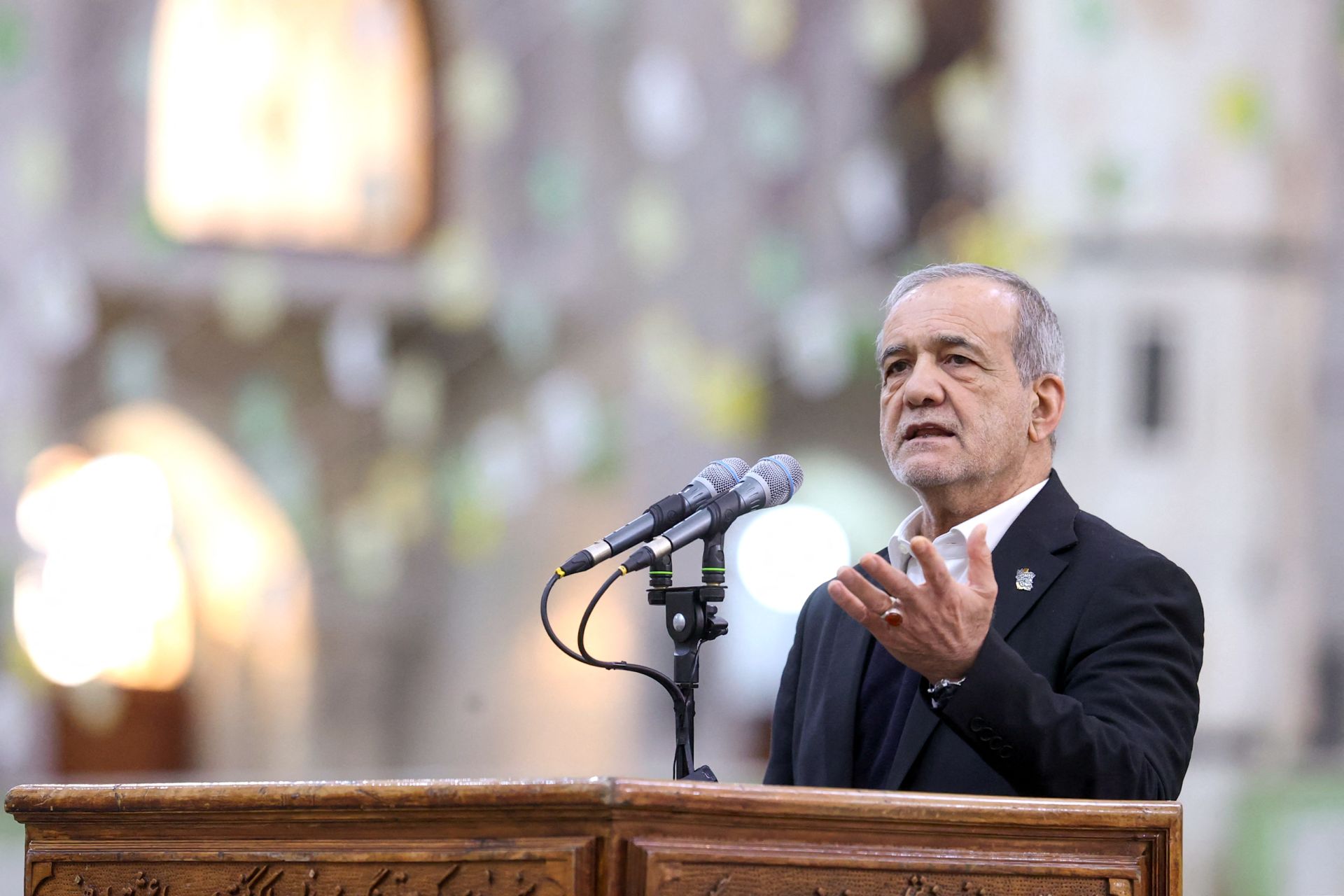
In this handout picture provided by Iranian presidency, Iran's President Masoud Pezeshkian addresses cabinet members, as they visit of the tomb of the late Iranian revolutionary leader Ayatollah Ruhollah Khomeini, in Tehran on January 31, 2026, ahead of the 47th anniversary of the 1979 Islamic Revolution. ©HANDOUT / IRANIAN PRESIDENCY / AFP
Iranian President Masoud Pezeshkian confirmed on Tuesday that he had ordered the start of nuclear talks with the United States, after his counterpart Donald Trump threatened "bad things" if no deal is reached.
The US leader has talked of military action and sent an aircraft carrier group to the Middle East following anti-government protests in Iran last month that were met with a deadly crackdown.
Trump has maintained he is hopeful that Washington will "work something out" with Tehran but also warned that "bad things would happen" if no deal is reached.
Tehran has insisted it wants diplomacy, while vowing an unbridled response to any aggression.
"I have instructed my Minister of Foreign Affairs, provided that a suitable environment exists, one free from threats and unreasonable expectations, to pursue fair and equitable negotiations," Pezeshkian wrote in a post on X.
The talks will be held "within the framework of our national interests", he said, adding that it followed requests "from friendly governments".
On Tuesday a senior official from Gulf power the United Arab Emirates said Iran needs to reach a deal and "rebuild their relationship with the United States".
"I would like to see direct Iranian-American negotiations leading to understandings so that we don't have these issues every other day," said presidential adviser Anwar Gargash, in reference to recent tensions.
There has been no official confirmation from Iran on where the talks will be held, but an Arab official, speaking on condition of anonymity, told AFP a meeting was likely to take place in Turkey on Friday, following diplomatic interventions by Egypt, Qatar, Turkey and Oman.
Iran has repeatedly stressed that talks should remain focused solely on the nuclear issue, rejecting negotiations over its missile programme or defence capabilities.
'Fair and equitable deal'
In an interview with CNN broadcast on Monday, Foreign Minister Abbas Araghchi said Iran has lost trust in the United States as a negotiating partner but noted that a deal on the nuclear issue was achievable.
"So I see the possibility of another talk if the US negotiation team follows what President Trump said: to come to a fair and equitable deal to ensure that there is no nuclear weapons," he said.
Nuclear talks between Tehran and Washington stalled last year after Israel launched an unprecedented bombing campaign against Iran in June, triggering a 12-day war.
The Israeli strikes hit nuclear and military facilities as well as residential areas, killing senior military commanders, nuclear scientists and hundreds of others. The United States briefly joined the conflict, carrying out strikes on key Iranian nuclear sites.
Iran responded with drone and missile attacks on Israel, as well as by targeting the largest US military base in the Middle East, located in Qatar.
Since his return to office in January last year, Trump has reinstated a "maximum pressure" policy of sanctions against Iran, where millions have suffered economic hardships exacerbated by the trade curbs.
Protests against the rising cost of living broke out in Tehran in December before morphing into wider nationwide anti-government demonstrations.
Tehran has acknowledged more than 3,000 deaths during the unrest, but insists that most were members of the security forces and innocent bystanders, attributing the violence to "terrorist acts".
The Human Rights Activists News Agency, a US-based NGO, said it has confirmed 6,854 deaths, mostly protesters killed by security forces, with other rights groups warning the figure is likely far higher.
Iranian authorities have said the protests were "riots" involving killings and vandalism and inflamed by its arch-foes the United States and Israel.
Iran's supreme leader Ayatollah Ali Khamenei likened the unrest to a "coup" attempt and warned of a "regional war" if the US attacked his country.
Adding to the tension, a massive fire broke out Tuesday at a bazaar west of the Iranian capital, state media reported, although the cause of the blaze was unclear.
AFP
Comments